Fall Prevention and Mobility Programs for Seniors in Care Homes
September 17, 2026

On this page
⚡ Quick Answer
- No two residents have the same fall risk, so effective programs are personalized and supervised, not one-size-fits-all classes.
- The safest exercises are simple and done beside a counter, chair, or rail: sit-to-stand, supported balance holds, calf raises, and walking drills.
- Care-home group sessions build routine and social connection; setting one up takes five steps, from screening residents to tracking progress.
- Fall prevention works best when it starts at home and carries into the care home, so the plan follows the person, not the facility routine.
A fall can change daily life quickly. For many older adults, it is not just the injury that matters.
It is the loss of confidence: hesitating to walk without help, or avoiding activities that used to be routine.
Health Canada notes that one in three seniors falls at least once each year, and that regular strength and balance activity is one of the most effective ways to change that, as set out in its guidance on preventing falls.
That is why fall prevention programs for seniors call for a thoughtful plan that protects safety while preserving independence, not a generic exercise class.
In care homes, the need is even clearer. Residents may be managing weakness, arthritis, post-surgical recovery, dizziness, or reduced balance, and families want reassurance that movement is still possible, but guided well.
That is where a personalized mobility program makes a real difference. At HomeStretch, our kinesiologists deliver fall prevention and balance programs in homes and care residences across Ontario, so safety and independence can coexist.
Why personalized fall prevention works better
Mobility support should match the person
No two seniors have the same fall risk. Chronic conditions, medication use, prior falls, mobility limits, and fear of falling all affect how someone moves through the day. A plan that works for one resident may be too easy, too difficult, or simply unsafe for another. That is why we build programs around the individual, not around a one-size-fits-all routine.
This matters in both home and care-home settings. A senior recovering from a hospital stay may need sit-to-stand practice and steady walking drills. Someone else may need more ankle mobility, balance retraining, and confidence with transfers. Public health guidance recognizes that older adults have varied health profiles and benefit from support that reflects those differences, as outlined in Canada's senior health profile.
Supervision helps seniors progress safely
Professional supervision is not about making exercise harder. It is about making it safer, more consistent, and more useful in everyday life. Canada recommends that older adults aim for 150 minutes of physical activity per week, including balance and muscle-strengthening activities when they can do so safely. Research summarized by public health authorities also found that a LiFE-style approach, which builds strength and balance into daily routines, was associated with about 31% fewer falls.
That combination is exactly why kinesiologist-led programming matters. We can adjust exercises in real time, spot unsafe movement patterns, and help seniors progress without rushing. For residents in care homes, that means support that fits their walking ability, energy level, and medical history, while staying grounded in Canadian physical activity guidance and fall-prevention research.
You can also read What Are Effective Fall Prevention Programs for Older Adults in Ontario? for the key components to look for in any program, including risk assessment, home safety, and professional supervision.
Safe exercises seniors can use at home or in care homes
The safest exercises are simple, targeted, and matched to current ability. In most cases, they should be done near a stable surface such as a counter, sturdy chair, or rail.
| Exercise type | Examples | Everyday benefit |
|---|---|---|
| Balance | Weight shifts, heel-to-toe standing, supported single-leg holds | Steadier walking and safer turning |
| Strength | Sit-to-stand, calf raises, supported mini squats | Easier transfers and stronger legs |
| Flexibility | Ankle circles, calf stretches, gentle hip mobility | Smoother steps and less stiffness |
| Functional movement | Walking drills, stepping practice, controlled turning | Better confidence in daily routines |
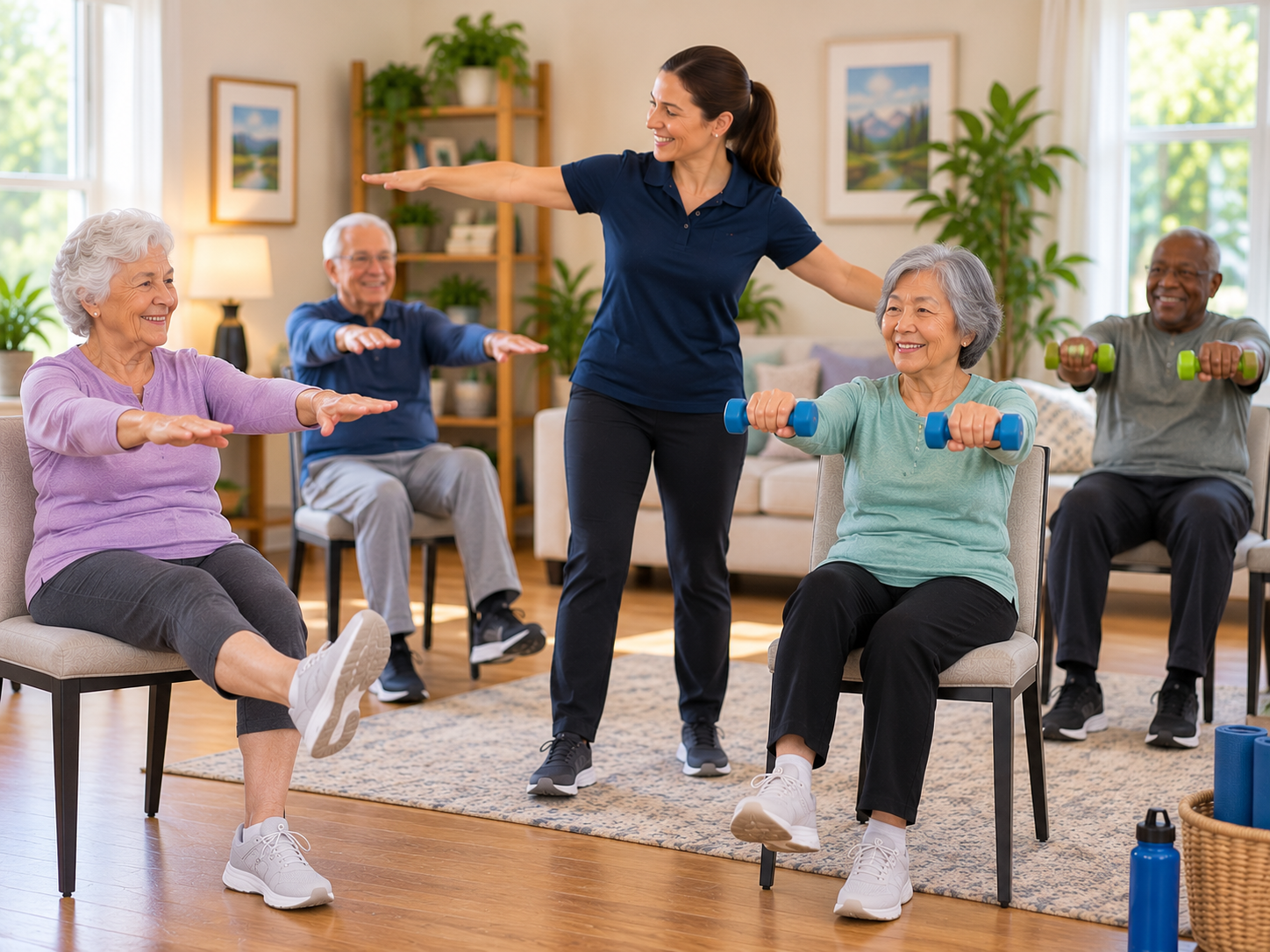
These exercises are effective because they support the movements seniors use every day. Sit-to-stand helps with getting up from a dining chair or toilet. Heel raises support push-off while walking. Gentle marching and stepping drills improve coordination. Walking practice helps residents manage direction changes, thresholds, and common obstacles more safely.
The key is progression. A resident with a recent fall history should not be pushed into challenging balance work without close guidance. Canada's fall-prevention resources stress tailored assessment and caution when gait, pain, dizziness, or neurological issues are involved, especially in fall-prevention guidance for older adults. If you are unsure where a parent or resident stands, our free fall-risk self-check is a quick first step.
Movement programs that fit care-home life
Group sessions can improve more than strength
In care homes, group wellness programs offer structure that many seniors respond well to. Scheduled movement sessions can improve balance and mobility, but they also support routine, social connection, and mental engagement. That matters because staying active is often easier when it becomes part of the rhythm of the week.
A well-run program may include seated and standing mobility work, strength practice, balance drills, and brain-body activities that challenge coordination and reaction time. Public health resources note that fall-prevention exercise can be delivered effectively in both home-based and group settings, which supports the value of group and home-based programs.
Bringing in-home expertise into care homes
Care homes benefit when programming is led by professionals who understand senior mobility, not just general fitness. Our approach brings in-home senior wellness expertise into shared living environments through our community workshops and group programs, so residents receive practical movement support that reflects real health needs. That includes balance classes, mobility sessions, and functional exercise that can be adapted for walker users, recovering residents, and more active older adults alike.
How to set up a fall prevention program in a care home
Five steps cover most of what a residence needs to get started:
- Screen residents first. A short assessment of strength, balance, walking, footwear, and mobility aids sorts residents into groups and flags who needs one-to-one support.
- Choose a weekly rhythm. Two group sessions a week, on fixed days, is a realistic starting point. Routine is what keeps participation up.
- Mix seated and standing work. Every session should have a version residents can do from a chair, so nobody sits out because the standing option feels too much that day.
- Add brain-and-balance drills. Coordination, reaction-time, and dual-task activities (counting backwards while marching, for example) keep sessions engaging and train the reflexes that matter when someone stumbles.
- Track and adjust. Note who progressed, who struggled, and why, then adjust the plan to the person rather than the timetable.
Home support and care-home support should connect
Families often think of fall prevention as something that begins after a move into a care home. In practice, it should start much earlier. At home, support can include mobility assessments, balance and strength plans, guided exercise, and education on safer movement patterns around the house. That early work can reduce risk and make transitions smoother if more structured support is needed later.
Once a senior moves into a care-home setting, programming usually becomes more scheduled and group-based. That can be a strength, but only if the resident's starting point is understood clearly. We focus on continuity, so the plan still reflects the person, not just the facility routine. Home safety remains an important part of the picture too, especially for families navigating changing needs, as noted in Canadian home fall-prevention advice.
Why families and care homes choose HomeStretch
What sets our work apart is straightforward. We provide personalized, kinesiologist-led support built around how older adults actually live and move. That means looking at medical history, current mobility, balance challenges, recovery goals, and the level of independence a person wants to maintain.
We also understand that senior wellness is not limited to private homes. The same expertise that supports one-on-one in-home care can be delivered in care homes through organized, practical movement programs. For families, that creates consistency. For care homes, it brings trusted wellness support that aligns with resident safety and confidence. Most importantly, for seniors, it keeps the focus where it belongs, on moving better, feeling safer, and staying as independent as possible. We work with residences and families across the Niagara Region, Hamilton and area, Burlington, Oakville, Mississauga, the Greater Toronto Area, and Thunder Bay; see all service areas.
Supporting dignity, safety, and independence
Fall prevention is not about limiting activity. It is about making activity safer, more purposeful, and more sustainable. That shift matters. Canada's national surveillance report is clear that strength and balance training is one of the most effective ways to lower fall risk, and the right mobility program does that while protecting confidence and quality of life.
Taking the next step with confidence
If your family member needs support at home or your care home wants structured senior wellness programming, a personalized assessment is the right place to begin. With expert guidance, older adults can stay active longer and move through daily life with more confidence.
Frequently Asked Questions
What are effective at-home fall prevention exercises for seniors in Canada?
Some of the most effective options are sit-to-stand practice, supported balance holds, heel raises, gentle marching, walking drills, and ankle or hip mobility exercises. These movements build strength, balance, and coordination in ways that carry over into daily tasks.
How do senior wellness programs in care homes promote safety?
They improve safety by giving residents supervised movement, consistent routines, and exercises that target balance and lower-body strength. Group sessions can also increase confidence and encourage regular participation, which makes progress more likely over time.
How can families access personalized mobility support for loved ones?
Start with an assessment of current mobility, fall history, medical background, and daily challenges. From there, we build a tailored plan and supervise progress so the exercises remain safe, practical, and matched to the senior's needs.
Author Bio - Melissa Gunstone, BSc, Kinesiologist
Melissa Gunstone is the founder of HomeStretch, a kinesiologist with years of experience supporting seniors across Canada. Her mission: to give older adults safe, effective, and individualized movement programs, from in-home training to community-based senior fitness classes and to build a nationwide movement that elevates the role of kinesiology in healthy aging.