Best In-Home Balance Programs for Older Adults in Ontario
September 14, 2026
On this page
⚡ Quick Answer
- The best in-home balance programs start with the person, not an exercise sheet: a kinesiologist assesses how someone moves, then builds leg strength, core stability, walking confidence, and everyday movement skills.
- Balance training also supports recovery after surgery or a hospital stay, with a gradual, supervised return to movement that respects medical guidance.
- Five questions to ask any provider: do they come to you, is it kinesiologist-led, does it start with an assessment and progress, is safety built in, and will they communicate with family and care teams.
- The same principles scale to retirement residences and long-term care through individual visits or adaptable group sessions.
Staying steady at home is about more than avoiding a fall.
It is about getting up from a chair without hesitation, walking to the kitchen with confidence, and feeling safe enough to keep doing the things that make daily life feel normal and independent.
For older adults in Canada, falls are the leading cause of injury-related hospitalizations, and most of them are preventable, which shows why practical, evidence-based balance support matters so much for seniors and families across the country, according to Canada's national falls data.
At HomeStretch, we bring personalized balance and mobility support into private homes, retirement residences, and care settings.
Our focus is simple: help older adults build strength, move with more confidence, and maintain independence in the place where they feel most comfortable.
This guide covers what a strong in-home balance program should include, and how to recognize the right one.
What strong balance programs should include
Balance and strength support that fits real life
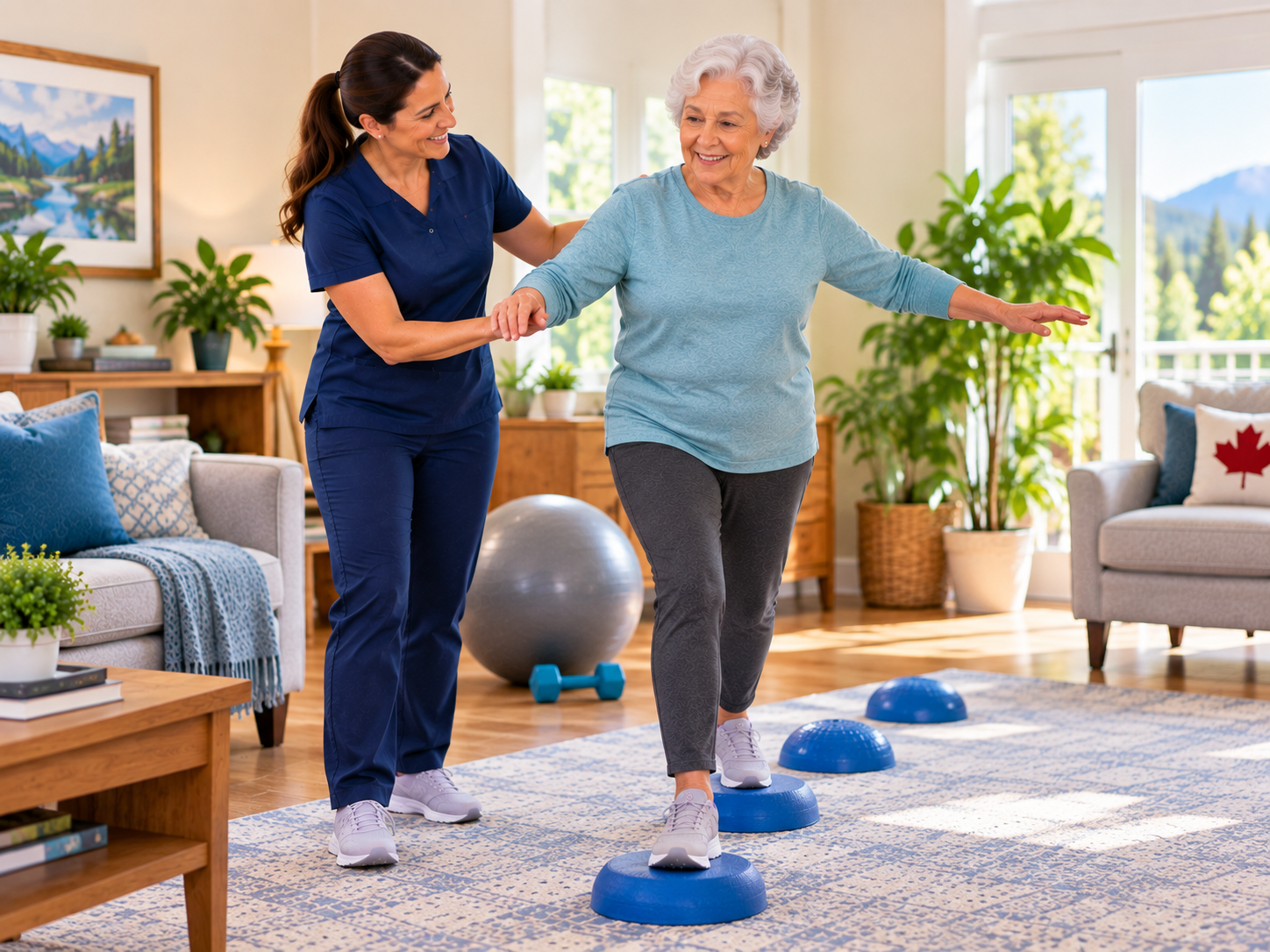
The best in-home balance programs do not start with generic exercise sheets. They start with the person. A qualified kinesiologist looks at how someone moves day to day, where they feel unsteady, what tasks have become harder, and what level of support feels safe and realistic.
From there, the program should build the physical skills that matter most for everyday function. That usually includes leg strength, core stability, walking confidence, flexibility, posture, and controlled movement during common tasks such as turning, reaching, stepping, and getting up from a seated position. Just as important, each session should be adjusted for the older adult's current ability, energy level, and health history.
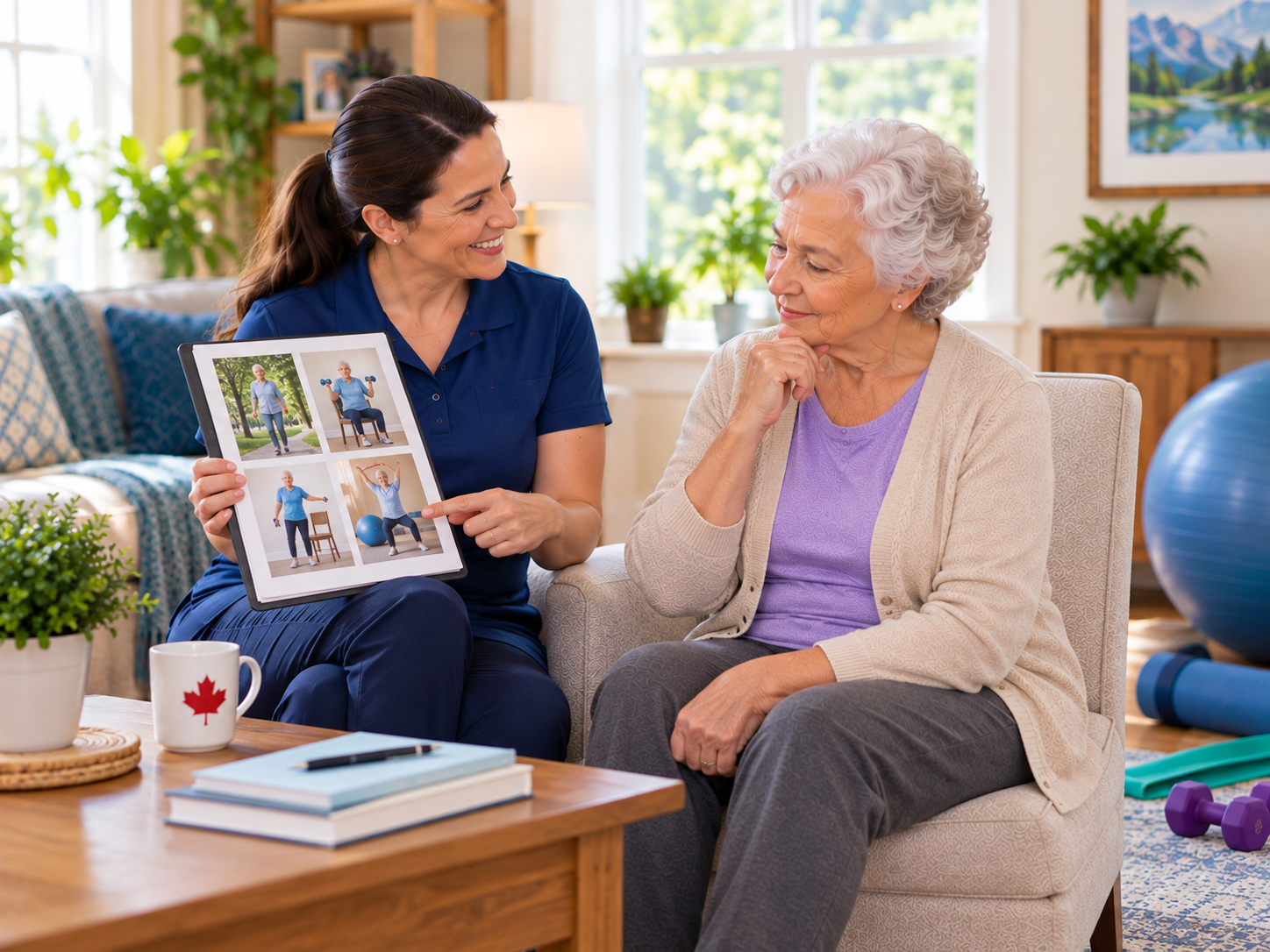
A strong program also includes progress tracking. Small changes matter, such as standing more steadily, walking farther indoors, or feeling less anxious on stairs. Those gains help restore confidence, which is often just as important as the physical exercise itself.
Research supports this approach. In a randomized clinical trial of high-risk older adults after a fall, a home-based strength and balance retraining program reduced subsequent falls to 1.4 falls per person-year, compared with 2.1 falls per person-year with usual care alone, roughly a third fewer falls. That is one reason we build programs around purposeful, structured exercise delivered at home through home-based strength and balance retraining.
Recovery support and healthy living at home
Balance training is not only for fall prevention. It is also valuable after surgery, after a hospital stay, or after a period of reduced activity that has left someone weaker and less sure on their feet.
In those moments, older adults often need a gradual return to movement. The right in-home program can help rebuild strength, improve mobility, and support safe recovery while respecting medical restrictions and the guidance of a physician or physiotherapist. That kind of support works best when the exercise plan is specific, supervised, and easy to follow in a familiar setting, which is how we approach pre- and post-operative rehabilitation.
We also know that not every client needs the same format. Some benefit from one-to-one sessions at home. Others need on-site programming in retirement homes or long-term care settings, where balance, mobility, and healthy living sessions can be delivered in individual or group formats. Canadian guidance on falls prevention consistently supports tailored exercise that matches the older adult's health status and functional needs, which is why personalized programming remains central to clinical recommendations for seniors living at home.
You can also read Simple Balance Exercises Seniors Can Do at Home for eight supported exercises that a program like this typically starts with.
How to recognize the right program
The questions that matter most
Families often feel overwhelmed when trying to choose a balance program. A simpler way to evaluate the right fit is to focus on a few essentials:
- Does the professional come to the home or residence?
- Is the program led by a kinesiologist with experience supporting older adults?
- Does the plan begin with an assessment and change over time as strength and confidence improve?
- Are safety practices built into every session?
- Can the provider communicate clearly with families and care teams when needed?
These are the details that turn exercise into meaningful support. If you are not sure where a parent stands today, our free fall-risk self-check is a quick first step before an assessment.
For retirement residences and long-term care homes, the same principles apply on a larger scale. On-site programming should include balance training, mobility support, functional strength work, and adaptable group sessions that respect a wide range of abilities.
| What to look for | Why it matters |
|---|---|
| In-home or on-site delivery | Reduces travel strain and helps seniors practice movement where they actually live |
| Kinesiologist-led sessions | Brings specialized knowledge of movement, safety, and progression |
| Personalized assessment | Makes the plan more effective and appropriate |
| Built-in safety practices | Supports confidence for both seniors and families |
| Group and individual options | Helps fit private homes, residences, and care settings |
| Communication with care teams | Keeps support aligned with recovery goals and health needs |
This level of structure matters because effective falls-prevention exercise is not random. Research on older adult exercise programs in Canada found that balance work needs the right level of challenge and should be delivered on an ongoing basis to support meaningful prevention, as shown in Canadian exercise program research.
Why families choose HomeStretch
We provide Canadian in-home and on-site support that is personal, respectful, and evidence-informed. That means each program is built around the older adult's goals, comfort level, mobility needs, and daily environment, not around a one-size-fits-all routine.
Our approach is especially helpful for seniors who want to stay independent at home, families supporting a loved one after surgery or illness, and residences that need reliable wellness programming delivered on site. Because sessions happen where the client lives, we can work on the movements that matter most in real life, with safety and dignity at the centre of every visit. We serve families and residences across the Niagara Region, Hamilton, Burlington, Oakville, Mississauga, the Greater Toronto Area, and Thunder Bay; see all service areas.
If you are exploring balance support for yourself, a parent, or a care setting, we can help you talk through goals, recovery needs, location, and the format that makes the most sense.
A steadier next step at home
The right in-home balance program can help an older adult move more safely, rebuild strength, and protect independence without leaving home. For many families, that support also brings something just as valuable, peace of mind.
Find the right starting point
HomeStretch makes it easier to begin with trusted guidance that respects the person, not just the problem. If you are ready to explore a program for yourself, a loved one, or your care community, our team can help you find the right starting point.
Frequently Asked Questions
Which in-home services help with balance and strength?
The most useful services combine senior fitness, kinesiology, mobility training, fall-prevention exercise, flexibility work, and functional movement practice. Together, these elements help older adults improve leg strength, walking ability, posture, and confidence in a safe home environment.
Can exercise help after surgery?
Yes, when it is planned properly. A qualified professional can create a gradual program that respects surgical precautions, supports rebuilding strength, and complements the recommendations of the person's physician or physiotherapist. The goal is not to rush recovery, but to restore safe movement step by step.
Do balance programs work in care homes?
Yes. On-site services can be delivered in retirement homes and long-term care settings through individual visits, small groups, or broader healthy living programming. The key is making sure sessions are adaptable, age-appropriate, and focused on balance, mobility, strength, and confidence.
Author Bio - Melissa Gunstone, BSc, Kinesiologist
Melissa Gunstone is the founder of HomeStretch, a kinesiologist with years of experience supporting seniors across Canada. Her mission: to give older adults safe, effective, and individualized movement programs, from in-home training to community-based senior fitness classes and to build a nationwide movement that elevates the role of kinesiology in healthy aging.