What Are the Benefits of Kinesiology-Led Exercise Programs for Seniors?
August 6, 2026

On this page
⚡ Quick Answer
- Kinesiology is a regulated health profession in Ontario focused on assessing and managing human movement.
- Kinesiology-led programs adjust to individual assessment, injury history, movement compensation, and changing needs over time.
- Balance, fall-risk reduction, and everyday functional tasks are built directly into the program, not treated as extras.
- No program can guarantee falls never happen, but exercise can meaningfully reduce fall risk.
Why Exercise for Older Adults Shouldn't Always Be One-Size-Fits-All
Maybe your dad wants to become stronger because stairs are becoming harder.
Maybe your mom has stopped going for walks since a fall made her nervous.
Or perhaps your parent finished a post-surgery program months ago but still isn't confident exercising independently.
As a caregiver, your first thought may be:
"They need to exercise more."
And you may be right.
Physical activity plays an important role in health and quality of life as we age. The Public Health Agency of Canada recommends that older adults remain physically active and include muscle- and bone-strengthening activities as part of their routine.
But there's another important question. What kind of exercise support does my parent need?
Older adults can bring decades of movement history into an exercise session: previous injuries, surgeries, changes in balance, reduced strength, joint limitations, fear of falling or movement habits developed over many years.
That is where kinesiology-led exercise can offer something different.
What Is Kinesiology?
Kinesiology is the study and application of human movement and performance.
In Ontario, kinesiology is a regulated health profession. Ontario defines its scope of practice as assessing human movement and performance and managing movement to maintain, rehabilitate or enhance movement and performance.
For seniors, that expertise can be especially valuable because exercise isn't only about whether someone can complete ten repetitions.
A kinesiologist may look at how the movement happens.
For example:
Is one leg doing most of the work when your parent stands from a chair?
Does your dad shift his weight away from a previously injured knee?
Does your mom become unstable when turning?
Is limited ankle mobility affecting the way she walks?
Does balance become noticeably harder when attention is divided?
These observations can help shape an exercise program around the person's actual abilities.
At HomeStretch, our Kinesiologists use this movement-focused approach to support older adults with strength, balance, mobility and confidence.
HomeStretch itself grew from recognizing the gap many older adults face after formal post-surgery support ends. Founder Melissa Gunstone, a Western University Kinesiology graduate, saw older adults complete scheduled programs only to return home with exercise sheets but without the ongoing support and confidence they needed to keep progressing. That experience helped shape HomeStretch's focus on personalized, practical exercise support for aging adults.
Why Does Clinical Exercise Supervision Matter for Seniors?
Older adults are not simply younger adults who need lighter weights.
Aging can bring changes in muscle strength, balance, mobility, reaction time and confidence. Some older adults may also have a history of falls, surgeries, injuries or health conditions that need to be considered when planning exercise.
That makes assessment and appropriate progression particularly important.
A kinesiology-led program can begin by asking:
What can this person safely and confidently do today?
Where are they having difficulty?
How do they move during everyday tasks?
Are there compensations or asymmetries?
What previous injuries or surgeries should be considered?
What does the older adult actually want to accomplish?
The goal isn't to make exercise unnecessarily clinical.
It's to make exercise personal.
7 Benefits of Kinesiology-Led Exercise Programs for Seniors
1. Exercise Is Based on an Individual Movement Assessment
Two 75-year-olds can have completely different abilities.
One might walk several kilometres every morning but struggle with getting up from the floor. Another may have excellent upper-body strength but feel unstable when turning quickly.
Age alone doesn't tell you what exercise someone needs.
A kinesiologist can look at factors such as:
Balance
Strength
Mobility
Movement quality
Coordination
Functional movement
Previous injuries
Current physical abilities
Individual goals
The exercise plan can then be built around what the person actually needs rather than relying solely on a standard senior fitness routine.
2. Exercises Can Be Progressed More Appropriately
Progress is important.
But "harder" isn't always the same as "better."
For one person, progression might mean adding resistance to a sit-to-stand exercise.
For someone else, it might mean improving control before adding resistance.
Another person may need to practise maintaining balance while turning or performing a second task.
A kinesiology-led program can adjust variables such as resistance, repetitions, range of motion, speed, stability demands and complexity according to how the individual responds.
That creates a more gradual path from:
"I can do this with help."
to:
"I can do this confidently."
3. Previous Injuries and Surgeries Can Be Considered
Many older adults have a long physical history.
A knee replacement from several years ago.
An old shoulder injury.
Back discomfort that changes how they bend.
A previous fall that made them cautious.
These experiences can influence movement long after the original injury occurred.
A kinesiologist can consider that history when selecting and modifying exercises.
For caregivers, this can be especially reassuring when a parent wants to become active again but you're unsure where they should begin.
4. Movement Compensation Patterns Can Be Identified
Sometimes the most important part of an exercise isn't whether someone completes it.
It's how they complete it.
Imagine your mom performing a sit-to-stand exercise.
She gets out of the chair successfully every time.
But she consistently shifts most of her weight onto her right leg because her left side feels weaker.
From the outside, the exercise looks successful.
From a movement perspective, however, that compensation may be important.
Kinesiologists are trained to assess human movement and can use these observations to modify exercises, provide cues or select movements that better support the individual's goals.
5. Exercise Can Support Balance and Fall-Risk Reduction
Falls remain an important concern for Canadian families.
The Public Health Agency of Canada identifies poor balance and muscle weakness among factors associated with falls in older adults and recommends improving balance and strength through exercise as one strategy for reducing fall risk.
A kinesiology-led exercise program can incorporate activities designed to challenge:
Lower-body strength
Static balance
Dynamic balance
Coordination
Walking
Turning
Reaction and movement control
Functional tasks
Fall risk is rarely about one single factor, which is another reason individualized assessment matters. Exercise doesn't guarantee that someone will never fall. However, appropriately designed strength and balance exercise can be an important part of a broader fall prevention strategy.
6. Exercise Can Better Reflect Everyday Life
For most seniors, the goal isn't to become good at exercising.
The goal is to make everyday life easier.
That could mean:
Getting out of a chair
Carrying groceries
Walking outside
Climbing stairs
Reaching into a cupboard
Gardening
Playing with grandchildren
Getting up from the floor
Moving confidently around the home
Kinesiology can connect exercise to these functional goals.
A squat isn't simply a squat.
It may be preparation for standing from the dining room chair.
A step-up isn't simply a leg exercise.
It may help build the strength and control needed for stairs.
When exercise connects to something meaningful, it becomes easier to understand why the movement matters.
7. Programs Can Change as the Senior Changes
An older adult's abilities aren't static.
Someone may become stronger.
Confidence may improve.
An old limitation may become less noticeable.
Or a new challenge may appear.
That means an exercise program shouldn't necessarily stay the same for months.
Ongoing supervision allows the program to evolve as the person's abilities, goals and circumstances change.
This is one of the most important differences between simply receiving an exercise sheet and having continued exercise support.
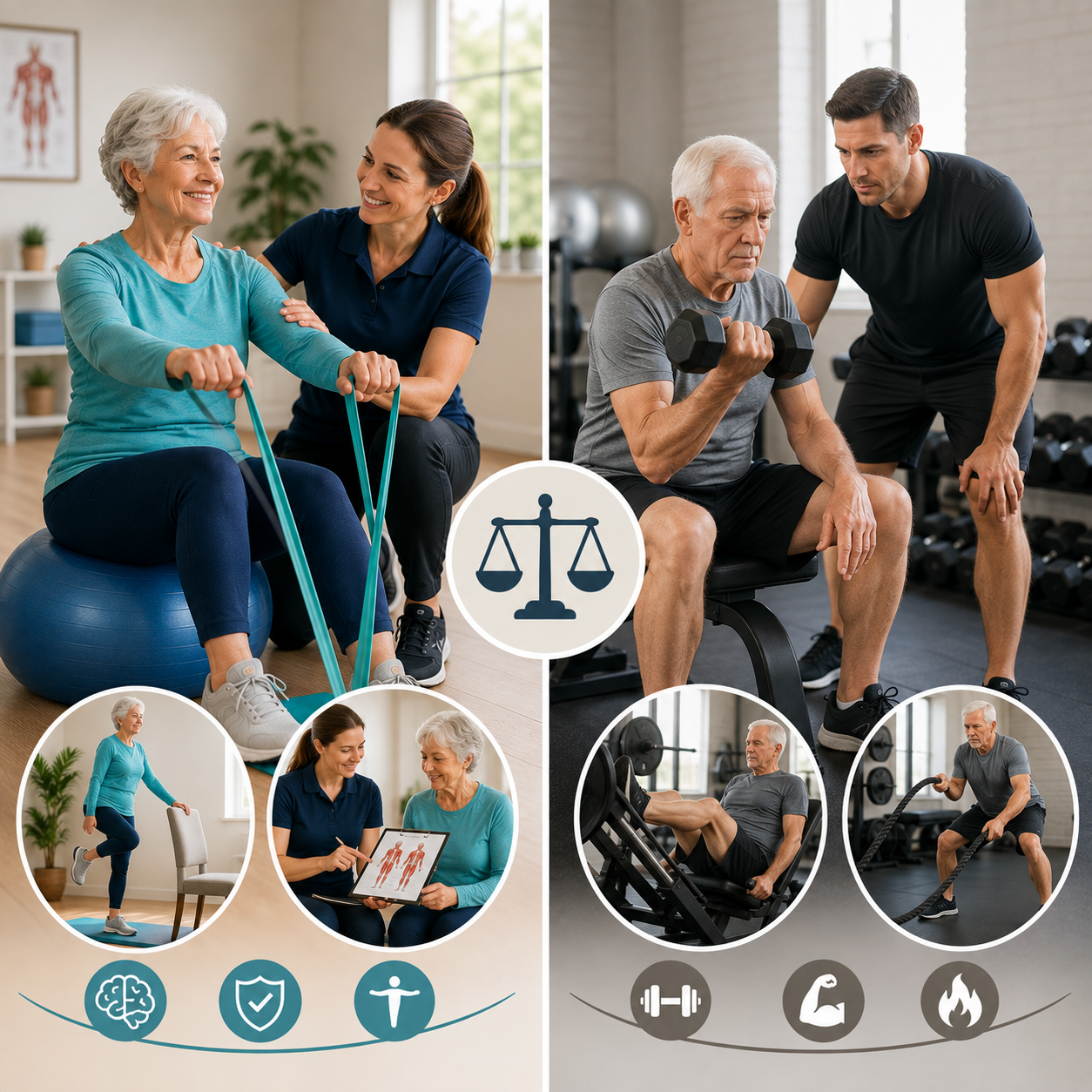
Kinesiologist vs. Standard Personal Trainer: What's the Difference for Seniors?
Both kinesiologists and personal trainers can play valuable roles in helping people become more active.
The key difference is the professional training and scope behind the service.
In Ontario, kinesiology is a regulated health profession. Kinesiologists assess human movement and performance and use that knowledge to maintain, rehabilitate or enhance movement and performance.
Personal trainer education and certification can vary considerably depending on the certification organization, experience and specialty of the individual trainer.
For a deeper explanation, read more about Kinesiologist vs. Personal Trainer: What's Actually Different?
Kinesiologist vs. Standard Personal Trainer Comparison
Important: This doesn't mean that every personal trainer provides the same service or that personal training isn't valuable. Many trainers have extensive education and experience. The important question is whether the professional's education, scope and experience match the older adult's needs.
When Might a Kinesiology-Led Program Be Especially Helpful?
A kinesiology-led exercise program may be worth considering when an older adult:
Has become less active or weaker
Is experiencing changes in balance
Has a history of falls
Is nervous about exercising independently
Has completed post-surgery or injury care and needs ongoing exercise support
Has previous injuries that affect movement
Has difficulty with everyday activities such as stairs or standing from a chair
Wants to maintain independence at home
Needs an exercise program that can change as abilities improve
For caregivers, another important sign is uncertainty.
If you keep wondering:
"Is this exercise actually appropriate for Mom or Dad?"
Professional movement assessment may help provide a clearer starting point.
How Can Kinesiology-Led Exercise Help Caregivers?
Caregiving often involves a difficult balance.
You want your parent to remain independent.
But you also don't want to push them into activities they're uncomfortable doing.
And you may not know whether an exercise is too easy, too difficult or simply not appropriate for their current abilities.
Having professional exercise support means you don't have to become your parent's trainer.
A kinesiologist can help establish an appropriate exercise starting point, observe how your parent moves, adjust activities and progress the program.
That can allow family members to return to being family members rather than constantly trying to supervise workouts.
Does a Senior Need to Be Fit Before Working With a Kinesiologist?
No. A senior doesn't need to already be fit to begin a kinesiology-led exercise program.
In fact, individualized exercise is particularly useful when someone isn't sure where to start.
The starting point could be simple.
Standing from a chair.
Walking comfortably around the home.
Practising balance near a stable support.
Building enough leg strength to manage stairs more confidently.
The program should meet the person where they are.
Then it can progress from there.
Are Kinesiology-Led Programs Only for Seniors Recovering From Injury?
No. Kinesiology-led exercise isn't only for injury recovery.
Older adults may work with a kinesiologist to support:
Strength
Mobility
Balance
Active aging
Fall prevention-focused exercise
Confidence with movement
Functional independence
Someone doesn't need to wait until something goes wrong before seeking professional exercise support. Supporting strength and mobility earlier can help older adults remain engaged in the activities that matter to them.
Can Kinesiology-Led Exercise Prevent Falls?
No exercise program can promise that an older adult will never fall.
However, strength and balance exercise are recognized components of fall prevention.
The Government of Canada's current fall-prevention guidance recommends improving balance and strength through exercise. Canadian surveillance guidance also identifies balance and strength exercise as part of fall-prevention strategies.
A kinesiologist can help personalize these exercises according to the person's abilities and movement patterns.
That distinction matters. The goal isn't to create fear around falling.
It's to help older adults build the physical capacity and confidence to continue moving.
What Should Caregivers Look for in a Senior Exercise Program?
Before choosing a program for a parent, consider asking:
Is there an assessment before exercise begins?
Will the program consider previous injuries and physical limitations?
Are exercises personalized rather than identical for every participant?
How will balance and strength be assessed?
How will exercises be progressed?
What happens if an exercise causes difficulty?
Does the professional have specific experience working with older adults?
Are exercises connected to everyday functional goals?
The best program isn't necessarily the hardest one. It's the one that appropriately challenges the older adult while supporting meaningful goals.
Exercise Should Support Independence, Not Just Fitness
For many older adults, exercise isn't about lifting heavier weights or achieving a fitness milestone.
It's about being able to say:
"I can still do this myself."
I can get out of my chair.
I can walk to the mailbox.
I can climb the stairs.
I can go shopping.
I can keep gardening.
I can visit my friends.
I can stay active in my community.
Those everyday abilities are why kinesiology-led exercise can be so meaningful for seniors.
At HomeStretch Active Living, our approach grew from the belief that older adults need more than an exercise sheet. They need practical support, appropriate progression, education, encouragement and programs designed around aging adults.
Our team of kinesiologists provides exercise-focused support designed to help older adults build strength, improve balance and mobility, and feel more confident in everyday movement.
Stay Strong. Stay Steady. Stay Independent. Meet the HomeStretch Kinesiologists and learn more about our approach.
Frequently Asked Questions
-
Yes. Sleep patterns naturally change with age. Older adults generally experience lighter, shorter and more interrupted sleep, even though they still typically need about seven to nine hours of sleep per night.
-
Frequent waking may be related to normal age-related sleep changes, pain, medical conditions, medications, insomnia, sleep apnea, movement disorders or lifestyle factors. Persistent sleep difficulties should be discussed with a healthcare provider.
-
Yes. Research from systematic reviews and randomized trials indicates that structured exercise programs can improve sleep quality in older adults. The type and intensity of exercise should be appropriate for the individual's abilities and health circumstances.
-
Most older adults still need approximately seven to nine hours of sleep each night. Aging changes how people sleep more than it changes how much sleep they need.
Related Posts
Spring Safety Tips for Seniors Safe Outdoor Activities and Fall Prevention
Spring Gardening for Seniors: Stay Active, Safe, and Prevent Falls
Exercises for Seniors: Routines to Improve Balance, Strength, and Mobility
Author Bio - Melissa Gunstone, BSc, Kinesiologist
Melissa Gunstone is the founder of HomeStretch, a kinesiologist with years of experience supporting seniors across Canada. Her mission: to give older adults safe, effective, and individualized movement programs, from in-home training to community-based senior fitness classes and to build a nationwide movement that elevates the role of kinesiology in healthy aging.