Canadian Care Home Balance and Mobility Programs Explained
August 20, 2026
On this page
⚡ Quick Answer
- Balance and mobility programs in Canada include physiotherapy, kinesiology, occupational therapy, and in-home fitness, each suited to different needs.
- Falls are a serious health issue in Canada, 7,189 fall-related deaths among older adults were recorded in 2022 (excluding Yukon).
- In-home programs can reveal real hazards, narrow hallways, rugs, stairs, that a clinic visit can't see.
- Post-surgery rehab is often available at home, helping with walking, transfers, and a gradual return to daily routines.
Balance and mobility programs are not just about exercise.
For many older adults, they are about staying steady in the kitchen, getting safely to the bathroom at night, managing stairs, and keeping the confidence to live as independently as possible.
That matters because falls are a serious health issue in Canada. In 2022, there were 7,189 fall-related deaths among older adults in Canada, excluding Yukon, a sobering reminder that fall prevention is not a minor concern, but a practical part of healthy aging and safer care at home or in supportive living settings.
Canada’s public health guidance also stresses that preventing falls takes more than one fix, it usually requires a mix of exercise, environmental changes, and personalized support, as outlined in this federal surveillance report.
What balance and mobility support really includes
Balance and mobility tend to change with age for understandable reasons. Muscle weakness, joint stiffness, pain, slower reaction time, and reduced flexibility can all affect how safely a person walks, turns, rises from a chair, or recovers from a stumble.
In senior care, mobility support usually focuses on the movements that matter most in daily life. That can include walking safely, transferring in and out of bed, climbing steps, using a walker properly, and building enough lower-body strength to stay steady during everyday tasks. Older adult rehab and exercise programs often aim to improve strength, balance, endurance, pain, and stiffness while helping preserve function and independence, which is consistent with how senior physiotherapy care is commonly described in Canada.
Why fall prevention is tied to independence
A fall can change more than physical health. It can also lead to fear of moving, reduced activity, loss of confidence, and greater dependence on family or caregivers. After one fall, many older adults begin avoiding walking outdoors, showering alone, or carrying items through the house, even if they were active before.
That is why good balance programs focus on prevention before a crisis happens. They aim to improve stability, but they also help a person keep doing ordinary things safely. In practical terms, that means fewer risky transfers, better confidence on stairs, and more control during turning, reaching, and walking.
How senior mobility programs are delivered in Canada
Across Canada, balance and mobility support is usually delivered through a few main service types. The right fit depends on a person’s health status, recent injuries, and goals.
| Program type | Main focus | Best suited for |
|---|---|---|
| Physiotherapy | Pain, recovery, mobility, rehabilitation | Seniors recovering from injury, surgery, or worsening movement problems |
| Kinesiology | Exercise-based movement, strength, function, body mechanics | Seniors who need structured exercise to improve safe movement and daily function |
| Occupational therapy | Daily tasks, home safety, adaptive strategies | Seniors struggling with bathing, dressing, transfers, or home setup |
| In-home senior fitness | Strength, balance, endurance, consistency | Seniors who want practical exercise support in their own home |
| Fall-prevention programs | Stability, gait, coordination, confidence | Seniors with fall risk, fear of falling, or recent near-falls |
What Kinesiology Adds
Kinesiology is sometimes less familiar to families than physiotherapy, but it plays an important role in mobility care. In Canada, kinesiologists use exercise, ergonomics, and body mechanics to improve recovery and function. That makes them especially helpful when the goal is to rebuild safe movement through a structured, progressive exercise plan rather than passive treatment alone, as explained in exercise therapy by kinesiologists.
Why In-Home Programs can Be Especially Useful
For many older adults, the home is the best place to work on balance. That is where the real challenges are: narrow hallways, rugs, bathroom thresholds, bed transfers, stairs, and the turn from walker to chair. A clinic can measure strength, but a home visit can reveal exactly where a person loses balance or hesitates.
In-home care also removes transportation barriers. That matters for seniors who no longer drive, tire easily, use mobility aids, or feel anxious about going out in winter conditions. Practicing movement in familiar surroundings can make exercise feel less intimidating and more relevant to daily life.
What effective at-home balance programs usually involve
A strong home-based balance program is rarely just a list of exercises. It is usually a mix of physical training and practical safety work.
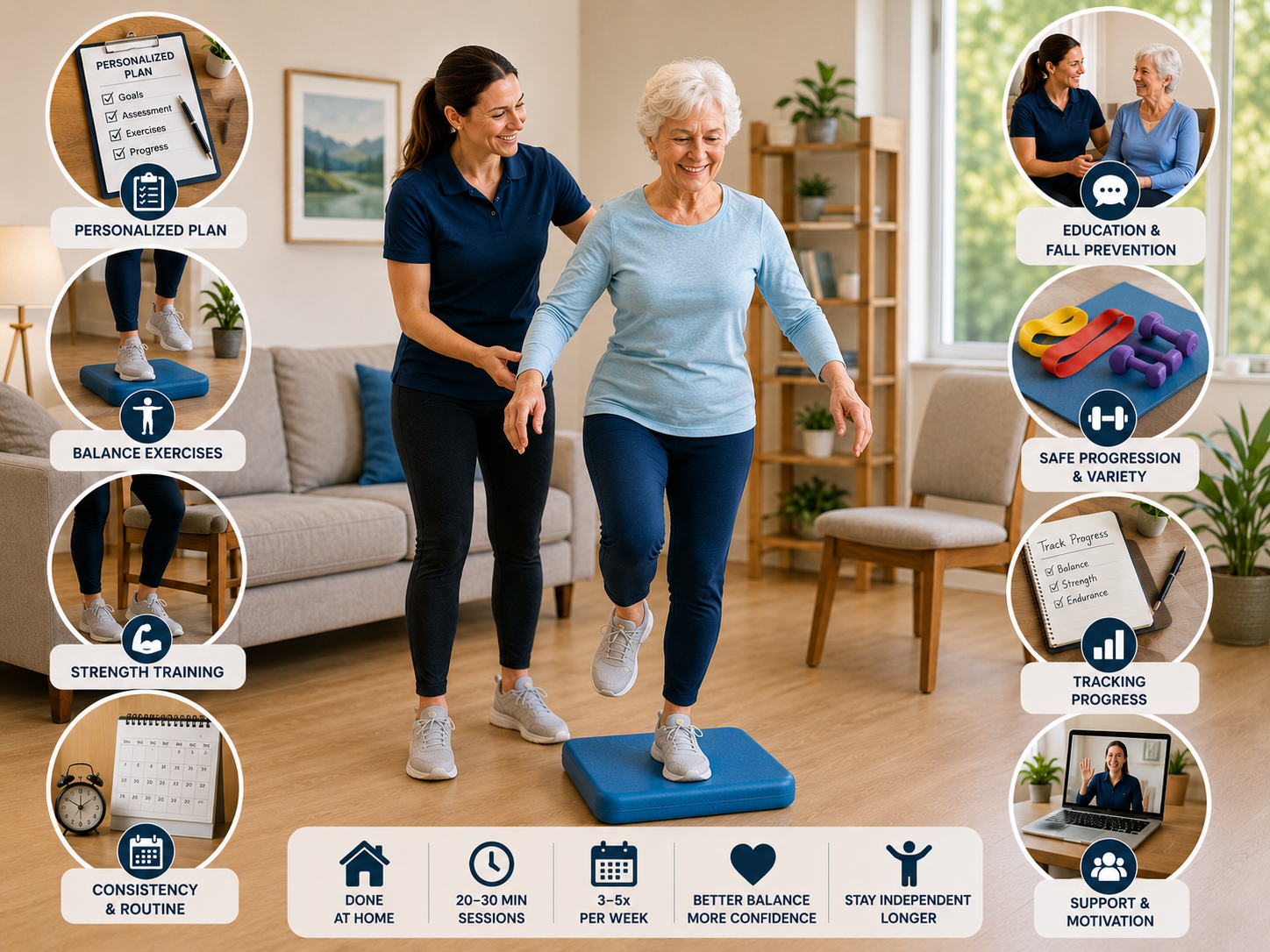
Common elements of a home balance plan
Most programs include lower-body strengthening, gait practice, posture work, and coordination drills. A provider may also work on sit-to-stand practice, stepping strategies, turning, reaching, and safe use of canes or walkers. Some programs add dual-task exercises, sometimes called brain and balance work, where the person moves while counting, naming items, or following directions. This helps train attention and movement together, which is important because many falls happen while doing more than one thing at once. For families who are also noticing changes in memory, attention, or everyday thinking, it can be helpful to understand the difference between expected changes with age and signs that may deserve further attention. Read more about Cognitive Decline vs. Normal Aging: What Should Actually Worry You? to learn more.
The benefit is not simply stronger legs. It is better control during ordinary moments, such as answering the door, backing up from the counter, or pivoting in the bathroom.
Signs a Senior May Need Balance Support
Families often wait for a major fall, but earlier signs are worth taking seriously. Watch for repeated near-falls, furniture walking, slower or shuffling steps, difficulty getting up from a chair, hesitation on stairs, or new fear during routine movement. A recent hospital stay or surgery can also lead to a sharp drop in strength and confidence.
How At-Home Recovery Supports Healing After Surgery
Post-surgery recovery is one of the clearest reasons to use a home mobility program. After hip, knee, back, or other orthopedic procedures, many older adults need to rebuild strength gradually while protecting healing tissues.
Why tailored exercise matters after an operation
Recovery exercises should match the person’s stage of healing, pain level, and current function. The goal is steady progress, not pushing too fast. A tailored program can help restore range of motion, improve walking quality, reduce stiffness, and support a safer return to daily activities. In Canada, post-operative rehab commonly focuses on reducing pain, improving mobility and strength, and helping people return to normal routines, as reflected in this overview of how physio supports recovery.
How movement professionals guide safe progress
A trained movement professional can adjust exercises week by week, watch for compensations, and make sure the work stays challenging without becoming unsafe. That is especially helpful for seniors using walkers, managing fatigue, or trying to regain confidence after a hospital stay.
Near the end of that process, some families look for in-home kinesiology support because it allows recovery work to continue in the exact space where everyday movement happens, and providers such as HomeStretch use that model to focus on safe, functional mobility.
Choosing a Program that Supports Confidence, Not Just Exercise
The best balance and mobility programs help older adults move through real life more safely. That means working on strength and coordination, but also on transfers, walking routes, home hazards, and the confidence to stay active.
If you are evaluating options in Canada, look for individualized assessment, clear exercise progressions, experience with seniors, and support that reflects the realities of the home environment. Those details are what turn a general exercise routine into a meaningful mobility plan.
Frequently Asked Questions
-
Common options include physiotherapy, kinesiology-led exercise therapy, in-home senior fitness, occupational therapy for daily activities, and dedicated fall-prevention programs. Many combine strength, gait training, coordination, and functional movement practice.
-
They reduce fall risk by strengthening key muscles, improving coordination, and practicing movement where falls are most likely to happen. They also allow a provider to spot hazards and adapt the plan to the person’s actual furniture, stairs, and walking paths.
-
Yes. Many older adults receive home-based exercise and mobility support after surgery. These programs can help with walking, transfers, range of motion, strength, and a gradual return to daily routines, especially when travel to a clinic is difficult.
Related Posts
Strength Training for Seniors: The Strength Training Sweet Spot for a Longer Life
Does Exercise Really Reduce Falls? What the Research Actually Shows
Exercises for Seniors: Routines to Improve Balance, Strength, and Mobility
Author Bio - Melissa Gunstone, BSc, Kinesiologist
Melissa Gunstone is the founder of HomeStretch, a kinesiologist with years of experience supporting seniors across Canada. Her mission: to give older adults safe, effective, and individualized movement programs, from in-home training to community-based senior fitness classes and to build a nationwide movement that elevates the role of kinesiology in healthy aging.