Does Exercise Really Reduce Falls? What the Research Actually Shows
July 28, 2026
On this page
⚡ Quick Answer
- Yes. A large Cochrane review found exercise reduced the rate of falls in community-dwelling older adults by about 23%.
- Balance and functional exercise was the strongest single approach, about 24%, and programs combining several exercise types reached about 34%.
- Evidence was uncertain for strength training alone or walking alone, so "just stay active" is not the same as training to reduce fall risk.
- No program guarantees no falls. Vision, medications, footwear and home hazards need attention too.
Does Exercise Reduce Falls in Older Adults?
Yes, High-quality research shows that appropriately designed exercise programs can reduce falls among older adults living in the community.
A major Cochrane systematic review involving 12,981 participants across 59 studies found that exercise reduced the rate of falls by approximately 23% compared with control groups.
The benefits were particularly clear when programs included balance and functional exercises to reduce falls. These programs reduced the rate of falls by approximately 24%.
The takeaway is important: simply being active is not necessarily the same as training specifically to reduce fall risk.
Programs designed around balance, functional movement and, where appropriate, strengthening appear to provide the strongest evidence for fall prevention.
Falls Are Common, But They Shouldn’t Simply Be Accepted as Part of Aging
A fall can happen quickly: getting up at night, stepping off a curb, turning too fast in the kitchen or losing your footing while carrying something.
For older adults, however, a fall can have consequences that extend beyond the initial injury.
It can affect confidence.
It may make someone hesitant to walk outside, use the stairs or participate in activities they previously enjoyed. In some cases, fear of another fall can lead to less movement, which can contribute to further losses in strength, mobility and confidence.
Falls are also extremely common.
According to Canadian public health information, approximately one in three Canadian seniors falls at least once each year.
That statistic naturally raises a question for older adults and their families:
Can exercise actually make a meaningful difference?
The research says yes, but with an important qualification.
It isn't simply about "getting more exercise."
The type, challenge, consistency and individual suitability of the exercise matter.
What Does the Research Say About Exercise and Falls?
One of the strongest sources of evidence comes from a Cochrane systematic review examining exercise for preventing falls among older adults living in the community.
Researchers reviewed 108 randomized controlled trials involving 23,407 participants across 25 countries.
When researchers looked specifically at trials comparing exercise with usual care or another control intervention, they found that exercise reduced the rate of falls by approximately 23%.
To make that number easier to understand, the researchers provided an example.
If a population would otherwise experience approximately 850 falls per 1,000 people over one year, exercise could be associated with approximately 195 fewer falls.
Exercise also reduced the number of people who experienced at least one fall by approximately 15%. That is strong evidence that exercise can play an important role in supporting fall prevention, but the findings become even more useful when we look at which types of exercise worked best.
What Types of Exercise Are Most Effective for Fall Prevention?
Not every exercise program studied produced the same results.
The strongest evidence supported programs that challenge the physical abilities involved in staying upright and moving safely.
1. Balance and Functional Exercise
Balance and functional exercises reduced the rate of falls by approximately 24% in the Cochrane review.
These programs can include movements that challenge:
Standing balance
Weight shifting
Stepping
Changing direction
Sit-to-stand ability
Walking patterns
Coordination
Everyday functional movements
Why might these exercises help?
Because maintaining balance in everyday life requires much more than simply having strong muscles.
Your body continuously needs to sense where it is, respond to changes in the environment and make quick adjustments.
A good balance program challenges these systems progressively rather than simply repeating movements that are already easy.
2. Programs Combining Multiple Types of Exercise
The review also found encouraging results for programs combining several types of exercise.
Programs that commonly combined balance and functional exercises with resistance training probably reduced the rate of falls by approximately 34%.
That doesn't mean every older adult should immediately begin an intensive strength program.
It means that fall prevention can benefit from addressing multiple physical abilities together.
For example, someone may need enough leg strength to stand from a chair but also enough balance and coordination to stabilize themselves once standing.
That combination matters in everyday life.
3. Tai Chi
The Cochrane review found that Tai Chi may also help reduce falls.
Tai Chi involves controlled movements, weight shifting and postural control, all of which challenge balance.
The review estimated that Tai Chi may reduce the rate of falls by approximately 19%.
For some older adults, it can be an enjoyable way to incorporate balance-focused movement into a regular routine.
4. Strength Training
Strength is an important component of maintaining mobility and independence.
Strong legs and hips help with activities such as:
Standing from a chair
Climbing stairs
Stepping over obstacles
Walking
Recovering balance after a small stumble
However, there is an important distinction.
The Cochrane researchers found there was not enough evidence to determine whether resistance training alone reduces falls.
That doesn't mean strength training isn't valuable.
Instead, it suggests that for fall prevention specifically, strength training may be most useful when incorporated into a broader program that also challenges balance and functional movement.
5. Walking
Walking has many benefits for older adults, including supporting cardiovascular fitness, mobility and opportunities for social activity.
But walking alone should not automatically be considered a complete fall prevention program.
The Cochrane review did not find enough evidence to determine whether programs consisting primarily of walking reduced falls.
This is an important point because "stay active and walk more" is common advice.
Walking is valuable.
But if your goal is specifically to improve the physical abilities associated with fall prevention, balance, functional and strengthening exercises may need to be deliberately included as well.
For practical examples, read our guide to Exercises for Seniors: Routines to Improve Balance, Strength, and Mobility.
What Do the Numbers Actually Mean?
Research statistics can sound impressive without explaining what they mean in everyday life.
Here is a simpler breakdown:
| Exercise Approach | What Research Found | What It Means |
|---|---|---|
| Exercise overall | About 23% lower rate of falls | Regular, appropriately designed exercise can meaningfully reduce falls. |
| Balance & functional exercise | About 24% lower rate of falls | Training balance and everyday movement is particularly important. |
| Multiple exercise types | About 34% lower rate of falls | Programs often combining balance, functional and resistance exercises showed promising results. |
| Tai Chi | About 19% lower rate of falls | Controlled movement and weight shifting may support balance. |
| Strength training alone | Evidence uncertain | Strength is valuable but may work best alongside balance training. |
| Walking alone | Evidence uncertain | Walking is healthy but shouldn't automatically replace targeted balance exercise. |
Important: These percentages describe results across groups participating in research studies. They do not guarantee that an individual person's fall risk will decrease by the same percentage.
Why Doesn't "Just Stay Active" Tell the Whole Story?
Being active is important for healthy aging.
But fall prevention involves several different physical abilities.
Imagine someone who walks for 30 minutes every morning.
That routine may be excellent for general activity and cardiovascular fitness. But during that walk, they may rarely have to:
Stand on a narrow base of support
Move sideways
Step backward
Quickly change direction
Recover from losing balance
Control their body while reaching
Perform repeated sit-to-stands
Navigate progressively challenging balance tasks
Those are different physical demands.
This is why a fall prevention-focused exercise program needs to be specific.
The body adapts to the challenges we give it.
If we want better balance, balance needs to be challenged appropriately.
Why Strength Still Matters
Although balance-specific training has particularly strong evidence, strength remains an important part of active aging.
Think about getting out of a chair.
Your legs need to generate enough force to lift your body.
But once you're standing, your balance system needs to stabilize you.
Or consider stepping onto a curb.
You need strength to lift your body onto the higher surface, mobility to position your leg, coordination to place your foot and balance to control your body while your base of support changes.
Daily life rarely requires only one physical ability at a time.
That's why well-rounded exercise programs can incorporate strength, balance, mobility and functional movement together.
Can Exercise Completely Prevent Falls?
No exercise program can guarantee that someone will never fall.
Falls can happen for many reasons, and not all of them can be addressed through exercise alone.
Factors that may contribute to fall risk include:
Vision changes
Medication effects
Environmental hazards
Footwear
Changes in sensation
Muscle weakness
Balance difficulties
Mobility limitations
Health conditions
Poor lighting
Loose rugs or clutter
Exercise addresses several important physical factors, but a comprehensive approach to fall prevention may also involve reviewing the home environment and discussing medical concerns, vision or medications with the appropriate healthcare professionals.
The goal is not to promise that every fall can be prevented.
The goal is to build physical capacity and address modifiable risk factors so older adults can continue moving through daily life with greater confidence.
What Should a Fall Prevention Exercise Program Include?
Research suggests that an effective program should go beyond simply telling someone to "move more."
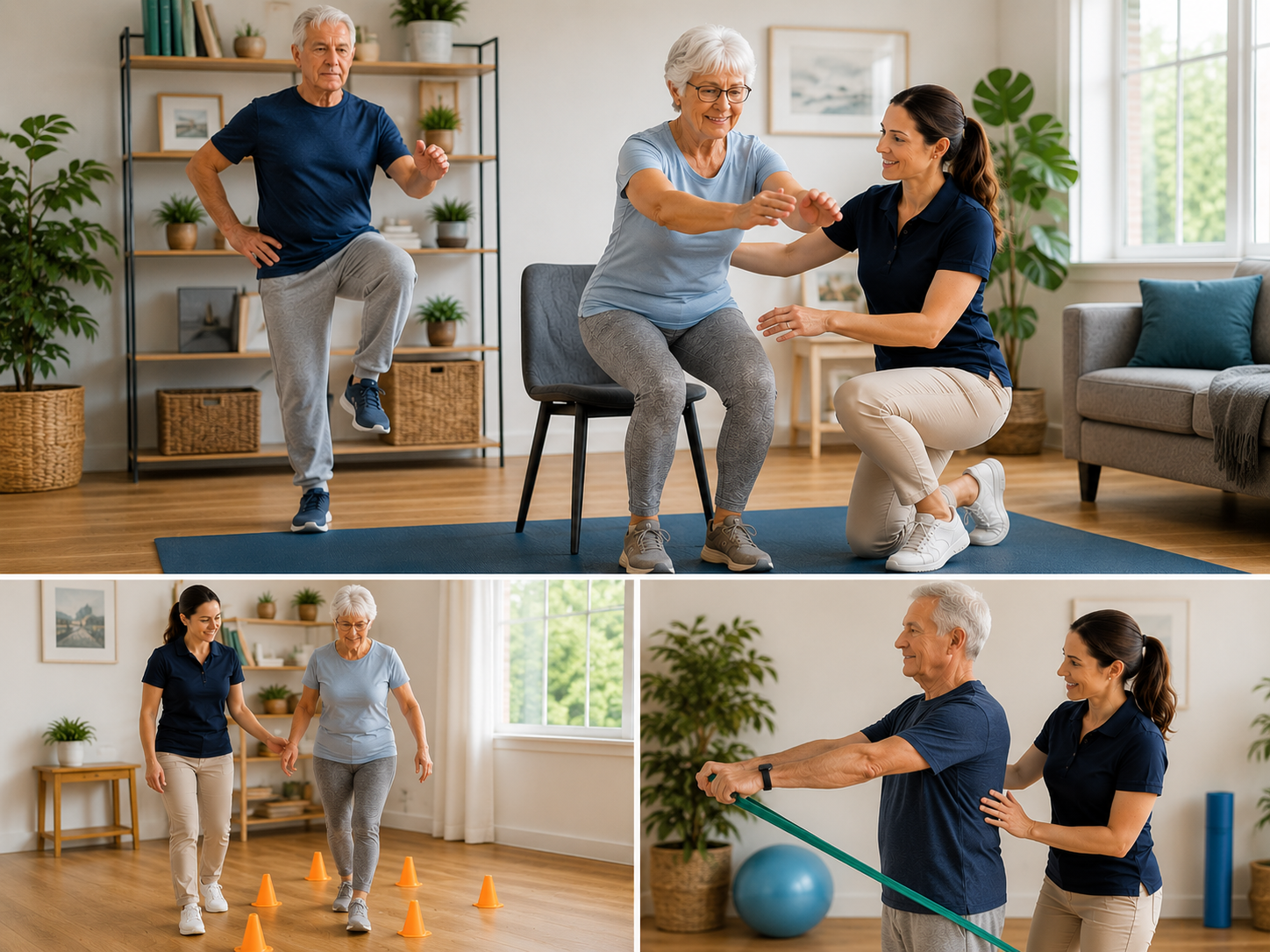
Depending on the individual, a program may include:
Balance Challenges
Exercises can progressively change the base of support, body position, direction or movement demands.
Functional Movement
Practising movements used in everyday life helps exercise translate into daily activities. Examples include standing from a chair, stepping, turning and reaching.
Lower-Body Strength
Exercises for the legs and hips can support walking, stair climbing, transfers and other daily movements.
Mobility
Adequate joint movement can make it easier to step, reach, turn and navigate the environment.
Progressive Challenge
An exercise that was challenging three months ago may eventually become easy. Programs need to progress appropriately to continue challenging the body.
Individualization
Two 75-year-olds can have completely different abilities. One person may be active and want to improve single-leg balance. Another may need support simply standing safely from a chair.
Fall prevention-focused exercise should meet the person where they are.
How Often Should Older Adults Exercise for Fall Prevention?
Consistency matters.
Fall prevention isn't something that can usually be addressed with a handful of exercises performed once or twice.
Balance, strength and functional abilities need ongoing practice.
The appropriate frequency and intensity depend on the person's current abilities, health, previous falls and exercise experience.
Rather than focusing only on completing a certain number of sessions, it can be helpful to think about fall prevention as part of an ongoing active-aging routine.
A kinesiologist can assess current movement abilities and help determine appropriate exercises and progression.
What If Someone Is Already Afraid of Falling?
Fear of falling deserves attention.
After a fall or near-fall, some older adults begin avoiding activities they previously enjoyed.
They may stop walking outside.
They may avoid stairs.
They may hold onto furniture while moving around the house.
They may decline social activities because they are worried about navigating unfamiliar environments.
The instinct to move less can feel protective.
But excessive inactivity can contribute to reductions in strength and mobility, potentially making everyday movement even more challenging.
The solution isn't to push someone into exercises that feel unsafe.
Instead, exercise can begin at an appropriate level and progress gradually as ability and confidence develop.
When Should You Consider Professional Exercise Support?
Consider speaking with a qualified professional if you or an older family member:
Has fallen recently
Has experienced several near-falls
Feels unsteady when walking
Has difficulty getting out of a chair
Has become less active because of fear of falling
Has noticed declining leg strength
Has difficulty navigating stairs
Is unsure which exercises are appropriate
Wants to maintain independence at home
HomeStretch's Fall Prevention & Balance Programs are designed to help older adults work on strength, balance, mobility and confidence through exercise-focused, evidence-informed support.
The Bottom Line: Exercise Works, But Specificity Matters
So, does exercise really reduce falls?
The best available evidence says yes.
A large Cochrane review found that exercise reduced the rate of falls among community-dwelling older adults by approximately 23%.
Balance and functional exercises reduced falls by approximately 24%, while programs combining multiple exercise types, commonly balance and functional training plus resistance exercise, showed even larger reductions in the research.
But the lesson isn't simply "exercise more."
It's: Train the abilities you need to stay steady.
That means appropriately challenging balance, maintaining strength, practising functional movements and progressing exercises as abilities improve. For older adults who want to remain active and independent, fall prevention-focused exercise can be an important part of that plan.
Stay Strong. Stay Steady. Stay Independent.
Ready to Build Strength and Confidence?
HomeStretch Active Living provides exercise-focused support for older adults through qualified kinesiologists.
Our Fall Prevention & Balance Programs focus on the abilities that matter for everyday independence, including balance, strength, mobility and functional movement.
Frequently Asked Questions
-
Some mild forgetfulness can occur with normal aging. Examples include occasionally forgetting a name, losing an object, or forgetting which day it is and remembering later. Persistent or worsening memory problems that interfere with everyday activities should be discussed with a healthcare professional.
-
Normal aging can involve occasional lapses in memory or slower recall without substantially affecting independence. More concerning cognitive changes tend to be persistent or progressive and may affect memory, communication, planning, judgment, orientation, or the ability to complete everyday activities
-
Consider talking with a healthcare professional if your parent's memory problems are becoming more frequent, getting worse, affecting familiar tasks, causing confusion, or reducing their ability to manage everyday responsibilities independently.
-
No. Repeating something occasionally does not diagnose dementia. Repeatedly asking the same questions or forgetting recently learned information, particularly when the behaviour represents a noticeable change and affects everyday functioning, deserves medical attention.
-
Yes. The Public Health Agency of Canada notes that memory loss is not always caused by dementia and can include age-related memory loss and mild cognitive impairment. A healthcare professional can help determine whether further assessment is appropriate.
Related Posts
Chair Exercises for Seniors: Safe Fitness Moves and Fall Prevention Tips
We’re Solving Fall Prevention Backwards and It’s Costing Seniors Their Independence
Top 5 Practical Strategies We Use to Prevent Falls for Seniors at Home
Author Bio - Melissa Gunstone, BSc, Kinesiologist
Melissa Gunstone is the founder of HomeStretch, a kinesiologist with years of experience supporting seniors across Canada. Her mission: to give older adults safe, effective, and individualized movement programs, from in-home training to community-based senior fitness classes and to build a nationwide movement that elevates the role of kinesiology in healthy aging.