Simple Balance Exercises Seniors Can Do at Home (No Gym Required)
September 08, 2026
On this page
⚡ Quick Answer
- Balance is a trainable skill, not something you either have or don't, and WHO recommends balance-focused activity three or more days a week for older adults with poor mobility.
- All 8 exercises here use just a sturdy chair or countertop for support, no gym required.
- Consistency matters more than difficulty, start supported and progress gradually as control improves.
- Recent falls, frequent unsteadiness, or fear of falling are signs it may be time for a personalized, kinesiologist-led program.
Why Balance Matters More as We Age
Have you noticed yourself holding onto furniture when walking around the house? Maybe you feel less steady when turning, stepping over a threshold, getting out of a chair, or walking on an uneven sidewalk.
These small changes can be easy to dismiss.
But balance training is an important part of everyday independence. It helps you move through your home, walk outdoors, get into and out of a vehicle, climb stairs, carry groceries, and respond when your footing unexpectedly changes.
The good news is that balance is not simply something you either have or do not have.
It is a skill that can be practiced.
The World Health Organization recommends that older adults with poor mobility include physical activity that enhances balance and helps prevent falls on three or more days each week. It also recommends combining balance, strength, gait, and functional training as part of physical activity for older adults.
That does not mean you need to join a gym.
For many older adults, a simple home routine can be a practical place to begin.
What Is Balance Training for Seniors?
Balance training is exercise that challenges your ability to control your body while standing, walking, changing direction, or performing everyday movements.
Balance training can include exercises that involve:
Standing with different foot positions
Shifting your weight
Stepping in different directions
Walking in a controlled pattern
Standing from a chair
Briefly reducing your reliance on hand support
Coordinating movement while maintaining control
Effective fall-prevention exercise programs commonly combine balance and functional exercises with strength training rather than relying on one type of exercise alone. The goal isn't to make every exercise difficult.
The goal is to gradually challenge your ability to stay controlled and confident while moving.
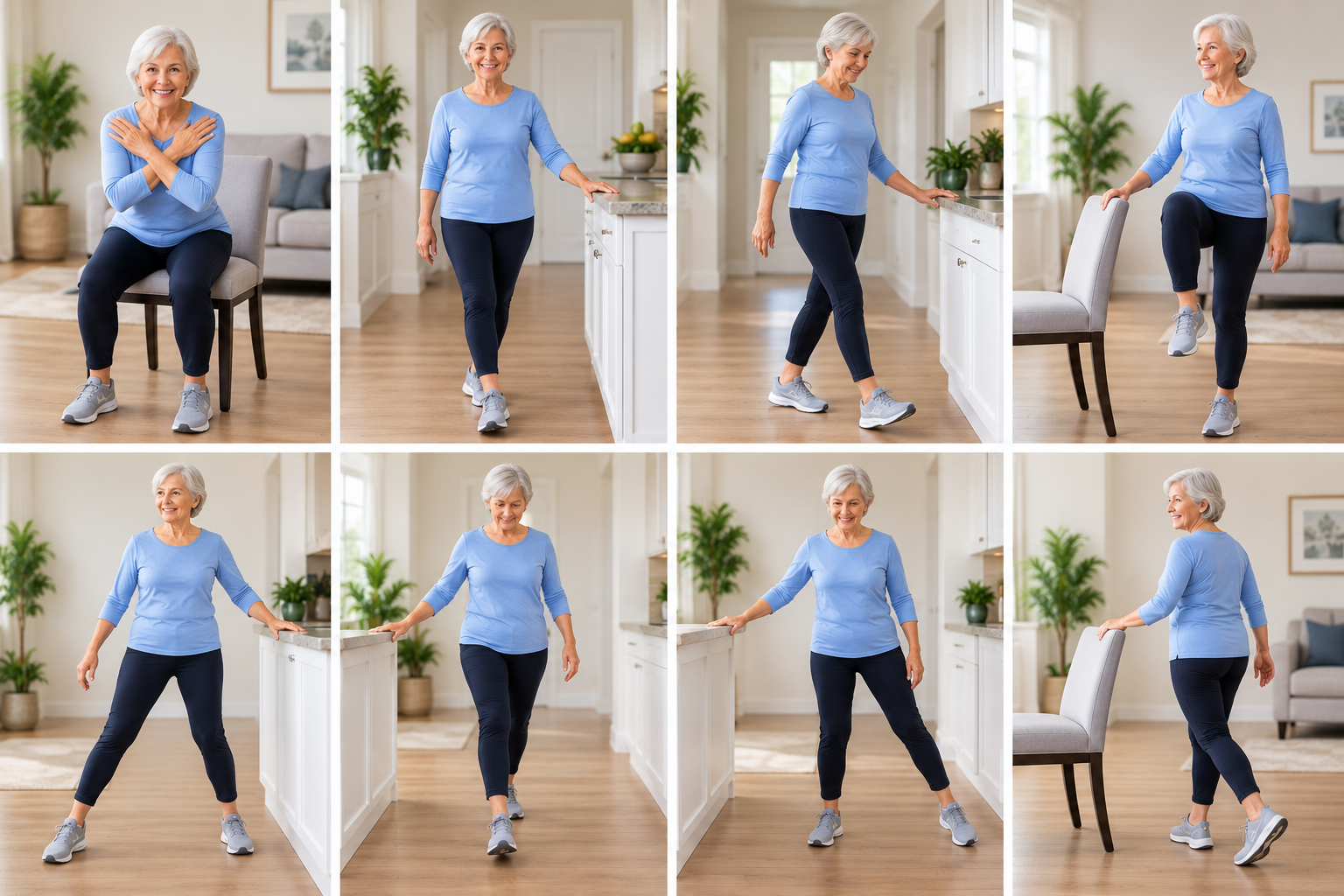
8 Simple Balance Exercises Seniors Can Do at Home
Before beginning, make sure you have a clear area without loose rugs, cords, clutter, or other tripping hazards.
Use a sturdy chair or countertop for support when needed. Do not use a lightweight chair that could slide or tip.
If you feel dizzy, unusually short of breath, experience chest discomfort, or develop significant pain, stop the exercise and seek appropriate medical advice.
1. Chair-Assisted Sit-to-Stand
This is one of the most practical exercises you can do because standing from a chair is something you already do throughout the day.
How to do it:
Sit near the front of a sturdy chair.
Place your feet approximately hip-width apart.
Lean your upper body slightly forward.
Push through your feet and stand.
Pause briefly once standing.
Slowly lower yourself back into the chair.
Repeat with controlled movement.
If necessary, use the armrests or a stable support.
Why it helps
Chair stands challenge the leg and hip muscles used for everyday transfers. They also require coordination between your lower body and trunk.
The CDC includes the 30-second chair stand as a functional assessment of leg strength and endurance.
Safety tip: Do not let yourself drop quickly into the chair. Control the lowering phase.
2. Supported Heel-to-Toe Stand
This exercise reduces your base of support and asks your body to maintain control.
How to do it:
Stand beside a sturdy countertop.
Place one foot directly in front of the other.
Keep your toes and heel as aligned as comfortably possible.
Lightly touch the counter if necessary.
Hold the position for several seconds.
Switch which foot is in front.
As your balance improves, you may gradually reduce how much you rely on your hand.
Why it helps
Narrowing your stance challenges your balance system in a controlled environment.
Safety tip: Keep your hand close to the counter rather than trying to prove you can balance without support.
3. Heel-to-Toe Walking
Once standing in a narrow position feels manageable, you can introduce controlled movement.
How to do it:
Stand near a kitchen counter or another stable support.
Look forward rather than down at your feet.
Take a slow step forward.
Place the heel of your front foot close to the toes of your other foot.
Continue for several controlled steps.
Turn carefully and return.
You can also perform this beside a hallway counter or with another stable surface nearby.
Why it helps
Walking requires continuous adjustments to your balance. Heel-to-toe walking provides a more challenging version of controlled walking.
Safety tip: If you cannot perform the movement safely, return to a wider stance and practice supported weight shifting instead.
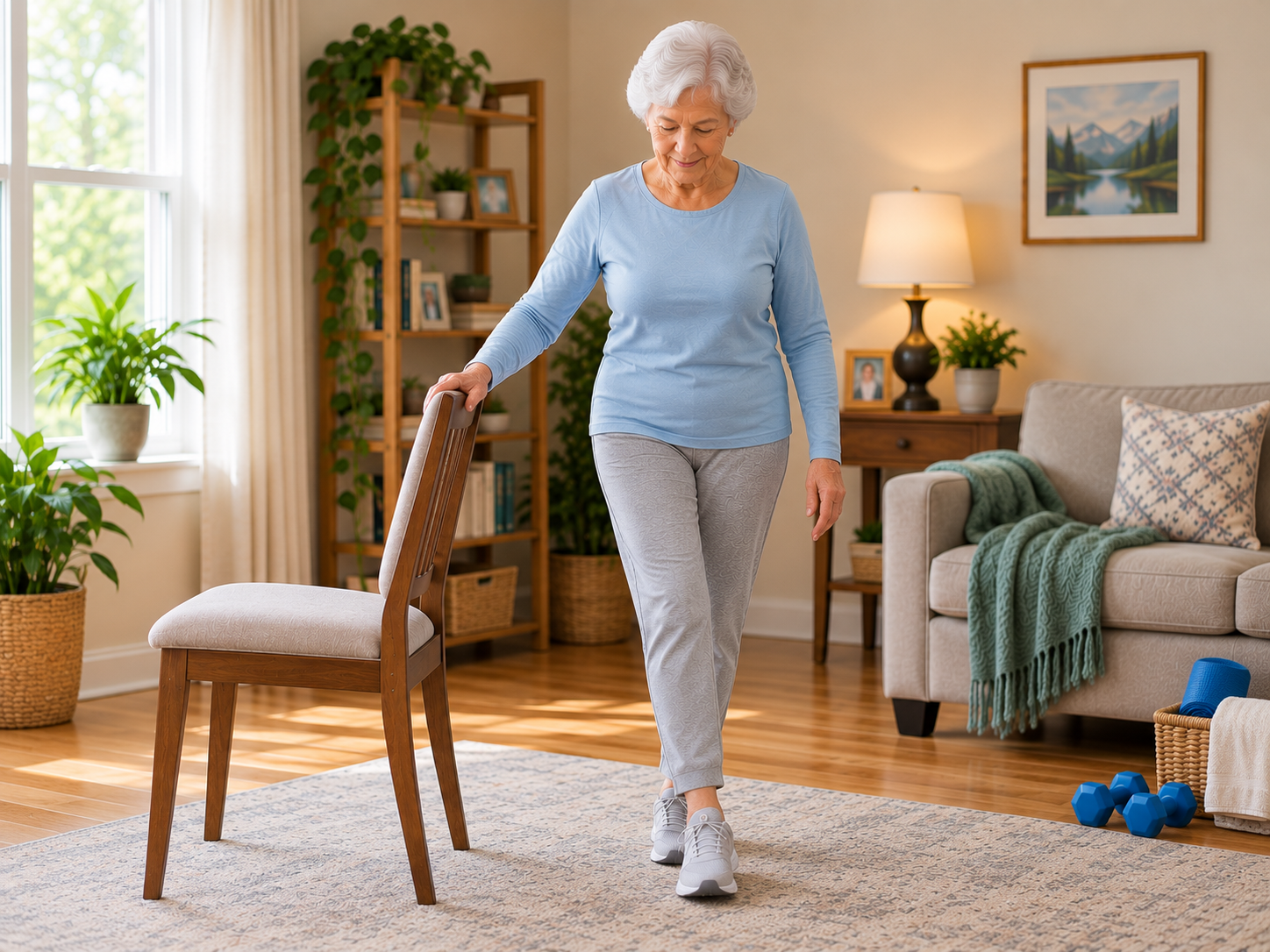
4. Supported Single-Leg Stand
Standing on one leg can be challenging, so start with substantial support.
How to do it:
Stand behind a sturdy chair or beside a countertop.
Keep both hands available for support.
Shift your weight onto one leg.
Lift the opposite foot slightly from the floor.
Hold briefly.
Lower your foot.
Repeat on the other side.
The goal is controlled movement, not seeing how long you can stand on one leg.
Why it helps
Single-leg balance is relevant to everyday activities such as stepping over an obstacle, climbing stairs, and putting on clothing.
The CDC identifies one-leg standing as an example of a balance activity.
Safety tip: Keep the supporting surface close enough that you can grab it immediately.
5. Side-to-Side Weight Shifts
This is a gentle way to introduce balance training if standing exercises feel intimidating.
How to do it:
Stand behind a sturdy chair.
Keep both feet comfortably apart.
Slowly shift your weight toward your right foot.
Return to the centre.
Shift toward your left foot.
Continue slowly from side to side.
Keep your upper body controlled rather than leaning dramatically.
Why it helps
Everyday movement requires your body to transfer weight from one foot to another. Practicing this movement can help you become more comfortable controlling your centre of mass.
Safety tip: Keep both feet on the floor throughout the exercise.
6. Forward and Backward Stepping
This exercise introduces directional changes while keeping the movement simple.
How to do it:
Stand beside a sturdy support.
Step one foot forward.
Bring the other foot forward.
Step back carefully.
Return to your starting position.
Repeat with the opposite leg.
Start with small steps.
Why it helps
Balance isn't only about standing still. It is also about controlling your body while your feet move.
Safety tip: Make sure there is plenty of space behind you before beginning.
7. Side Steps Along a Counter
Sideways movement is often overlooked in everyday exercise routines.
How to do it:
Stand beside a sturdy countertop.
Keep one or both hands near the surface.
Step sideways.
Bring the other foot toward it.
Continue for several steps.
Reverse direction.
Avoid crossing one foot over the other when first learning the exercise.
Why it helps
Side-stepping challenges your ability to control lateral movement and can complement forward walking practice.
Safety tip: Keep your steps small and controlled.
8. Controlled Turning Practice
Turning is an important part of everyday mobility.
You turn when walking through your kitchen, entering a bathroom, changing direction in a hallway, or moving around furniture.
How to do it:
Stand near a stable support.
Walk forward several small steps.
Slow down before turning.
Take several small steps to change direction.
Avoid pivoting quickly on one foot.
Walk back to your starting point.
Why it helps
Practicing controlled turns can help you become more aware of how your body responds when direction changes.
Safety tip: Do not rush. If turning makes you feel unstable, use more support or have someone nearby.
How Often Should Seniors Do Balance Exercises?
A common question is:
“How often should seniors do balance training?”
For older adults with poor mobility, the World Health Organization recommends physical activity that emphasizes balance and fall prevention three or more days per week.
However, the appropriate amount depends on your current fitness, mobility, health conditions, and experience with exercise.
If you are starting from a very inactive level, begin with manageable amounts and build gradually.
Consistency matters more than trying to do an extremely difficult workout once in a while.
A practical routine might look like:
| Day | Activity |
|---|---|
| Monday | Balance + strength |
| Tuesday | Walking or light activity |
| Wednesday | Balance practice |
| Thursday | Walking or light activity |
| Friday | Balance + strength |
| Saturday | Gentle movement or walking |
| Sunday | Rest or light activity |
This is an example—not a prescription. Your own exercise schedule should reflect your abilities and health needs.
What Should Seniors Do If They Are Afraid of Falling During Exercise?
Fear can become a barrier to movement.
If you're worried about losing your balance, don't start by standing in the middle of a room and trying a difficult exercise.
Instead:
Start with support.
A sturdy countertop, properly positioned chair, or another stable surface can give you a sense of security while you learn the movement.
Then gradually progress the exercise as your control improves.
You can also have another person nearby when trying a new exercise for the first time.
This is one reason individualized exercise programs can be valuable. A professional can help determine how much challenge is appropriate rather than expecting you to figure everything out alone.
What Should You Check Before Doing Balance Exercises at Home?
Your environment matters.
Before starting, take a quick look around your exercise area.
Check for:
Loose rugs
Electrical cords
Clutter
Slippery flooring
Poor lighting
Furniture that moves easily
Pets underfoot
Shoes that do not provide adequate support
Fall prevention is not only about exercise. The CDC also recommends talking with a healthcare provider about fall risk and identifying factors such as medications that may contribute to dizziness or sleepiness.
When Is DIY Balance Training Not Enough?
Home exercises can be a useful starting point, but they aren't appropriate for every situation.
Consider professional guidance if you:
Have fallen recently
Frequently feel unsteady
Avoid activities because you're afraid of falling
Have significant difficulty walking
Need to hold onto furniture to move around your home
Have recently had surgery
Have a neurological or cardiovascular condition affecting movement
Experience dizziness during exercise
Are unsure which exercises are appropriate for you
Have difficulty progressing exercises safely on your own
This doesn't mean you need to give up exercising.
It means your program may benefit from being individualized.
At HomeStretch, Kinesiologists work with older adults in their homes to understand their current movement abilities, daily routines, environment, and goals. Programs can incorporate strength, balance, mobility, and functional movement rather than simply handing someone a generic exercise sheet.
That home setting can also make the exercises more relevant because the Kinesiologist can see the actual chair, hallway, stairs, bathroom, and other areas where movement challenges occur.
How Does Professional Balance Training Differ From Doing Exercises Alone?
There is nothing wrong with exercising independently when you are able to do so safely.
The difference is personalization and progression.
A professional can help answer questions such as:
Is this exercise appropriate for me?
Should I use one hand or two?
Is this movement too easy or too difficult?
How should I progress it?
Should I work on strength as well as balance?
Why do I feel unstable during this particular movement?
How can I make this exercise more relevant to walking, stairs, transfers, or other daily activities?
The goal isn't to make exercise complicated.
It is to make the exercise appropriate for the person doing it.
HomeStretch's approach is built around supporting older adults with strength, balance, mobility, confidence, and independence rather than using a one-size-fits-all program.
How Balance Training Connects With Strength Training
Balance and strength are closely connected.
Imagine you stumble slightly.
Your balance system helps you recognize that your position has changed. But your muscles also need enough strength and control to respond.
That is why a well-rounded fall-prevention program shouldn't focus exclusively on standing exercises.
It can include:
| Training area | What it supports |
|---|---|
| Balance | Staying controlled while standing and moving |
| Leg strength | Standing, climbing stairs and recovering from movement |
| Mobility | Moving joints through useful ranges |
| Gait training | Improving walking patterns and control |
| Functional training | Practicing movements used in everyday life |
WHO guidance supports combining balance, strength, gait, and functional training for older adults.
And importantly, the goal isn't simply to exercise for exercise's sake.
It is to maintain the physical abilities that help you participate in daily life.
What If I Also Have a Shoulder Injury?
If you've recently experienced a shoulder injury or are recovering from shoulder surgery, some exercises may need to be modified.
Balance training can still be useful, but how you use your arms for support matters.
For example, you may need to avoid putting excessive weight through an injured shoulder or using certain arm positions.
HomeStretch also provides educational resources for older adults recovering from injuries, including Shoulder Injury Rehabilitation Exercises for Seniors.
The important point is that your balance routine should fit your overall physical condition—not treat balance as an isolated issue.
Ready to Build Better Balance at Home?
HomeStretch Active Living provides in-home kinesiology services for older adults, with programs focused on strength, balance, mobility, fall prevention, and active aging.
Instead of asking you to fit into a generic exercise program, HomeStretch can bring the program into your real environment and work around the movements that matter to your everyday life.
Ready to take the next step? Contact HomeStretch to discuss your goals and learn whether in-home support is right for you or your loved one.
Stay Strong. Stay Steady. Stay Independent.
Frequently Asked Questions
-
Some practical options include supported single-leg stands, heel-to-toe walking, side steps, weight shifts, chair stands, and controlled turning. The best exercise depends on the individual's current balance, strength, mobility, and health needs.
-
Yes. Balance can be practiced through appropriately challenging exercises performed consistently. For older adults with poor mobility, WHO recommends balance-focused physical activity three or more days per week.
-
Older adults with poor mobility should include balance-focused activity on three or more days per week, according to WHO recommendations. Beginners should start at an appropriate level and gradually build their activity.
-
There is no single safest exercise for everyone. Supported exercises using a sturdy chair or countertop may provide an accessible starting point, but the appropriate exercise depends on the person's abilities and health.
Related Posts
Better Sleep for Older Adults, Practical Strategies for Restful Nights
Kinesiology for Seniors: In-Home Personal Training, Rehabilitation & Fall Prevention in Toronto
In-Home Personal Training for Seniors in Toronto: Why Local Kinesiology Matters
Author Bio - Melissa Gunstone, BSc, Kinesiologist
Melissa Gunstone is the founder of HomeStretch, a kinesiologist with years of experience supporting seniors across Canada. Her mission: to give older adults safe, effective, and individualized movement programs, from in-home training to community-based senior fitness classes and to build a nationwide movement that elevates the role of kinesiology in healthy aging.