Best Fall-Prevention Exercises for Older Adults at Home
September 21, 2026
On this page
⚡ Quick Answer
- The best home routine combines three balance moves (tandem stance, heel-to-toe walk, single-leg stand) with four strength moves (sit-to-stand, marching, side leg lifts, calf raises).
- Do the six exercises three days a week with a rest day between, always next to a counter or sturdy chair.
- Progress slowly: full support for two weeks, then fewer fingertips and more repetitions, then a lower chair for sit-to-stands.
- Start with a kinesiologist if there has been a recent fall, dizziness, or noticeable weakness; the routine should match the person, not a handout.
Falls are common, but they are not something older adults have to accept.
Health Canada reports that one in three seniors falls at least once each year, and the confidence lost after a fall often matters more than the fall itself, as described in its guidance on preventing falls at home.
The best fall-prevention exercises for seniors are the ones that build balance and leg strength together, and that get done consistently.
That last part is the challenge: only about 11% of Canadians aged 60 to 79 meet physical activity guidelines, even though regular activity improves balance, mobility, and bone health, according to Seniors' Falls in Canada.
This guide gives you six well-established moves, a simple weekly routine, and clear rules for progressing safely.
At HomeStretch, our kinesiologists teach exactly these exercises in seniors' homes across Ontario through our fall prevention and balance programs, so the routine fits the person and the house.
Why Does Home-Based Fall Prevention Work So Well?
Exercising at home removes the biggest barrier to consistency: getting there. Home is familiar, private, and easier to fit into the week, especially for older adults who no longer drive, feel uneasy on winter sidewalks, or tire with travel. Canadian guidance supports fall-prevention exercise in both home-based and group settings, which makes in-home support a practical, evidence-based option.
Just as important, home exercise can be built around real movement. Practising sit-to-stands from the actual dining chair, balance at the kitchen counter, or walking drills in the hallway makes the work more relevant and more useful day to day.
The value of kinesiologist-led support
Professional guidance turns a list of exercises into a safe plan. Our kinesiologists focus on body mechanics, pacing, and progression, so each movement matches the person, not a generic handout. That matters for seniors living with arthritis, reduced strength, a recent fall, reduced stamina, or a fear of losing balance.
It also reassures families. Instead of wondering whether an exercise is too easy, too hard, or being done incorrectly, they know the program is being adjusted with safety and function in mind.
Which Balance Exercises Build Steadiness?
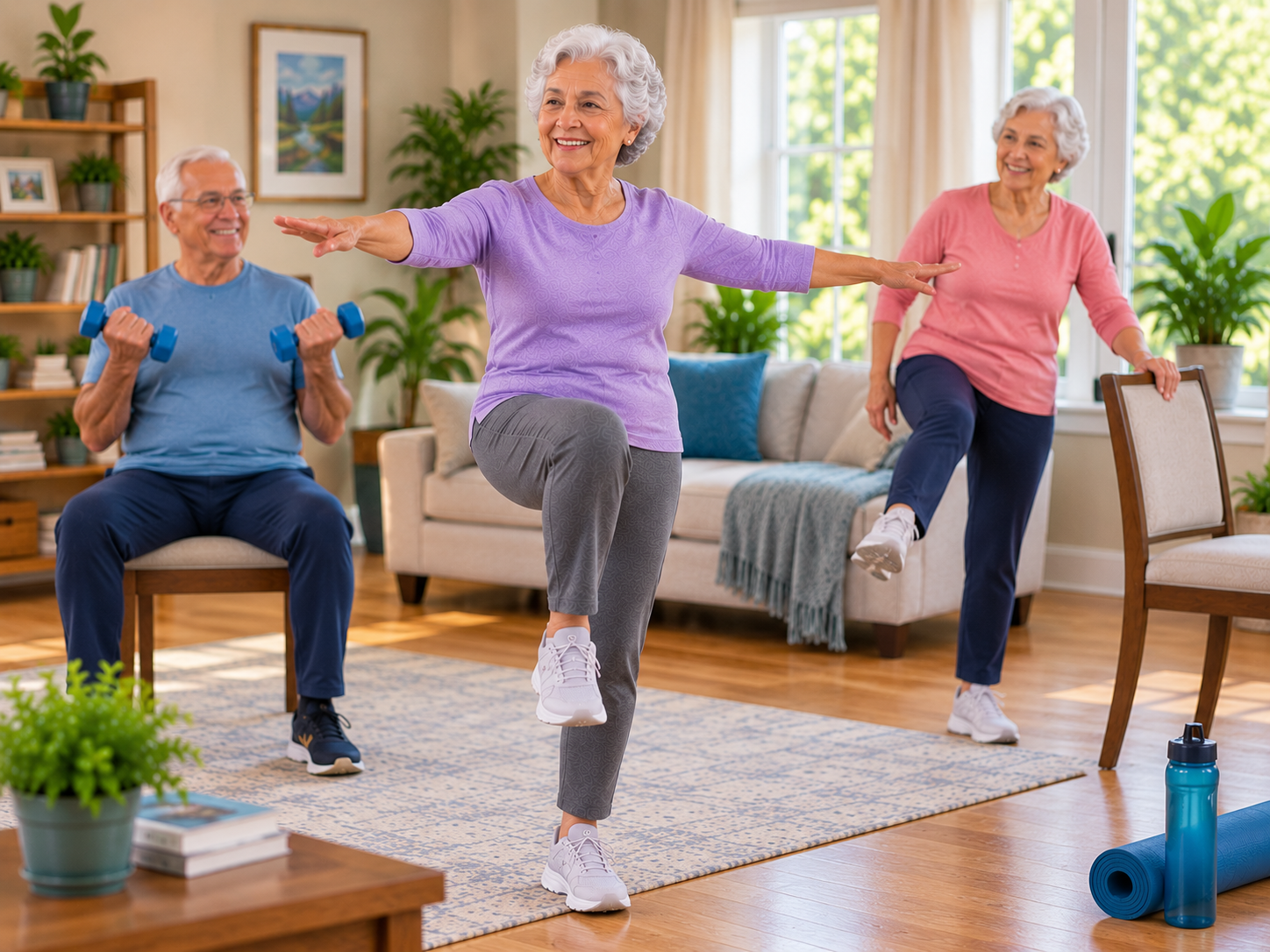
Balance training improves control during standing, turning, and walking. It trains the small adjustments that help someone recover when they feel unsteady. Do each of these next to a counter or the back of a sturdy chair.
- Tandem stance – stand with one foot directly in front of the other, heel touching toe, and hold. Fingertips on the counter to start; lift them for a few seconds as control improves.
- Heel-to-toe walk – walk a straight line placing each heel just in front of the opposite toes, eyes forward, hand near the counter or wall.
- Single-leg stand – lift one foot a few centimetres off the floor and hold, first with fingertip support, then with less assistance as it feels safe. Switch sides.
These may look simple, but they challenge the body in exactly the ways that matter for everyday life: turning in the kitchen, stepping around a pet, or reaching into a cupboard.
Which Strength Exercises Support Everyday Movement?
Strength is what lets an older adult rise from a chair, climb a step, or catch themselves if they trip. The four moves below cover the hips, thighs, and calves that do most of that work.
- Sit-to-stand – from a firm chair, feet flat and slightly back, lean forward and stand without using the hands, then lower slowly. One of the most useful exercises for everyday independence.
- Marching in place – hold the counter, lift one knee toward hip height, then the other, with a steady rhythm.
- Side leg lifts – hold the counter, keep the torso tall, and lift one leg out to the side without leaning. Builds the hip muscles that keep the pelvis level when walking.
- Calf raises – hold the counter, rise onto the balls of the feet, pause, and lower with control. Builds push-off power for walking and stairs.
Functional strength and balance training together are what the research points to. In one Canadian review, a LiFE-style program that builds strength and balance into daily routines was associated with about 31% fewer falls, as discussed in this MoveStrong analysis published by the Public Health Agency of Canada.
How Should Seniors Organize a Weekly Home Routine?
A good routine is short, repeated, and progressed slowly. Aim for the six exercises below three days a week, with a day of rest between sessions, and keep a sturdy chair or counter within reach every time.
| Exercise | Main benefit | Good starting point |
|---|---|---|
| Tandem stance | Static balance | 10 to 20 seconds, 2 to 3 rounds |
| Heel-to-toe walk | Walking balance | 5 to 10 steps, 2 to 3 rounds |
| Single-leg stand | Weight shifting and stability | 5 to 10 seconds per side |
| Sit-to-stand | Leg strength and function | 8 to 10 reps |
| Side leg lifts | Hip strength | 8 to 12 reps per side |
| Calf raises | Ankle strength and push-off power | 10 to 15 reps |
How to progress safely
- Weeks 1 and 2 – learn the moves with full support. Stop each set while it still feels controlled.
- Weeks 3 and 4 – add a round or a few repetitions, and reduce fingertip support on the balance holds.
- Week 5 onward – add a second daily balance hold (for example, tandem stance while the kettle boils) and try sit-to-stands from a slightly lower chair.
If dizziness, pain, or marked unsteadiness shows up, stop and adjust. Canada's fall-prevention resources stress caution when gait, pain, dizziness, or neurological issues are involved, and that is where a professional assessment earns its keep. Our free fall-risk self-check is a quick way to see whether a parent should start with supervision. For a brain-and-balance element, our weekly balance exercises page adds coordination drills that pair well with this routine.
How Does Exercise Fit a Bigger Healthy-Aging Plan?
Exercise is one part of staying safe, and it works best when paired with broader support: good nutrition, a medication review, vision care, hydration, and home safety changes such as better lighting and removing loose rugs.
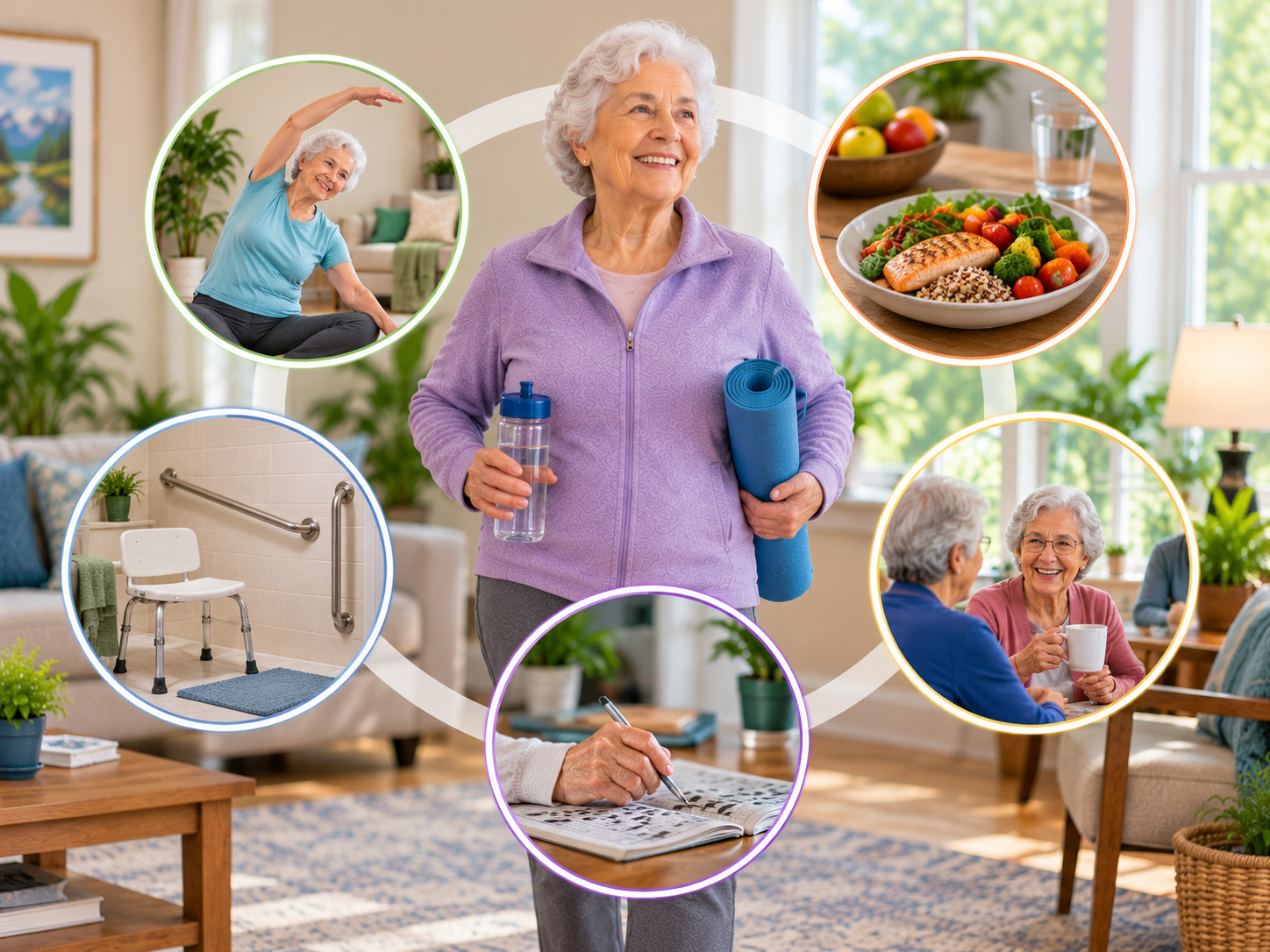
This bigger view matters because the Public Health Agency of Canada lists exercise, medication review, vision care, and home safety together as the core of fall prevention in its falls in older adults summary. Each one supports the others.
Home, care home, or group class?
Different settings serve different needs. In-home exercise is ideal when personalization, convenience, and direct supervision matter most. Care-home programs suit residents who benefit from built-in structure and routine. Group classes, like our community workshops, add social connection and accountability.
What matters most is not the setting but the quality of the program: balance training, lower-body strengthening, gradual progression, and attention to medications, footwear, and home hazards. For many older adults, that combination is easiest to deliver at home, where exercises are taught safely and practised where daily life actually happens.
Why Do Ontario Families Choose In-Home Support?
Personalized in-home training gives older adults a plan that fits their health history, mobility level, and confidence. That is especially helpful after a recent fall, during recovery from illness, or when someone has started avoiding activities because they feel unsteady. Seniors' Falls in Canada reports that home-based exercise programs have improved daily function, balance confidence, strength, and flexibility for older adults with limited mobility.
It also improves follow-through. Exercises are easier to keep doing when they are realistic, clearly taught, and tied to daily routines. Our kinesiologists serve families across the Niagara Region, Hamilton, Burlington, Oakville, Mississauga, the Greater Toronto Area, and Thunder Bay; see our service areas.
Build More Confidence at Home
The best fall-prevention exercises for seniors are the ones that build balance, strengthen the legs, match the person, and get done every week. If you or a family member would benefit from a personalized plan taught in your own home, reach out and let us help you take the first steady step.
Frequently Asked Questions
Are fall-prevention exercises safe for all seniors?
Yes, when they are tailored to the person's health conditions and ability level. Some seniors can begin with simple supported exercises right away, while others should start with professional guidance, especially after a recent fall or with ongoing dizziness.
How often should seniors do fall-prevention exercises?
Aim for balance and strength exercises at least three days a week, with a rest day between sessions, and keep it up over months rather than weeks. Canadian guidance recommends 150 minutes of physical activity a week for older adults, including balance and strength work.
What is the difference between balance and strength exercises for fall prevention?
Balance exercises like tandem stance and single-leg stands train the small corrections that keep you upright. Strength exercises like sit-to-stands and calf raises build the leg power to rise, climb, and catch yourself. You need both, which is why the routine here combines them.
Can I do these exercises alone at home?
Many older adults continue independently once they know proper form and have a counter or sturdy chair nearby. Start with instruction or supervision if there has been a recent fall, noticeable weakness, or ongoing balance trouble.
Author Bio - Melissa Gunstone, BSc, Kinesiologist
Melissa Gunstone is the founder of HomeStretch, a kinesiologist with years of experience supporting seniors across Canada. Her mission: to give older adults safe, effective, and individualized movement programs, from in-home training to community-based senior fitness classes and to build a nationwide movement that elevates the role of kinesiology in healthy aging.