Aging Well: 5 Anchors for Staying Strong, Steady, and Independent
October 02, 2026

On this page
⚡ Quick Answer
- Aging well means staying able to do the things that matter to you, not trying to stop getting older.
- Melissa Gunstone's five anchors are purpose, mindset, resilience, connection, and learning.
- Walking is valuable, but strength, power, and safely challenged balance matter too. Canada's guidelines for adults 65+ include muscle strengthening at least twice a week.
- Start with one question: what do you want your body to keep doing?
Aging well isn't about trying to stop getting older. It's about spending more years doing the things that matter to you.
Maybe that's getting out of your favourite chair independently. Walking to the grocery store. Gardening. Playing with your grandchildren. Going to a fitness class. Travelling. Meeting friends for coffee. Or simply feeling confident enough to keep participating in everyday life.
For Melissa Gunstone, founder of HomeStretch Active Living and a registered Kinesiologist, aging well starts with a simple question:
What do you want your body to keep doing?
At HomeStretch, our kinesiologists bring that question into in-home personal training for older adults across Ontario, building strength, balance, and confidence around the life each person wants to keep living.
In a recent presentation on aging well, Melissa shared five anchors that can help older adults think differently about movement, independence, and staying active as they age:
- Purpose
- Mindset
- Resilience
- Connection
- Learning
These five areas offer a practical way to think about healthy aging beyond simply asking, "Am I exercising enough?"
What Does Aging Well Mean?
Aging well can look different for everyone.
For one person, it may mean continuing to garden. For another, it may mean getting up and down from a chair comfortably, walking around the neighbourhood, attending social activities, or maintaining enough strength and balance to live independently.
Instead of focusing only on age, Melissa encourages older adults to think about the activities and experiences they want to continue enjoying.
That shift can change the way we approach exercise.
Rather than exercising simply because someone told us we should, we can build movement around a meaningful purpose.
The goal isn't simply to exercise. The goal is to maintain your ability to participate in the life you enjoy.
The 5 Anchors of Aging Well
1. Purpose: Have a Reason to Move
One of the most important questions you can ask yourself is:
What do I want my body to keep doing?
Having a purpose behind exercise can make movement feel more meaningful.
Maybe you want to continue gardening. Perhaps you want to be able to travel, play with your grandchildren, walk with friends, or get up from a chair without assistance.
These everyday goals can become the reason behind your exercise routine.
For example, someone who loves gardening may benefit from working on movements involved in gardening, such as:
- Bending
- Reaching
- Kneeling
- Getting up from the ground
- Pulling
- Maintaining strength and mobility
Someone who enjoys boxing may have different movement goals, such as coordination, reaction time, rotation, footwork, and confidence.
The important question is not simply:
"What exercise should I do?"
Instead, ask:
"What do I want to stay capable of doing?"
That answer can help give your exercise routine a purpose.
Strength and Power: What's the Difference?
Aging well also means thinking about more than just walking.
Walking is valuable movement and an important part of staying active. But Melissa explains that strength and power also play an important role in everyday movement.
Strength is your ability to produce force.
For example, standing up from a chair requires strength.
Power involves producing force quickly.
This matters when you need to react quickly, such as taking a quick step after losing your balance.
Many everyday activities involve a combination of strength, power, coordination, and balance.
Consider stepping off a curb. You need to notice the change in your environment, coordinate your movement, control your body, and respond appropriately.
This is one reason exercise for older adults shouldn't be limited to one type of movement.
A well-rounded approach can include strength, balance, mobility, coordination, and appropriately challenging movement.
That matches the Canadian 24-Hour Movement Guidelines for adults 65 and older, which recommend muscle-strengthening activities using major muscle groups at least twice a week, along with physical activities that challenge balance.
2. Mindset: Change the Way You Think About Aging
The second anchor is mindset.
Positive thinking about aging doesn't mean ignoring challenges or pretending everything is easy.
Instead, Melissa encourages older adults to avoid automatically assuming that weakness, decline, or dependence are inevitable.
One phrase she highlights is:
"I'm too old for that."
What if, instead, you asked:
"How could I adapt that?"
or
"How could I learn how to do that?"
That small change in perspective can create room for curiosity and problem-solving.
Maybe you see someone participating in a fitness class and think you could never do it.
Instead of deciding immediately that the activity isn't for you, consider what would help you participate safely and appropriately.
Perhaps the movement needs to be modified. Perhaps you need to build strength first. Perhaps you need support or guidance.
The goal isn't to ignore your limitations.
It's to understand them and find appropriate ways to keep moving within them.
3. Resilience: Safely Challenge Your Balance
The third anchor is resilience.
Balance is a skill that can be challenged and practiced. But balance exercises should be appropriate for the individual and performed safely.
Melissa demonstrated several ways of challenging reaction time and coordination during her presentation, including clock stepping, reaction-based activities, and dual-task exercises.
The idea behind these activities is to give the brain and body opportunities to respond to movement challenges.
For example, clock stepping involves imagining a clock in front of you and stepping toward different positions on the clock.
A simple movement can become more challenging by changing directions or coordinating which foot moves first.
Other activities can combine movement with another task, such as handling a ball while moving.
These types of exercises can challenge:
- Balance
- Coordination
- Reaction time
- Concentration
- Movement control
Can Balance Be Practiced as You Age?
Yes, balance can be included as part of an exercise routine, but the right level of challenge depends on the individual.
Safety matters.
Melissa repeatedly emphasized knowing your limits and using support when appropriate during more challenging balance activities.
If you are unsure which exercises are appropriate for you, working with a qualified professional can help you choose movements that match your current abilities and goals.
Balance training isn't about proving how difficult an exercise you can perform. It's about building confidence and capability through an appropriate level of challenge.
Understanding the Fear of Falling Cycle
For many older adults, a fall, or even a near fall, can change the way they move.
Melissa described a cycle that can begin with fear:
Fall or near fall → fear → less movement → reduced strength → reduced mobility → slower reactions → less confidence
Imagine someone who regularly walks to the grocery store and attends an exercise class.
After experiencing a fall, they may become worried about falling again.
They stop walking as often.
They stop attending their exercise class.
They move less.
Over time, reduced activity can affect strength, mobility, coordination, and confidence.
The result can be a cycle in which fear of movement leads to even less movement.
The Public Health Agency of Canada's Seniors' Falls in Canada report describes the same pattern: a fear of falling may lead to less physical activity, which in turn leads to muscle weakness and poorer balance. The same report notes that fear of falling may be reduced through home-based exercise and fall prevention programs.
This is why fall prevention-focused exercise isn't simply about doing more exercises.
It's also about building confidence and finding safe, appropriate ways to keep participating in meaningful activities.
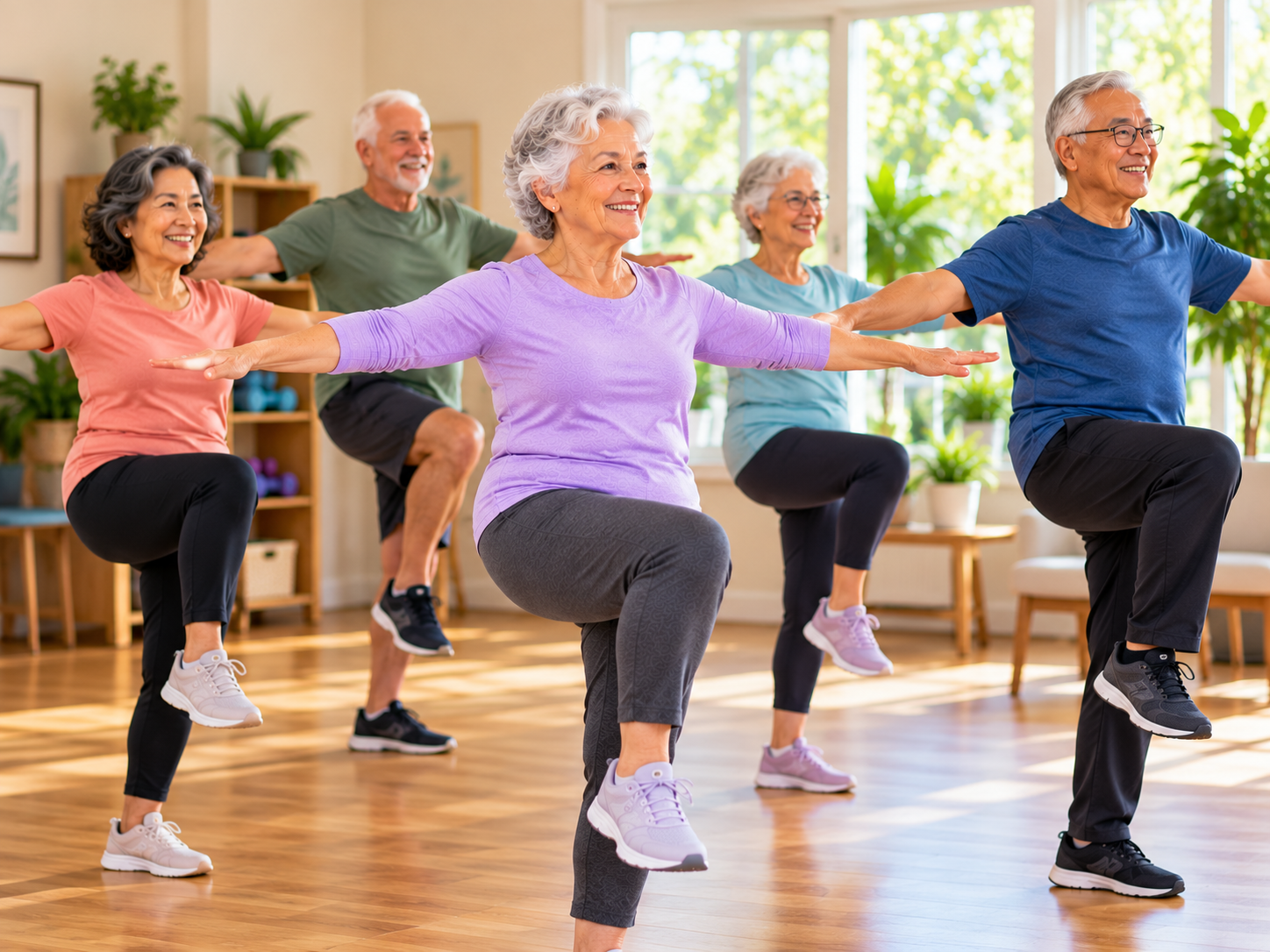
4. Connection: Don't Underestimate the Power of Community
The fourth anchor is connection.
Aging well isn't only about physical fitness.
The people around us and the communities we participate in can also play an important role in how we experience aging.
Melissa encourages older adults to think about:
- Who helps you feel capable?
- Who encourages you to try something new?
- Where do you feel welcomed?
- Where do you have meaningful conversations?
- Are there opportunities to connect with people outside your usual routine?
This doesn't mean you need to become the most social person in the room.
It can be as simple as having coffee with someone, joining a group activity, talking to someone you haven't spoken with before, or participating in a community program.
HomeStretch's Brain & Balance Workshops are designed around this idea of combining movement, cognitive challenges, and social connection.
Staying active can be about more than moving your body. It can also be an opportunity to stay connected with the people and community around you.
5. Learning: Give Your Brain Something New
The fifth anchor is continued learning.
Our routines can become very predictable as we get older. While routines can be helpful, Melissa encourages older adults to continue giving themselves opportunities to learn and adapt.
That could mean:
- Learning a new dance
- Trying a new card game
- Learning an instrument
- Joining a choir
- Taking a different walking route
- Learning how to use new technology
- Trying a new activity
- Adding a new movement challenge to an existing routine
Even something as simple as changing your usual walking route can introduce something different.
Melissa also discussed dual-task activities, where the brain and body are working on different tasks at the same time.
For example, walking while performing a simple mental task can create an additional challenge.
The important takeaway isn't that every older adult needs to perform complicated exercises.
It's that learning, adapting, and trying new things can remain part of an active lifestyle at any age.
How Can You Start Aging Well?
You don't have to completely change your lifestyle overnight.
Instead, start with one question:
What do you want to keep doing?
Think about an activity that matters to you.
Maybe it's:
- Walking with friends
- Gardening
- Travelling
- Playing with your grandchildren
- Getting out of a chair independently
- Going to community activities
- Cooking
- Dancing
- Shopping independently
- Staying active with your partner
Once you know what matters, think about the abilities that support that activity.
Do you need strength?
Balance?
Mobility?
Coordination?
Confidence?
Reaction time?
Social connection?
Learning something new?
This gives your movement routine a purpose.
You can also read Practical Planning for Active, Independent Seniors in Southern Ontario for how to turn a goal like this into a step-by-step plan.
Aging Well Isn't About Doing Everything Perfectly
There is no single definition of aging well.
It doesn't mean having the same physical abilities you had decades ago.
It doesn't mean never experiencing limitations.
And it doesn't mean following every exercise trend you see online.
Instead, aging well can mean continuing to invest in the abilities that help you participate in the life you value.
As Melissa shared during her presentation, the conversation can start with your why.
Ask yourself:
What do I want to be able to do one year from now?
What do I want my body to keep doing?
What matters enough to me that I want to maintain it?
Those questions can help you move from simply "exercising" to exercising with purpose.
A Simple Aging Well Checklist
Use these five questions as a starting point:
| Aging Well Anchor | Ask Yourself | Try This |
|---|---|---|
| Purpose | What do I want my body to keep doing? | Name one activity you want to keep doing and list the movements it needs |
| Mindset | What am I telling myself about getting older? | Swap "I'm too old for that" for "How could I adapt that?" |
| Resilience | How can I safely challenge my balance and movement? | Try clock stepping beside a counter you can hold for support |
| Connection | Who and what helps me stay engaged? | Join one group activity or have coffee with someone new |
| Learning | What new activity, skill, or challenge could I try? | Take a different walking route this week |
You don't have to work on all five at once.
Start with the one that feels most meaningful to you.
Keep Moving Toward What Matters to You
Aging well doesn't have to be complicated.
It can start with a simple question:
What do you want your body to keep doing?
From there, you can build habits that support your purpose, challenge you appropriately, keep you connected, and give you opportunities to continue learning.
At HomeStretch Active Living, we provide in-home personal training for older adults with an exercise-focused, evidence-informed approach. Our kinesiologists support older adults in building strength, balance, mobility, confidence, and independence in ways that connect to their everyday goals.
Whether you're looking to stay active at home, work on balance, maintain strength, or continue doing the activities that matter most to you, the right starting point is personal to you.
Stay Strong. Stay Steady. Stay Independent.
Frequently Asked Questions About Aging Well
What does aging well mean?
Aging well means continuing to participate in the activities, relationships, and experiences that matter to you while supporting strength, balance, mobility, confidence, and independence.
What are the five anchors of aging well?
The five anchors Melissa presented are purpose, mindset, resilience, connection, and learning. Together, they provide a broader way to think about active aging beyond exercise alone.
Is walking enough exercise for older adults?
Walking is valuable physical activity, but Melissa emphasizes that walking alone may not provide enough resistance to maintain the strength and power needed for certain everyday activities. A well-rounded exercise routine can include additional strength and balance work.
How can I stay independent as I get older?
Start by identifying the activities that are important to you and consider the physical abilities needed to continue doing them. Strength, balance, mobility, coordination, confidence, social connection, and continued learning can all be part of an active-aging approach.
Author Bio - Melissa Gunstone, BSc, Kinesiologist
Melissa Gunstone is the founder of HomeStretch, a kinesiologist with years of experience supporting seniors across Canada. Her mission: to give older adults safe, effective, and individualized movement programs, from in-home training to community-based senior fitness classes and to build a nationwide movement that elevates the role of kinesiology in healthy aging.