Fall Prevention and Mobility Programs for Hamilton Care Homes
October 05, 2026

On this page
⚡ Quick Answer
- Strong care-home fall prevention and mobility programs combine balance and strength training, mobility practice, gentle group exercise, and brain-and-balance activities.
- Look for registered kinesiologists, individual safety screening, seated and standing options, and programming that progresses as residents get stronger.
- Our Brain & Balance workshops run one hour (30 minutes of teaching, 30 minutes of games and guided exercise), as a single session or a 6-week series.
- We bring them to care homes and retirement residences across Hamilton, Dundas, Ancaster, Stoney Creek, and Waterdown. Start with a free consult.
A fall can change much more than someone's physical health. Many older adults start walking less after a fall, stop joining activities they used to enjoy, and slowly lose confidence in their own bodies.
Health Canada notes that one in three Canadian seniors falls at least once each year, and its guidance on preventing falls recommends staying active to maintain flexibility, balance, and strength.
The good news is that strength and balance can be trained at any age, and well-run fall prevention and mobility programs help older adults in Hamilton care homes stay steady and independent.
At HomeStretch, our programs are led by kinesiologists and built around each person's abilities and goals.
Each one starts with an individual assessment and moves forward in steady steps. We work with care homes, residents, and families across Hamilton and area, from Dundas and Ancaster to Stoney Creek and Waterdown.
For residences, that includes our Brain & Balance Training Workshops for Seniors, which bring movement, learning, and connection right into your activity room.
Care Home Wellness Programs
Healthy Living Programs for Seniors
A good care-home wellness program covers more than exercise. Effective programs include several parts that support each other:
- Balance and strength training to help residents stay steady and get up from chairs with less effort
- Mobility practice for safe transfers, walking, and turning
- Gentle group exercise that keeps the pace friendly and social
- Recreation and social engagement to keep residents motivated
- Cognitive and dual-task activities, such as moving while counting or recalling words
- Nutrition education and mental wellness support
Group sessions need to fit the setting. A long-term care home may have many residents who use wheelchairs or walkers, so seated strength work and supported standing practice make sense there. A retirement residence might run more active classes focused on agility and reaction time. Our care-home wellness programming offers both group and one-on-one sessions, so residents at different mobility levels can take part with dignity.
Choosing the Right Provider
When administrators look at mobility programs, a few key standards matter. This table shows what to look for and how we meet each one.
| What to Look For | Why It Matters | How We Deliver It |
|---|---|---|
| Kinesiologist expertise | Exercise for older adults needs real clinical understanding | Programs are led by registered kinesiologists |
| Fall-prevention focus | Generic fitness classes often miss balance-specific needs | Specialized fall-prevention and brain-and-balance programs |
| Safety screening | Programs must take health conditions into account | Individual assessments before any program begins |
| Cognitive experience | Many residents live with memory changes | Experience supporting residents with memory changes |
| Flexibility | Residents have very different abilities | Programs suited to everyone from walker users to highly active seniors |
| Progress tracking | Families and staff want to see results | Progressive programming that changes as strength improves |
We have supported thousands of clients through in-home care, retirement community workshops, and specialized programs. That experience is covered in more detail on our kinesiologist-led team page.
You can also read Healthy Living Programs for Seniors in Canadian Care Homes and at Home for a closer look at what families should expect from a strong program, in a residence or at home.
Brain & Balance Workshops for Hamilton Care Homes
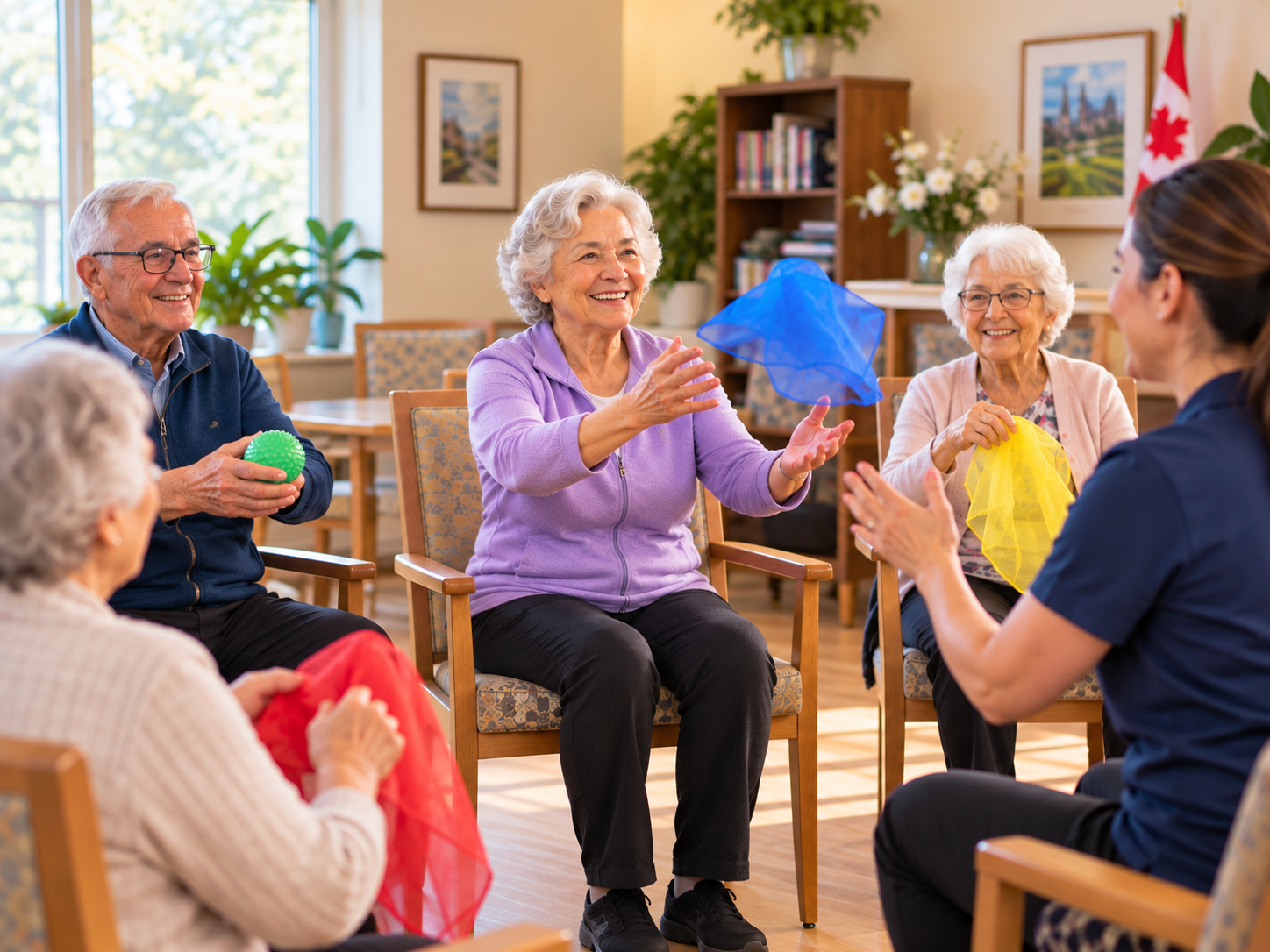
Staying steady involves more than leg strength. Attention and reaction time play a part too, which is why our Brain & Balance Training Workshops for Seniors train the body and the mind together. Workshops are led by licensed kinesiologists who specialize in seniors' health, and they are designed so residents of every ability level can join in.
What a Workshop Looks Like
Each session runs for one hour and blends exercise, education, and social connection:
- 30 minutes of teaching on a practical topic, such as fall prevention, muscle loss, or bone health
- 30 minutes of interactive games and guided exercises, with seated and standing options
- Reaction-ball drills that train focus and quick reflexes in a way that feels like play
- Time to connect, because residents tend to come back to classes they enjoy with friends
This approach lines up with Canada's 24-Hour Movement Guidelines for Adults 65+, which recommend muscle-strengthening activities at least twice a week and physical activities that challenge balance.
One Workshop or a 6-Week Series
Residences can book a single workshop to introduce residents to the program, or the full 6-Week Train Your Brain & Balance Program for steady, week-by-week progress. We also offer educational presentations on aging, muscle loss, fall prevention, arthritis, nutrition, and bone health. Between sessions, staff and families can use our free weekly brain and balance exercises to keep residents moving.
How to Bring a Fall Prevention and Mobility Program into Your Hamilton Residence
Five steps cover the essentials a Hamilton care home or retirement residence needs to get started:
- Start with a conversation. Tell us about your residents, your activity space, and your schedule. A free consult is the easiest first step.
- Choose a format. A single Brain & Balance workshop, an educational presentation, or the 6-week series, depending on your goals and calendar.
- Screen residents who need extra support. Individual assessments flag anyone who would do better with one-on-one sessions alongside the group.
- Mix seated and standing work. Every session has a version residents can do from a chair, so nobody sits out on a lower-energy day.
- Keep it going between visits. Weekly exercises, staff cues, and family involvement help residents hold on to their progress.
We bring workshops and mobility programs to residences across Hamilton and area, including Dundas, Ancaster, Flamborough, Stoney Creek, and Waterdown. See all our service areas.
In-Home Fall Prevention Support
Safe Exercises and Daily Mobility
Several simple exercises build the strength and balance needed for everyday tasks:
- Supported sit-to-stands: rising from a sturdy chair with hands on the armrests, which builds leg strength for getting up from the toilet or bed
- Heel raises: holding a counter while lifting onto the toes, which strengthens the ankles and calves
- Marching in place: lifting the knees one at a time while holding support, which trains single-leg balance
- Walking practice: short, purposeful walks through hallways and doorways
- Balance exercises: standing with feet closer together, then working toward heel-to-toe positions
Stop right away if you feel pain, dizziness, or unusual shortness of breath. Speak with a healthcare provider before starting any new routine.
Working on these exercises at home has one big advantage, because home is where many real fall risks are. A kinesiologist can see how someone handles the stairs, the step into the bathtub, or a loose rug in the hallway, and then shape the program around those specific problems. Our fall prevention and balance programs do this. You don't need a gym, because we bring balance tools, strength equipment, and mobility supports to the client.
Personalized Support for Families
Adult children often notice the warning signs first. A parent may be holding onto furniture, avoiding stairs, or recovering slowly after a hospital stay. Expert help can include a home-based assessment, an individual exercise plan, tips on making the home safer, and education for caregivers on how to help without taking over.
Our kinesiologists provide one-on-one care at home. With permission, they also share goals with family members and care teams, so everyone works toward the same plan. We give the same personal attention after surgery or illness through our pre- and post-operative rehabilitation services.
Building Safer, More Confident Days
A strong fall-prevention plan has three parts: safe exercise, expert guidance, and support that respects each person's pace and independence. With all three in place, residents and parents can keep moving with confidence.
If you run a care home, or you're worried about a parent living on their own, we're happy to talk it through. We offer free consultations and custom quotes. To start, you can request a free consultation and ask about an in-home assessment or a mobility program built around the people you care for.
Frequently Asked Questions
What fall prevention services are available at home in Canada?
Services usually include a mobility assessment, personalized strength and balance exercises, walking practice, home-safety guidance, and support for caregivers. A qualified kinesiologist adjusts each part to the person's abilities and goals. Our answers to common questions explain how a first visit works.
Which in-home services help seniors rebuild strength after surgery?
Supervised exercise that gets gradually harder, practice with everyday movements, and help with daily tasks all rebuild strength safely. Always follow your surgeon's recovery instructions and get clearance before you begin.
Can HomeStretch run group programs in care homes?
Yes. We help care homes set up respectful, adaptable mobility and wellness programs for groups or individuals. Activities are matched to each resident's needs, confidence, and abilities.
What happens in a Brain & Balance workshop?
Each one-hour session combines 30 minutes of teaching with 30 minutes of interactive games and guided exercises, led by a kinesiologist. Activities are adapted for every ability level, and residences can book a single workshop or a 6-week series.
Author Bio - Melissa Gunstone, BSc, Kinesiologist
Melissa Gunstone is the founder of HomeStretch, a kinesiologist with years of experience supporting seniors across Canada. Her mission: to give older adults safe, effective, and individualized movement programs, from in-home training to community-based senior fitness classes and to build a nationwide movement that elevates the role of kinesiology in healthy aging.