Expert Help for Aging Parents to Avoid Falls at Home in Ontario
October 19, 2026
On this page
⚡ Quick Answer
- No single professional covers every part of fall risk: the family doctor, pharmacist, optometrist, occupational therapist, physiotherapist, and kinesiologist each handle a different piece.
- Work in order: check health risks first, then make the home safer, then build strength and balance.
- In Ontario, anyone can refer a parent to Ontario Health atHome for publicly funded care at home.
- A kinesiologist turns balance and strength training into a gradual program at home. Start with a free consult.
Each year, 20 to 30 percent of older Canadians living in the community have a fall, and many of those falls happen at home, in the kitchen, on the stairs, or on the way to the bathroom at night.
If you've noticed your mother holding onto the counter, or your father has stopped walking to the corner store, it makes sense to look for support that helps aging parents avoid falls at home.
The good news is that falls aren't a normal part of getting older. They can usually be prevented when three things happen together: health risks get checked, the home gets safer, and strength and balance get built back up.
This guide covers who can help in Ontario, the order to bring each person in, and the mistakes families tend to make.
Our kinesiologists support this work in homes across Ontario through our fall prevention and balance program.
What signs mean your parent needs fall support?
Spot the Warning Signs
Fall risk is the chance of a fall caused by a mix of health, medications, eyesight, mobility, and surroundings. It often shows up in small ways before anyone actually falls. Watch for:
- a recent fall, or a near-miss your parent shrugs off
- fear of falling, or avoiding stairs or outings
- an unsteady walk, or reaching for furniture to get across a room
- dizziness, especially when standing up
- new medications or changed doses
- changes in eyesight
- weakness after surgery or a hospital stay
Write down what you see in a short note, for example: "Tuesday, felt dizzy getting out of bed, held the dresser." Dates and details like these help each professional find patterns that a single appointment could miss.
Know Your Expert Team
No single person covers every part of fall risk. Each member of the team below handles a different piece.
| Professional | What they focus on | When to involve them |
|---|---|---|
| Family doctor or nurse practitioner | Falls risk screening, blood pressure, referrals | First stop |
| Pharmacist | Medications that cause dizziness or drowsiness | Any new or multiple prescriptions |
| Optometrist | Eyesight changes | Yearly, or sooner if vision changes |
| Occupational therapist (OT) | Home safety assessment, grab bars, railings, bathroom equipment | Once health risks are reviewed |
| Physiotherapist (PT) | Injury, pain, walking problems, recovery after surgery | After an injury, a fall, or surgery |
| Kinesiologist | Step-by-step balance and strength exercise programs | For lasting conditioning, often at home |
A kinesiologist is a university-trained specialist in human movement. Their job is to turn exercise into a safe, gradual program that fits your parent's body and history.
How do you build a fall prevention plan at home?
Assess, Adapt, Then Strengthen
Step 1: Book a falls risk check. Ask the family doctor to look at medications, eyesight, blood pressure, heart rhythm, strength, and balance. Our free 5-minute fall risk self-check is a useful list to bring along, as a starting point for the conversation.
Step 2: Contact your provincial home care program. In Ontario, Ontario Health atHome provides publicly funded home and community care, and anyone can make a referral, including you or your parent. Other provinces run their own systems with different steps, so check your local health authority if you live outside Ontario.
Step 3: Make the changes the OT recommends. An occupational therapist can suggest ways to make the home easier to get around, plus assistive devices and transfer aids that lower the chance of a serious fall. Common changes include brighter lighting and night lights, handrails on both sides of the stairs, clear walkways with loose rugs removed, grab bars in the bathroom, and supportive shoes that fit well.
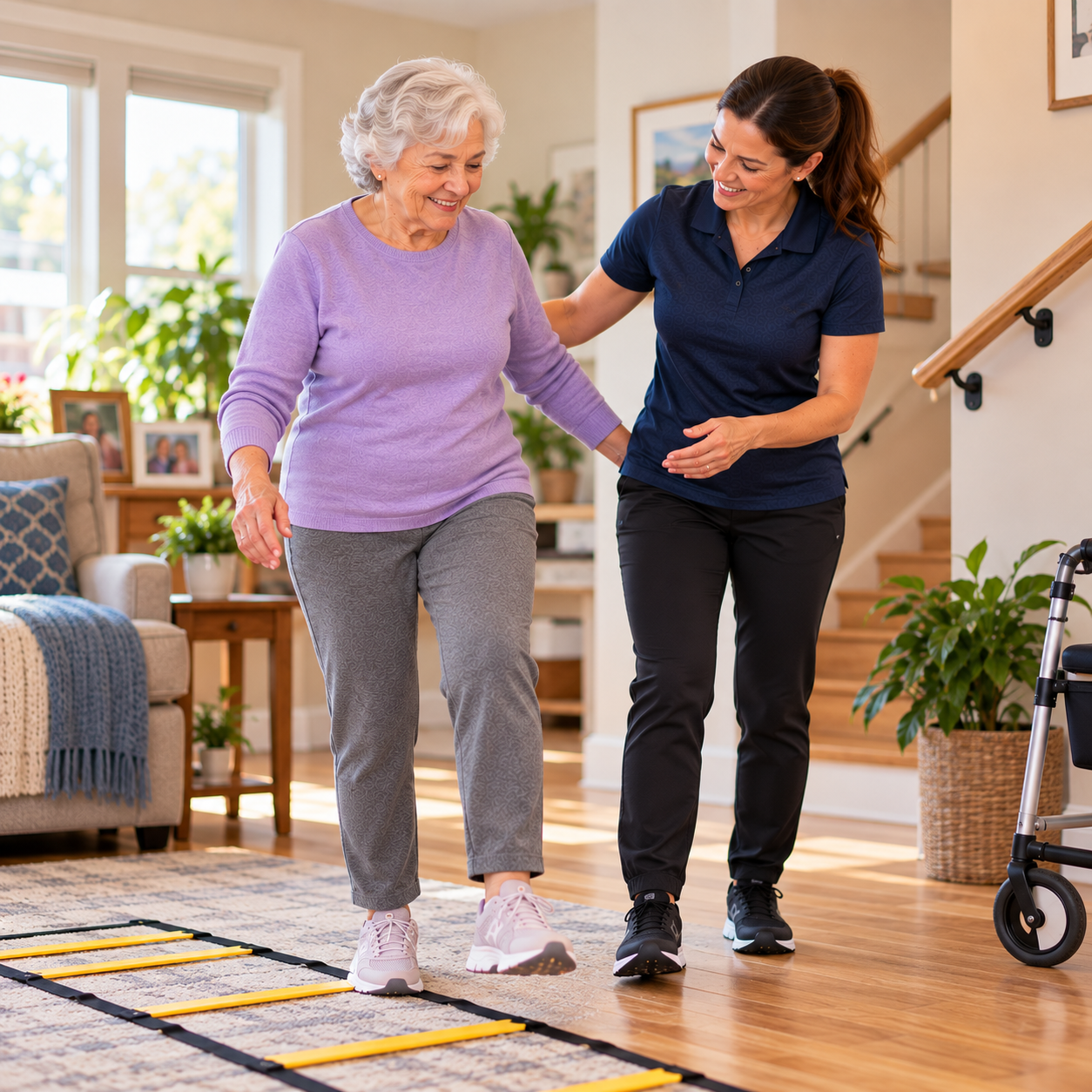
Step 4: Start a balance and strength program. This is a step families often skip. Progressive training means exercises that get a little harder over time as your parent gets stronger, so the body keeps improving. Doing these sessions at home works especially well when your parent is nervous about leaving the house, is recovering from surgery, or needs someone to supervise and keep them on track. A well-run in-home balance program starts with a check of how your parent moves and then progresses at a pace they can handle.
You can also read What Helps Older Adults Stay Safer and Steadier at Home for a closer look at fall-risk assessments, a safer home setup, and a short daily routine.
A Worked Example
Here is how that can look for one family (an illustrative example).
Margaret, 78, lives in Hamilton and is recovering from hip surgery. Her daughter notices that she's afraid to walk to the mailbox. Her doctor refers her to home care, and an OT visit adds a raised toilet seat and a second stair railing. The pharmacist finds that her sleep medication makes her groggy in the morning and works with her doctor to adjust it. Margaret then starts kinesiology sessions twice a week in her living room, with sit-to-stand practice, weight shifting, and short walks. A few weeks later, she walks to her mailbox on her own, with confidence.
Common Pitfalls
- Waiting until after a fall. Prevention works best when it starts early.
- Making home changes without adding exercise. Grab bars help, but they don't rebuild leg strength.
- Stopping exercise too early. Balance and strength fade again without regular practice.
- Using generic online workouts. These don't take surgery, dizziness, or a history of falls into account.
- Leaving your parent out of decisions. People stick with a plan they helped make.
Who can help aging parents avoid falls at home in Ontario?
In Ontario, public services and private support work side by side. The family doctor or nurse practitioner, a community pharmacist, and an optometrist cover the health checks. Ontario Health atHome arranges publicly funded care at home, and its occupational therapists and physiotherapists can assess the home, recommend equipment, and help with walking and mobility when your parent is eligible.
Ongoing balance and strength training is where a kinesiologist fits. We bring one-on-one sessions to homes in Hamilton, Dundas, Burlington, Toronto, Mississauga, and other communities across our service areas. Sessions are planned around what the rest of the team has found, so the exercise matches your parent's health, home, and goals.
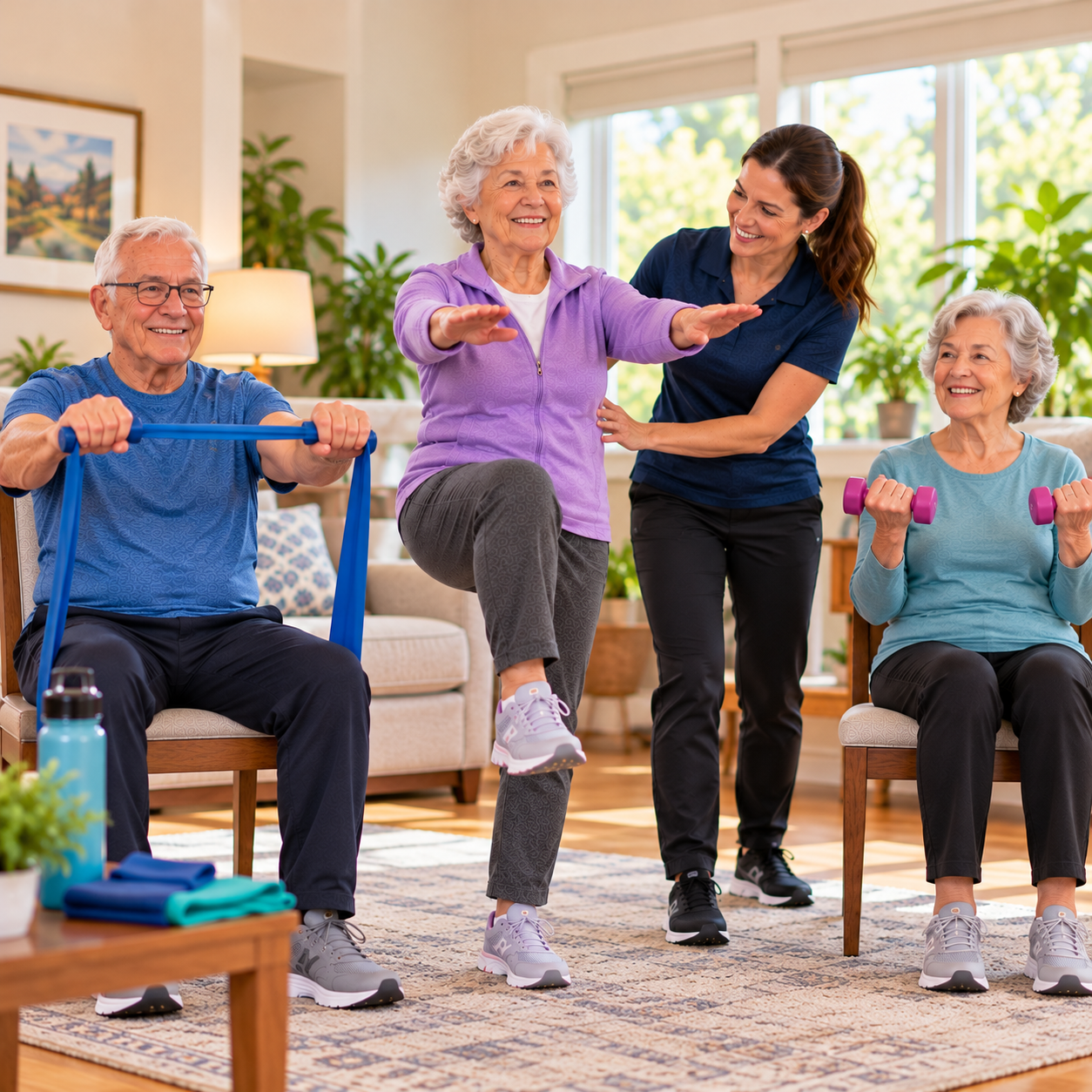
For groups, our Brain & Balance Training Workshops for Seniors bring fall prevention education to retirement residences, Legions, libraries, and community centres. Each one-hour session pairs 30 minutes of teaching with 30 minutes of interactive games and guided exercises, which can be a comfortable first step for a parent who is not ready for one-on-one training.
Where does in-home kinesiology fit?
Preventing falls works best as a team effort. Check health first, make the home safer, and then build strength and balance in the place your parent feels most comfortable, which is their own home. The Safe Living Guide from the Public Health Agency of Canada takes the same approach: adapt the home, stay active, and use supports when needed. For parents who need personalized balance work or strength training after surgery, our kinesiologists at HomeStretch bring that step-by-step program right to the living room.
Contact HomeStretch to book a free consult and talk through a plan for your parent.
Frequently Asked Questions
What expert support helps my parent avoid falls at home in Canada?
The team is the family doctor, pharmacist, optometrist, occupational therapist, physiotherapist, and kinesiologist. Each one covers a different part of fall risk, from medications and eyesight to home hazards and muscle strength.
Which in-home balance programs reduce fall risk?
Look for programs that offer balance and strength exercises that get harder over time, led by a kinesiologist or physiotherapist. Ontario Health atHome and local community programs are also good options.
How can my parent rebuild strength at home after surgery?
Follow the surgical team's instructions first. After that, work with a physiotherapist or kinesiologist on a gradual, supervised exercise plan at home, and support recovery with healthy eating that includes protein foods, as Canada's food guide recommends.
Does HomeStretch offer in-home fall prevention for aging parents in Ontario?
Yes. Our kinesiologists bring one-on-one balance and strength programs to homes across Ontario, including Hamilton, Dundas, Burlington, and Toronto. We also run fall prevention workshops for residences and community groups. Start with a free consult.
Author Bio - Melissa Gunstone, BSc, Kinesiologist
Melissa Gunstone is the founder of HomeStretch, a kinesiologist with years of experience supporting seniors across Canada. Her mission: to give older adults safe, effective, and individualized movement programs, from in-home training to community-based senior fitness classes and to build a nationwide movement that elevates the role of kinesiology in healthy aging.