November 12, 2026
On this page
⚡ Quick Answer
- Safe home exercises for seniors combine balance, strength, and gentle mobility work, such as heel-to-toe walking, chair stands, and seated stretches.
- Start with short sessions and build toward at least 150 minutes of activity a week, as Canada's guidance recommends.
- For Fall Prevention Month, pick one habit, practise the activities you want to keep doing, and walk like a penguin on icy days.
- Our kinesiologists visit homes in Caledonia and across Haldimand County. Start with a free intro call.
Safe home exercises for seniors can do much more than help older adults in Caledonia stay active.
They can protect independence and build confidence with everyday movement, from rising out of a chair to walking along the Grand River.
20 to 30 per cent of older adults fall each year, according to Parachute, and Canada's public health guidance reminds us that falls can be prevented.
For many older adults, the goal is simple: keep walking safely, get up from a chair more easily, and stay independent longer.
All of that is achievable without a gym, especially when routines focus on balance, strength, and gentle mobility.
HomeStretch brings fall prevention and balance programs to homes in Caledonia and across Haldimand County.
Why do safe home exercises matter for seniors in Caledonia?
A steady home routine helps with the movements you rely on every day: standing up, turning, climbing stairs, reaching, and walking on uneven surfaces. These are the real-life tasks that often become harder after illness, a period of inactivity, or a previous fall.
Canada's physical activity guidance recommends that older adults get at least 150 minutes of physical activity each week, along with muscle- and bone-strengthening activities and exercises that challenge balance. The same physical activity recommendations say that being active can help reduce the risk of falls and prolong good health and independence.
In Caledonia, that shows up in ordinary moments: the stroll from Kinsmen Park along the Grand River, a walk down Argyle Street past the old bowstring bridge, or stepping out of the car for an errand downtown.
What safe home exercises can seniors start with?
A safe home routine usually includes three categories: balance, strength, and flexibility. Together, they support steadier movement and better body control.
Balance exercises that build stability
Balance work helps the body react more quickly when footing changes. It also supports coordination and body awareness, which are key parts of fall prevention.
Good beginner options include standing with feet close together while holding a counter and gentle stepping drills. If balance feels uncertain, use a sturdy chair, wall, or kitchen counter for support.
Strength exercises for legs and hips
Stronger thighs, hips, and glutes make it easier to rise from a chair, climb stairs, and recover from a small loss of balance. Side and back leg lifts are useful additions, and they often appear in gentle at-home routines because they need no equipment.
Flexibility and mobility work that keeps movement comfortable
Mobility exercises do not have to be intense to be helpful. Gentle seated hamstring stretches, shoulder rolls, ankle circles, and hip openers can ease stiffness and help you move with better posture and less hesitation.
This matters because tight joints and stiff muscles can lead to awkward, rushed movements, especially when getting out of bed, reaching into cupboards, or turning in narrow spaces.
Four fall-prevention moves to practise at home
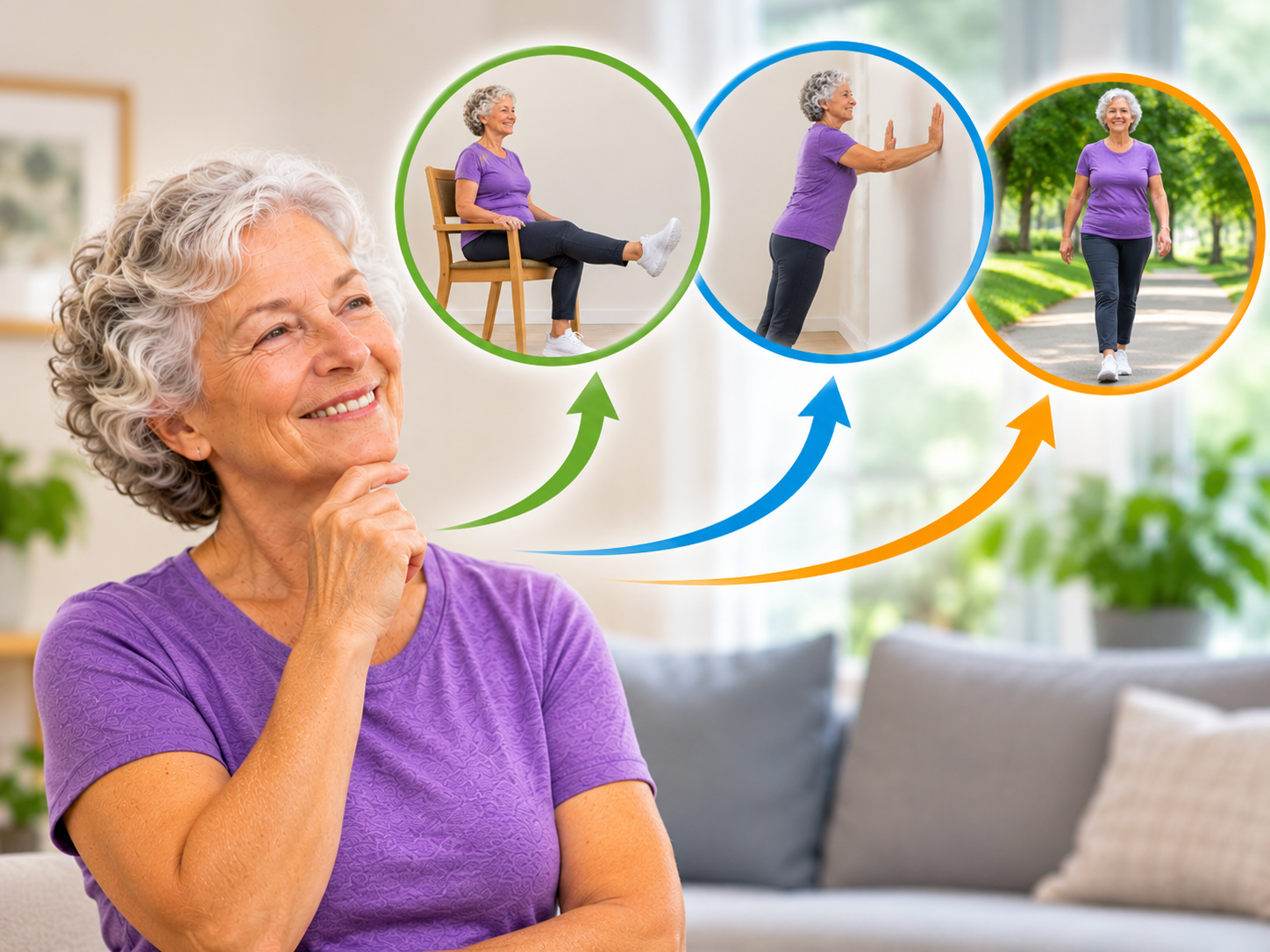
- Heel-to-toe walking: place one foot directly in front of the other, as if walking on a line, and keep one hand near a wall if needed. Start with 5 to 10 slow steps.
- Chair stands: sit near the front of a sturdy chair, place feet under the knees, and stand up without pulling on furniture if possible. Then sit down slowly.
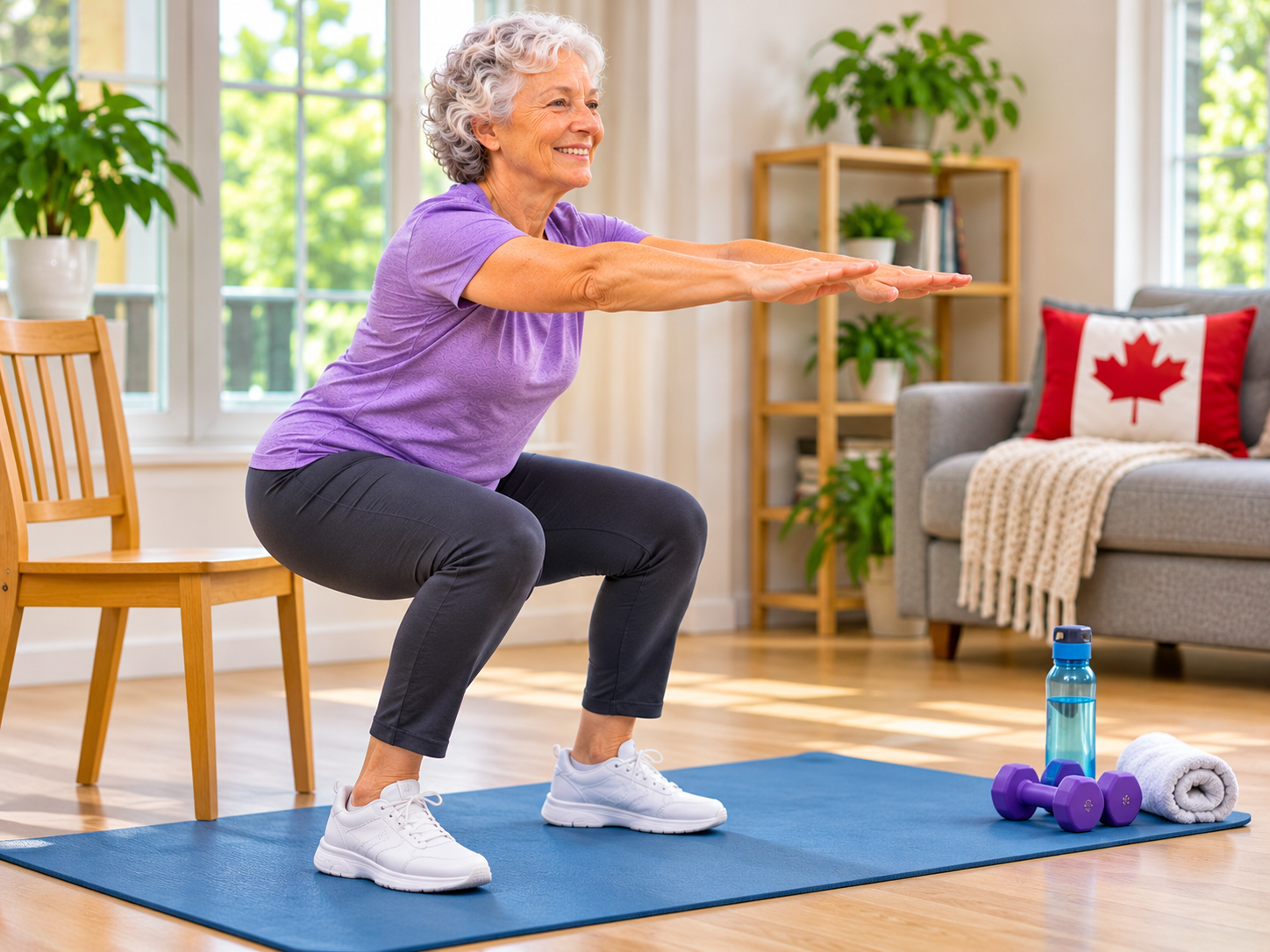
- Supported squats: holding a counter, bend the knees slightly into a shallow squat, then return to standing.
- Tai chi style balance work: shift slowly from one foot to the other. If you would like to try a class, the CYPRES 55+ program from Community Support Centre Haldimand-Norfolk lists tai chi among its activities.
How much home exercise do seniors need each week?
Many seniors do best with short, consistent sessions rather than long workouts. Starting small also limits soreness and builds confidence.
| Exercise focus | Good starting point | Why it helps |
|---|---|---|
| Balance | 10 minutes, 3 days a week | Supports steadiness and reaction time |
| Strength | 15 to 20 minutes, 2 to 3 days a week | Supports stairs, transfers, and walking |
| Flexibility | 5 to 10 minutes most days | Eases stiffness and supports posture |
| Walking or light activity | 10 to 30 minutes on most days | Builds endurance for daily life |
If that feels like too much at first, begin with 5 to 10 minutes and add time gradually.
How can Caledonia seniors build fall prevention into daily life?
Fall Prevention Month in Caledonia
November is Fall Prevention Month, a national campaign led by Parachute. It's a natural moment to choose one small change and stick with it:
- Pick one habit: choose a row from the table above and link it to something you already do, like your morning coffee.
- Check your footing: look over your winter boots for good grip, and salt or sand your walkway or ask someone to help.
- Plan your winter walks: the trail along the Grand River just downstream of Caledonia is open all year but isn't maintained in winter, so save it for clear days.
Share what you're doing with #FallPreventionMonthCA.
Four ideas our kinesiologists use
These are ideas Melissa Gunstone, our founder and kinesiologist, shares in one-on-one sessions:
- Train for what you want to keep doing: pair your exercises with the activities you care about. If shopping trips matter, practise getting in and out of the car. If gardening matters, practise getting down to the ground and rising safely from your knees.
- Treat a wobble as practice: Melissa likes to say that "every wobble is more data and information" for your brain. Feeling unsteady doesn't always mean a fall is coming. With something sturdy close by, those small corrections are how you practise reacting and catching yourself.
- Let confidence grow with strength: even the thought of falling can change what we believe our bodies can do. Sometimes it takes an extra set of eyes and ears, from someone who knows you're capable, to help you try again. Progress isn't always a straight line, and that's normal.
- Walk like a penguin on slippery days: if you do need to go out on an icy day, take small, slow steps. The Thunder Bay District Health Unit describes the same penguin walk: feet wide, knees bent, arms out for balance, shorter steps.
You can also read Afraid of Falling? How Seniors Can Improve Balance, Strength & Confidence at Home for more on rebuilding confidence.
Making the home exercise space safer
Exercise works best when the space is safe too. Clear loose cords and clutter from the floor, improve lighting in hallways and bathrooms, and wear shoes with non-slip soles instead of socks on smooth floors. If a cane or walker is already being used, it should be fitted and used correctly.
When does a personalized home exercise plan make sense?
A general routine is a good starting point, but it is not always enough. Seniors with arthritis, osteoporosis, dizziness, recent surgery, repeated falls, or pain during exercise often need more tailored guidance. In those cases, it helps to have a plan that matches current strength, mobility, and medical history.
That is where in-home kinesiology can help. A kinesiologist can watch how you move in your actual living space, adjust exercises to fit the home, and progress the routine gradually. HomeStretch offers personalized in-home exercise support built around safety and real-world function.
Our Fall Prevention and Balance Program in Caledonia
Our fall prevention and balance program has four parts, all delivered in your home:
- In-home fall-risk assessment: a walk through your rooms to spot hazards, with a checklist of practical changes.
- Home modification options: budget-friendly upgrades such as grab bars and anti-slip mats.
- Physical fall-risk assessment: a gentle look at posture, walking, stability, strength, and coordination.
- Customized exercise prescription: balance, coordination, and strength work matched to your comfort level and health conditions.
We visit homes in Caledonia and across Haldimand County, as well as nearby Hamilton. See all of our service areas.
How can Caledonia seniors keep moving safely at home?
A good home exercise plan is not the hardest one. It is the one you can do safely, regularly, and with confidence. A few well-chosen movements, practised week after week, can support leg strength, steadiness, and comfort with daily tasks. If you'd like a plan built for your home in Caledonia, book a free consultation with HomeStretch.
Frequently Asked Questions
How often should seniors exercise at home?
For many older adults, 3 to 5 days a week is a practical routine for maintaining strength and balance. The broader goal is at least 150 minutes of weekly activity, with balance and strengthening work included regularly. Short sessions still count.
Are there exercises seniors should avoid?
Yes. High-impact jumping, fast twisting, deep unsupported bending, and complicated movements with a high chance of losing balance are usually poor choices at home, especially without supervision. Choose low-impact, controlled moves matched to your current ability.
How can in-home kinesiology help?
In-home kinesiology adds assessment, progression, and safety monitoring. It can help seniors choose suitable exercises, use proper support, and build confidence step by step, especially after a fall or a long period of inactivity.
Does HomeStretch offer in-home exercise support in Caledonia?
Yes. Our kinesiologists visit homes in Caledonia and across Haldimand County for one-on-one exercise, balance training, and fall-risk assessments. A free intro call is a simple way to start.
Author Bio - Melissa Gunstone, BSc, Kinesiologist
Melissa Gunstone is the founder of HomeStretch, a kinesiologist with years of experience supporting seniors across Canada. Her mission: to give older adults safe, effective, and individualized movement programs, from in-home training to community-based senior fitness classes and to build a nationwide movement that elevates the role of kinesiology in healthy aging.