Dual-Task Exercises: Training Your Brain and Balance at the Same Time
July 21, 2026

On this page
⚡ Quick Answer
- Dual-task exercises combine a physical movement with a mental task, like walking while counting backwards.
- They train the brain and body to work together, improving coordination, reaction time, and confidence.
- Most older adults benefit from practicing 2 to 3 times per week.
- Simple examples include walking while naming categories, ball toss with counting, and alphabet walking.
Have you ever walked through the grocery store while looking for items on your shopping list, only to suddenly lose your balance when someone stepped into your path?
Or maybe you've found yourself talking with a friend while walking and instinctively slowed down because it became harder to do both at once.
These situations happen because your brain is performing more than one task simultaneously. Walking may feel automatic, but it actually requires your brain to continuously process information, maintain balance, react to obstacles, and coordinate movement.
As we age, this ability can become less efficient. Research has shown that performing two tasks simultaneously, known as dual-tasking, can affect walking speed, balance, and stability in older adults.
That's why many healthcare and movement professionals now include dual-task exercises as part of evidence-informed fall prevention and healthy aging programs.
Rather than training balance or memory separately, dual-task exercises combine physical movement with mental challenges.
This approach helps older adults strengthen the important connection between the brain and body, supporting greater confidence during everyday activities.
At HomeStretch Active Living, this concept forms an important part of our Brain & Balance Workshops, where older adults learn practical movement strategies that support independence and active living.
What Are Dual-Task Exercises?
Dual-task exercises involve performing a physical movement and a cognitive task at the same time.
Instead of simply walking across a room, you might:
Count backward by threes
Name animals alphabetically
Recall grocery items
Follow changing movement directions
Toss and catch a ball while walking
Although these activities may seem simple, they encourage your brain to process information while maintaining balance and coordinating movement.
This reflects everyday life much more accurately than practicing balance in isolation.
For example, people rarely:
Stand perfectly still without thinking
Walk without looking around
Climb stairs without talking
Carry groceries without planning their next step
Daily life constantly requires the brain and body to work together.
Why Dual-Task Training Matters
Balance is often thought of as a physical skill, but it is equally a neurological one.
Your brain is continuously receiving information from:
Your eyes
Your inner ear (vestibular system)
Your muscles and joints
Your feet
It must quickly organize all of this information before sending signals that allow your body to move safely.
When a second task is introduced, such as holding a conversation or making a decision the brain must divide its attention.
For many older adults, this divided attention can result in:
Slower walking speed
Shorter steps
Reduced stability
Delayed reactions
Increased hesitation
Practicing dual-task activities helps improve the brain's ability to manage these competing demands more efficiently.
The Science Behind Brain and Balance Training
Researchers have found that dual-task training can improve several areas that contribute to safe mobility.
Potential benefits include:
Better walking coordination
Improved balance confidence
Faster reaction time
Enhanced attention
Better executive function
Improved movement planning
Increased mobility during everyday activities
Rather than focusing solely on strengthening muscles, dual-task training develops the communication between the brain and body that supports confident movement.
This is one reason why dual-task training has become increasingly common in fall prevention programs and healthy aging initiatives.
Everyday Situations That Challenge Dual-Task Ability
Many people don't realize how often they perform dual tasks during the day.
Examples include:
| Everyday Activity | Brain Task |
|---|---|
| Walking while talking | Language processing |
| Carrying groceries | Weight management and navigation |
| Cooking dinner | Memory and sequencing |
| Crossing the street | Decision making and visual scanning |
| Climbing stairs | Attention and coordination |
| Shopping | Planning and problem solving |
| Walking the dog | Environmental awareness |
How Dual-Task Training Supports Healthy Aging
Healthy aging isn't only about maintaining muscle strength.
It's also about maintaining the ability to:
React quickly
Stay mentally engaged
Navigate changing environments
Adapt to distractions
Maintain confidence while moving
Dual-task exercises challenge these skills in a safe and structured way.
They encourage the brain to stay active while supporting functional movement patterns used throughout daily life.
This complements many of the ideas discussed in our blog, "Exercising the Aging Brain: How Movement Protects Memory, Balance, and Independence," which explores how regular movement supports lifelong brain health.
Common Signs You May Benefit From Dual-Task Training
Older adults may notice:
Slowing down when talking while walking
Feeling less confident in crowded environments
Difficulty multitasking while moving
Hesitating during direction changes
Losing focus while carrying objects
Feeling mentally tired during longer walks
These experiences are common and can often be addressed through appropriate exercise and practice.
8 Evidence-Based Dual-Task Exercises for Seniors
Dual-task exercises don't have to be complicated. The goal is to safely combine movement with a mental challenge, gradually increasing the difficulty as confidence improves. Always begin with an activity that matches your current ability and perform exercises in a safe environment.
1. Walk While Counting Backwards
This classic dual-task exercise combines walking with mental focus.
How to do it:
Walk at a comfortable pace.
Count backward from 100 by ones.
Progress to counting backward by twos or threes as you become more comfortable.
Benefits:
Improves divided attention
Enhances walking coordination
Builds concentration while moving
2. Name Categories While Walking
This exercise strengthens memory and verbal fluency while keeping your body moving.
Try naming:
Fruits
Animals
Canadian cities
Flowers
Sports
Movies
Challenge yourself to avoid repeating answers.
Benefits:
Supports memory recall
Encourages faster thinking
Improves cognitive flexibility
3. Walk and Carry a Lightweight Object
Daily life often requires carrying groceries, laundry, or household items while walking.
Practice by carrying:
A small ball
A lightweight basket
A water bottle
Focus on maintaining good posture and steady walking.
Benefits:
Improves coordination
Simulates everyday activities
Supports functional mobility
4. Follow Direction Changes
Have a partner call out simple instructions such as:
Turn left
Turn right
Stop
Walk backward a few safe steps
Step sideways
The brain must process the command while maintaining balance.
Benefits:
Improves reaction time
Builds body awareness
Encourages quicker decision-making
5. Ball Toss While Standing
Stand near a sturdy chair or countertop and gently toss a soft ball from one hand to the other.
Progressions include:
Tossing slightly higher
Saying every second letter of the alphabet
Counting backward while tossing
Benefits:
Hand-eye coordination
Visual tracking
Cognitive processing
6. Obstacle Navigation with Conversation
Set up simple household obstacles using cones, pillows, or water bottles.
Walk around them while:
Answering questions
Talking about your day
Remembering a shopping list
This closely mirrors real-life situations where distractions are common.
Benefits
Environmental awareness
Planning movements
Improved confidence
7. Step Patterns with Memory
Create a simple stepping pattern.
Example: Forward → Side → Back → Side
Repeat while remembering:
Three grocery items
Family birthdays
Phone numbers
Months of the year
This strengthens both motor planning and working memory.
8. Alphabet Walking
Walk slowly while saying one letter of the alphabet for every step.
Once comfortable, make it harder by naming:
Foods beginning with each letter
Countries
Occupations
Birds
Musical instruments
This exercise combines rhythm, movement, language, and executive function.
Safety Tips Before Starting
Although dual-task exercises are beneficial, safety should always come first.
Consider these guidelines:
Wear supportive footwear.
Exercise in a clutter-free area.
Keep a sturdy chair or countertop nearby.
Begin with easy cognitive tasks before progressing.
Stop if you feel dizzy, fatigued, or unsteady.
Practice with supervision if balance is a concern.
Remember, the goal isn't speed. It's maintaining quality movement while gently challenging your brain.
How Often Should Seniors Practice Dual-Task Exercises?
Most older adults benefit from practicing dual-task activities 2–3 times per week, alongside regular strength, flexibility, and balance exercises.
Sessions don't need to be long. Even 10–20 minutes of focused practice can help reinforce the connection between thinking and moving.
Consistency is far more important than intensity.
Why Group Brain & Balance Programs Make a Difference
While these exercises can be practiced at home, many older adults enjoy learning them in a supportive group setting.
Participating in structured classes offers several advantages:
Guidance from trained movement professionals
Progressive exercise challenges
Social interaction and encouragement
Safe practice environments
Opportunities to build confidence alongside peers
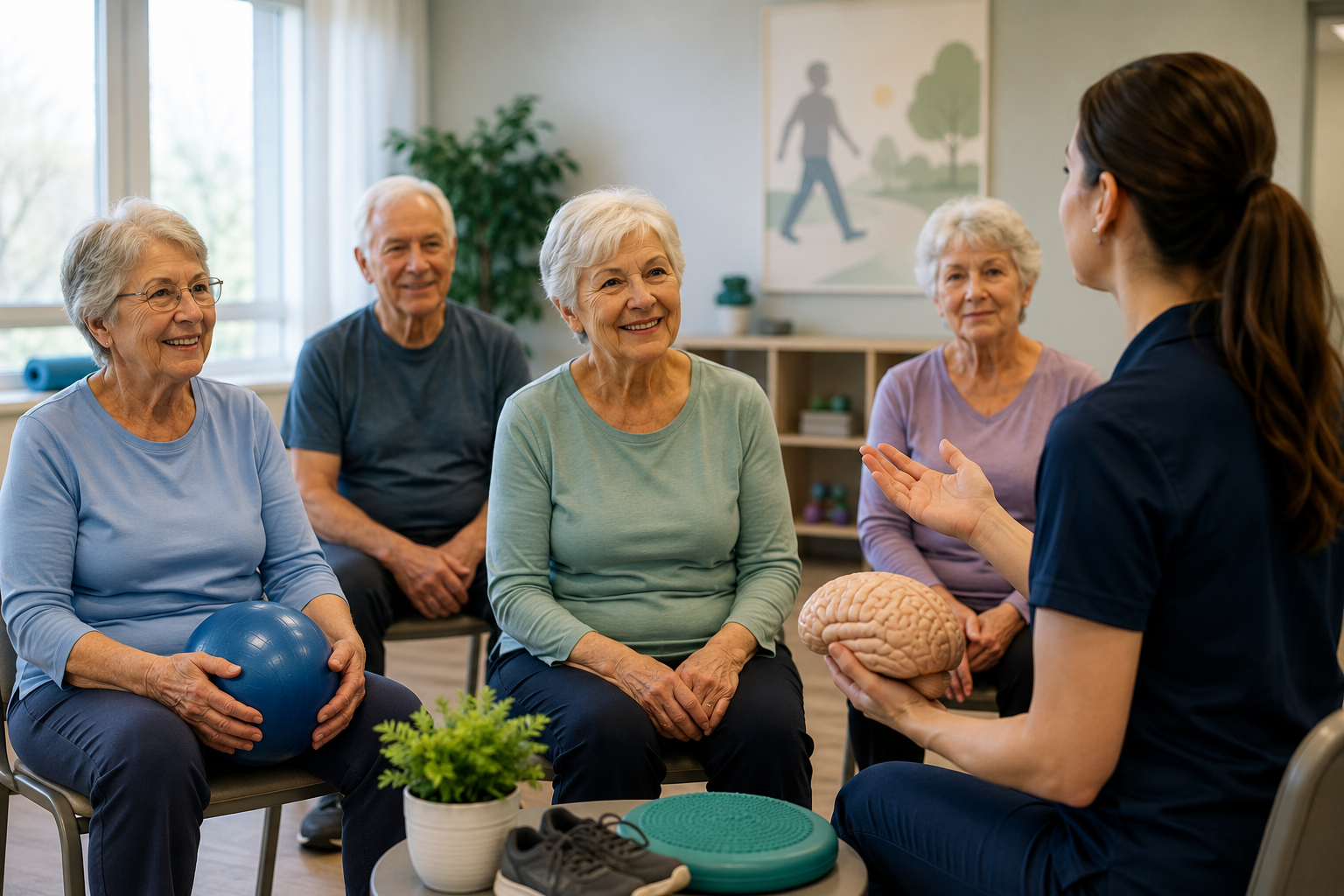
At HomeStretch Active Living, our Brain & Balance Workshops combine movement, education, and engaging activities designed specifically for older adults. Participants practice evidence-informed exercises that support strength, mobility, coordination, and confidence while enjoying the motivation that comes from learning together.
Learn more about our Brain & Balance Workshops here: https://www.homestretch4seniors.ca/programs/forseniors/community
Bringing Brain & Balance Workshops to Your Community
HomeStretch Active Living partners with retirement communities, senior centres, community organizations, and local groups to deliver engaging Brain & Balance Workshops across Ontario.
Each workshop is designed to help older adults:
Improve balance confidence
Stay physically active
Challenge their minds through movement
Learn practical strategies for healthy aging
Build meaningful social connections
If your retirement residence, seniors' centre, or community organization is looking for an engaging wellness program, our team would be happy to help. Find a HomeStretch team serving near your area.
Staying steady isn't just about stronger legs, it's about strengthening the connection between your brain and body. Every time you walk while talking, carry groceries through your home, or navigate a busy community centre, your brain is coordinating countless decisions that help you move safely and confidently.
Dual-task exercises offer a practical way to challenge both the mind and body at the same time, making exercise more relevant to the situations older adults face every day. Whether you're looking to improve confidence, stay active, or support healthy aging, incorporating these activities into your weekly routine can be an enjoyable step toward maintaining independence.
If you'd like guided instruction in a welcoming group environment, HomeStretch Active Living's Brain & Balance Workshops provide engaging, evidence-informed activities designed specifically for older adults. Our team is passionate about helping seniors stay strong, stay steady, and continue enjoying the activities they love.
Frequently Asked Questions
-
Dual-task exercises combine a physical movement with a mental activity, such as walking while counting backwards or balancing while naming animals. They help strengthen the connection between thinking and moving.
-
Many daily activities require older adults to move while paying attention to other tasks. Practicing dual-task exercises helps improve coordination, attention, and confidence during these real-world situations.
-
Most older adults can benefit from practicing brain and balance exercises two to three times each week, depending on their individual abilities and guidance from a qualified exercise professional.
-
When performed at an appropriate level and in a safe environment, dual-task exercises are generally suitable for many older adults. Individuals with significant balance concerns should consult their healthcare provider or work with a qualified movement professional before beginning a new exercise program.
Related Posts
Spring Safety Tips for Seniors Safe Outdoor Activities and Fall Prevention
Spring Gardening for Seniors: Stay Active, Safe, and Prevent Falls
Exercises for Seniors: Routines to Improve Balance, Strength, and Mobility
Author Bio - Melissa Gunstone, BSc, Kinesiologist
Melissa Gunstone is the founder of HomeStretch, a kinesiologist with years of experience supporting seniors across Canada. Her mission: to give older adults safe, effective, and individualized movement programs, from in-home training to community-based senior fitness classes and to build a nationwide movement that elevates the role of kinesiology in healthy aging.