November 23, 2026
On this page
⚡ Quick Answer
- Start with what your parent wants to keep doing, then link each exercise to that goal.
- Let your parent choose the time, the pace and the number of repetitions, and celebrate small wins.
- Simple moves at a sturdy chair or counter, like sit-to-stands and calf raises, build strength and balance.
- Stop for dizziness, pain or shortness of breath, and check with their doctor before starting something new.
Your parent wants to keep living at home, making their own coffee, tending their garden, and getting around on their own terms.
But if they've had a near-miss on the stairs, or simply feel less steady than they used to, being told to "just exercise more" can sound risky.
If you're wondering how to motivate an aging parent to exercise safely at home in Guelph, the answer starts with what they want to keep doing, not with a workout.
In the National Institute on Ageing's 2025 Ageing in Canada Survey, published in January 2026, 81% of Canadians aged 50 and older said they want to age at home, and regular, gentle movement is one of the most useful ways to support that goal.
The good news is that falls aren't an unavoidable part of aging. Gentle, regular movement builds the strength and balance your parent needs for everyday tasks like climbing stairs or getting out of a chair, and encouragement from family and guidance from a kinesiologist can make that movement safer, more enjoyable, and much easier to keep up.
HomeStretch kinesiologists bring in-home personal training to older adults in Guelph and across Ontario, built around each person's own goals.
How Do You Motivate an Aging Parent to Exercise Safely at Home?
Start With What Matters to Your Parent
Many people don't stick with exercise just because it's good for them. They stick with it because it protects something they care about. Ask your parent what they want to keep doing. Maybe it's kneeling in the garden, walking to the mailbox, or getting down on the floor to play with the grandchildren. Once you know the goal, every exercise has a clear purpose. Sit-to-stands become practice for getting out of the car at their daughter's house, and calf raises help them reach the top shelf without wobbling.
Let your parent set the pace. They should choose the time of day, the music, and how many repetitions feel right. Many older adults find a routine easier to keep when they feel in charge of it, and it's normal for fear to be part of the picture. Families who learn how to ease exercise anxiety often find that patience helps more than pushing. Celebrate small wins too. Five steady sit-to-stands this week, when three felt hard last week, is real progress.
Next, make the space safe. Clear clutter and loose rugs from the area, turn on good lighting, and keep a sturdy chair or kitchen counter within reach. Remind your parent to rise slowly from a chair or bed so they don't get lightheaded. Ontario Health's 2026 guide to preventing falls recommends exercise that combines strength and balance work as a key way for older adults to lower their risk of falling.
When Your Parent Says No
Resistance is common, and it usually has a reason behind it. Listening for that reason works better than repeating the request. Here are four things parents often say, and a gentle way to respond to each.
- "I'm too old for this." Agree that it isn't about workouts. It's about keeping the things they already do, like getting up from the couch or carrying the laundry. Many of the moves below start beside a chair or counter, so they can match almost any starting point.
- "I'm afraid I'll fall." Take the worry seriously. Start with supported moves at the kitchen counter, and offer to stay in the room for the first few sessions so they never practise alone until they feel ready.
- "I'm too tired today." Shrink the ask. Two minutes of calf raises while the kettle boils still counts, and a short session on a low-energy day keeps the habit alive.
- "I don't want you fussing over me." Hand back control. Ask how they would like you to help, if at all, and then let them lead. Some parents prefer to hear exercise advice from someone outside the family.
If the answer is still no, let it rest for a week and come back with a different goal. Pressure tends to make resistance stronger, while patience leaves the door open.
You can also read Unlocking Motivation for Success: Your Best Health at Home for goal-setting ideas your parent can use on their own.
Simple Fall-Prevention Exercises to Try
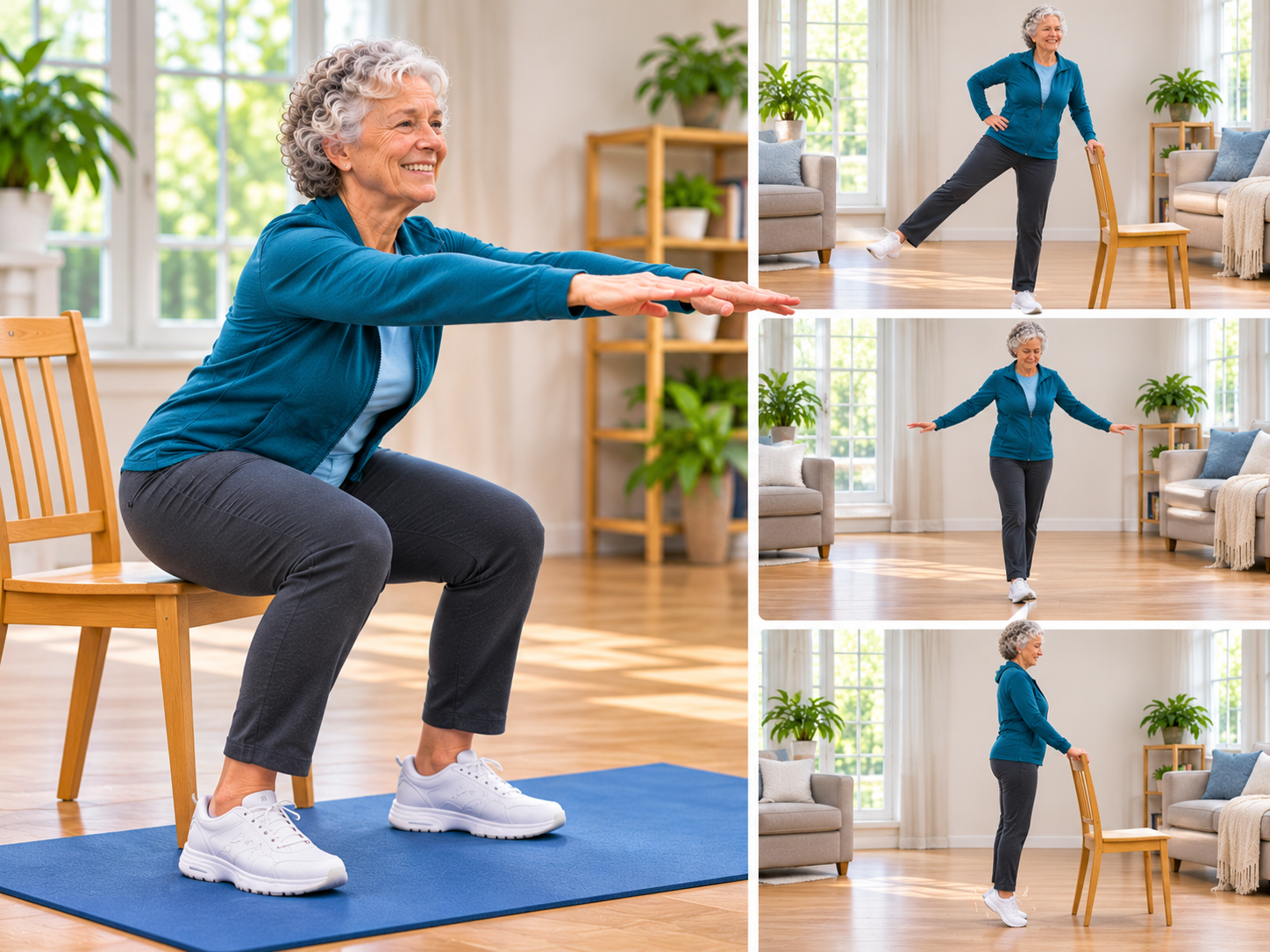
These moves need nothing more than a stable chair or counter. The World Guidelines for Falls Prevention, published in 2022, recommend balance and functional exercise at least three times a week for 12 weeks or more, so a short routine your parent can repeat is a good place to begin.
| Exercise | How to Do It | Everyday Benefit |
|---|---|---|
| Sit-to-stand | Rise from a firm chair, then sit back down slowly, using hands only if needed | Getting out of chairs, cars, and bed |
| Heel-to-toe walking | Walk along a counter, placing one heel directly in front of the other toes | Steadier steps in hallways and on uneven ground |
| Side leg raises | Hold the chair back and lift one leg out to the side, then lower it | Hip strength for side-stepping and stability |
| Calf raises | Hold the counter and rise onto your toes, then lower slowly | Reaching shelves and climbing stairs |
| Supported single-leg stand | Hold the chair and lift one foot for 5 to 10 seconds | Stepping into the tub or over a threshold |
Short sessions are a fine place to start, and several brief sessions spread over the day can add up. Have your parent stop if they feel dizzy, short of breath, or in pain, and ask them to check with their doctor before starting anything new. Acclaim Health's Home Support Exercise Program describes a simple, progressive routine that older adults in Ontario follow at home, and it gives more ideas for supporting a loved one.
What Does a Simple First Week Look Like?
A plan for the first seven days takes the guesswork out of getting started. Keep it light, and let your parent change any step.
- Day 1: Ask, don't assign. Over coffee, ask what your parent wants to keep doing this winter. Write the goal down in their own words.
- Day 2: Set up the space together. Pick a clear patch of floor with good light, a sturdy chair without wheels, and the kitchen counter close by.
- Day 3: Try two moves. Start with sit-to-stands and calf raises, a few repetitions each. Your parent decides when to stop.
- Days 4 to 6: Attach it to a habit. Link the routine to something that already happens every day, such as after breakfast or during the evening news.
- Day 7: Look back and adjust. Ask what felt good and what felt hard. Keep the routine, add one repetition, or swap in a new move. If anything caused pain or dizziness, check with their doctor before continuing.
Guelph winters can make outdoor walks harder to keep up, which is one more reason to set up an indoor routine now, before the snow settles in.
How Can a HomeStretch Kinesiologist Help?
One-on-One Kinesiology in Your Parent's Home
Generic videos can't see whether your parent's knees cave in during a sit-to-stand, and a busy gym can feel intimidating. Our Canadian kinesiologists come to your parent's home and assess their balance, strength, and fall risk in the place where they actually live. From there, we build a plan around your parent's own goals and update it as they get stronger.
Every visit includes safety checks, hands-on coaching, and friendly accountability. When someone is expecting you on Tuesday morning, it's a lot harder to skip the exercises. Over time, that steady routine builds confidence, which may be the most important result of all.
Group Programs for Care Homes
We also run on-site balance, mobility, and fall-prevention classes in retirement residences and long-term care homes. A kinesiologist leads each class and adapts it for every ability level, so residents using walkers can exercise next to residents who still golf. Group sessions also bring people together, and that social connection gives residents another reason to keep showing up. Learn more about our community and residence programs.
How Can You Help Your Parent Move With Confidence?
Your parent is more likely to stay motivated when exercise feels safe, fits their abilities, and connects to the life they want to keep living. You can help by listening, cheering them on, and setting up a safe space. A kinesiologist can add the expertise to make each step count.
Book a free intro call with a HomeStretch kinesiologist to get your parent started at home, or ask us about group programs for their care home. We support families in Guelph and across Ontario, from Hamilton to the Kitchener-Waterloo region. See all of our service areas.
Frequently Asked Questions
What expert support helps prevent falls at home in Canada?
Kinesiologists and physiotherapists can assess fall risk and design safe, personal exercise plans. Our kinesiologists provide this one-on-one support in your parent's own home and adjust the program as they progress. It's also a good idea to talk with your parent's doctor before starting a new routine.
Who runs balance programs in Canadian care homes?
Our kinesiologists lead balance and mobility classes on site in retirement residences and long-term care homes. Each class is adapted to the residents' abilities.
What are the best fall-prevention exercises for older adults?
Sit-to-stand, heel-to-toe walking, calf raises, side leg raises, and supported single-leg stands all build strength and balance. Your parent should always do them with a sturdy chair or counter nearby for support.
What if my parent refuses to exercise?
Ask what they want to keep doing, then offer one small, supported move tied to that goal. Respect a "not today" and try again later. Some parents find it easier to take advice from a kinesiologist than from family.
Author Bio - Melissa Gunstone, BSc, Kinesiologist
Melissa Gunstone is the founder of HomeStretch, a kinesiologist with years of experience supporting seniors across Canada. Her mission: to give older adults safe, effective, and individualized movement programs, from in-home training to community-based senior fitness classes and to build a nationwide movement that elevates the role of kinesiology in healthy aging.