What You Really Get with an In-Home Personal Trainer for Seniors
January 05, 2026

Why “Exercise at Home” Isn’t the Whole Story
When most seniors hear “in-home personal training,” they picture someone showing up with a few exercises and maybe counting reps.
But that’s not what we do at HomeStretch.
After working with hundreds of older adults across Canada, I’ve learned something important.
Most seniors don’t fail at exercise, they’re failed by the system meant to support them. They’re given generic programs, rushed appointments, or advice that doesn’t consider how aging bodies actually work.
I hear the same thing from seniors in Toronto, Vancouver, the Niagara region, and beyond:
“I’ve tried physio.”
“I’ve done classes.”
“I still don’t feel steady.”
“I’m afraid of falling.”
The missing piece is not more effort. It’s the right kind of support, delivered the right way, by the right professional.
That’s where kinesiology comes in.
This article explains what you really get when you work with an in-home personal trainer who is also a registered kinesiologist, and why that distinction makes all the difference for senior strength, balance, confidence, and long-term independence.
Not All “Trainers” Are the Same
One of the biggest sources of confusion I see is this:
People assume all movement professionals do roughly the same thing.
They don’t.
A kinesiologist is trained in:
Human movement science
Anatomy and biomechanics
Aging physiology
Injury history and chronic conditions
Balance systems and fall risk
Exercise prescription and progression
Behaviour change and habit formation
This matters, especially for seniors.
When you work with a kinesiologist, you’re not just getting exercise.
You’re getting clinical reasoning applied to real life.
What Actually Happens When a Kinesiologist Comes to Your Home
Let’s walk through what you can truly expect.
A Real Assessment, Not a Guess
The first visit is not about jumping into workouts.
It’s about understanding you.
A kinesiologist looks at:
How you move through your home
How you stand up, walk, turn, and sit down
Your balance reactions
Strength asymmetries
Joint limitations
Pain patterns (and where pain is not the real problem)
Past injuries, surgeries, and falls
What feels unsafe or scary
This is often the first time a senior feels fully seen and listened to in their movement care.
Why Assessment Is the Differentiator
One of the biggest problems in senior fitness is skipping assessment.
Without assessment:
Exercises are generic
Progressions are unclear
Pain is misunderstood
Confidence doesn’t improve
Falls still happen
With assessment:
Exercises are targeted
Load and challenge are appropriate
Progress is measurable
Safety improves
Confidence builds
We treat exercise prescription the way a doctor treats medication: right dose, right timing, right progression.
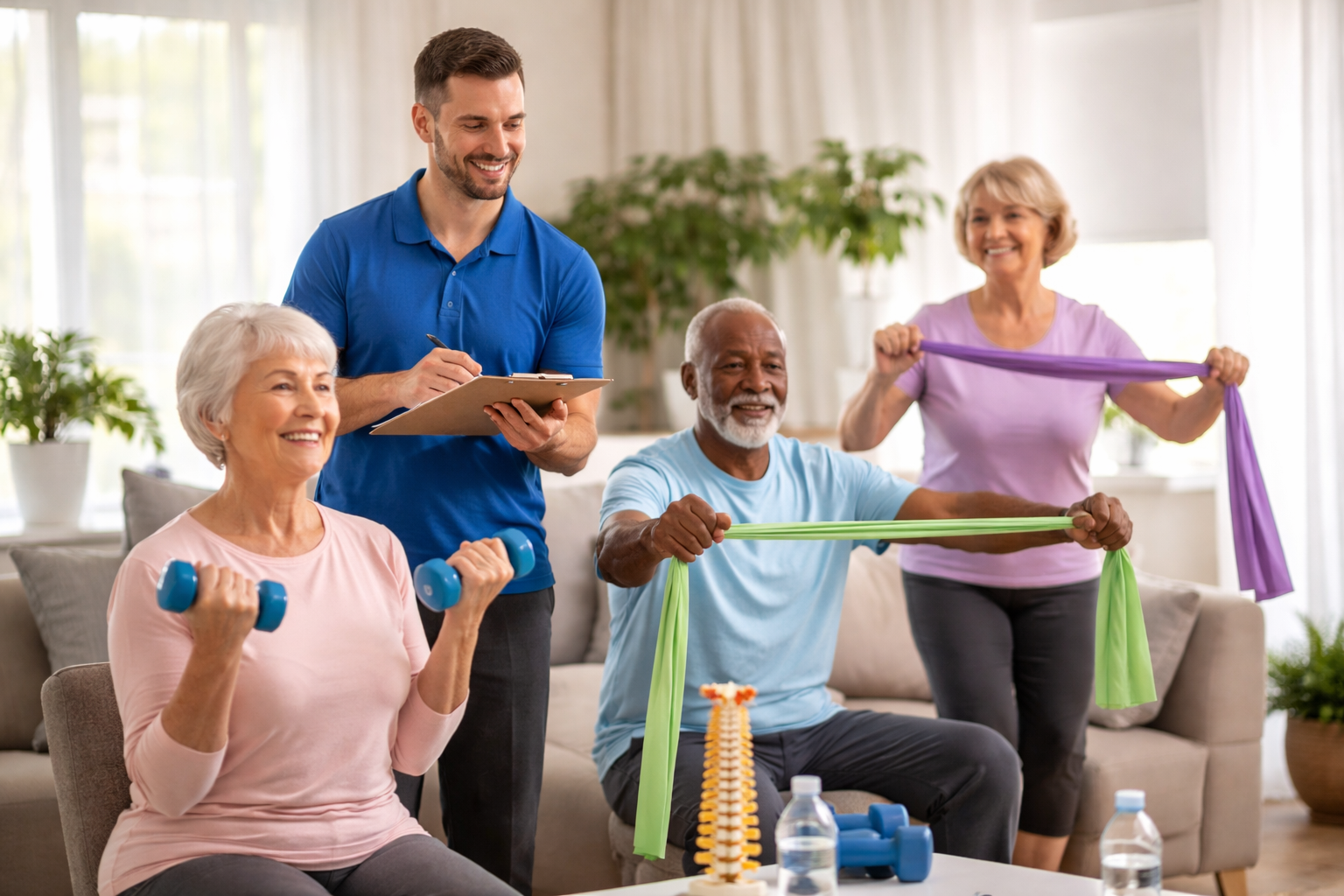
In-Home Training Changes Everything
Why does home matter so much?
This is where falls happen.
This is where habits form best.
This is where confidence is either built or lost.
In-home personal training allows a kinesiologist to:
See environmental risks
Train transfers (bed, chair, toilet)
Practice stairs and thresholds
Address real daily movements
Reduce fear in familiar spaces
This is not something a gym or clinic can replicate.
You’re Not Just Given Exercises, You’re Given Understanding
One of the most overlooked benefits of kinesiology is education.
Seniors are taught:
Why they’re doing each movement
How it connects to balance and fall prevention
What good effort feels like vs. unsafe effort
How to adjust exercises on low-energy days
How to practice safely between sessions
This knowledge creates ownership, not dependence and ownership is how healthy habits actually stick.
Why Seniors Feel More Confident Working with a Kinesiologist
Confidence doesn’t come from pushing harder.
It comes from feeling capable.
Our In-Home kinesiologist:
Meets seniors where they are
Progresses at the right pace
Adjusts for arthritis, joint replacements, dizziness, fear
Respects bad days and celebrates small wins
This is especially important for seniors who’ve had negative experiences with gyms, physio, or “one-size-fits-all” classes.
What Makes HomeStretch Different
HomeStretch wasn’t built to be another fitness service. It was built to solve a gap.
For Seniors
Proactive care, not reactive rehab
Fall prevention before the fall
Strength and balance that translate to daily life
Care delivered with dignity, patience, and expertise
For Kinesiologists
A platform to practice fully and ethically
Recognition for their expertise
Support, structure, and professional identity
A role in reshaping how senior care is delivered in Canada
I believe deeply that kinesiologists are underutilized and that seniors are paying the price for it.
This Is Bigger Than Individual Sessions
At HomeStretch, we’re building something long-term.
A movement that:
Reduces preventable falls
Keeps seniors independent longer
Lowers ER visits and healthcare strain
Elevates kinesiology as a core pillar of aging care
Brings movement back to being safe, empowering, and human
This is not about “getting fit.” It’s about staying independent.
Who In-Home Kinesiology Is (and Isn’t) For
This model is for:
Seniors who feel unsteady
People recovering from injury or surgery
Those who fear falling
Adults who want personalized, respectful support
Families who want proactive care for parents
It’s not for:
People looking for high-intensity workouts
Anyone wanting a quick fix
Those who don’t want guidance or progression
And that’s okay.
What Most Seniors Say After Starting
I hear variations of this all the time:
“I wish I’d started sooner.”
“I didn’t know this kind of help existed.”
“I finally understand what my body needs.”
“I feel safer moving around my home.”
That’s the difference.
Start with a Conversation
If you’re a senior, or supporting one, and wondering whether this kind of support is right, the next step is simple.
Have a conversation.
We don’t rush people into programs.
We talk, assess, explain, and support.
Sometimes the biggest step toward independence isn’t exercise but it’s clarity.
Frequently Asked Questions
-
Yes, when led by a kinesiologist. Programs are built around safety first, using support surfaces, gradual progressions, and real-world movements. This approach reduces fall risk while improving confidence and stability over time.
-
In-home training targets the real causes of falls: weak leg strength, poor balance reactions, reduced mobility, and unsafe movement habits. Sessions focus on functional tasks like standing up, walking, turning, and navigating home obstacles, not just isolated exercises.
-
Physiotherapy and kinesiology serve different roles. Physio often addresses acute injury or post-surgical recovery, while kinesiology supports long-term strength, balance, and independence after discharge. Many seniors transition to kinesiology once physio ends.
-
Most seniors benefit from 2–3 structured sessions per week, combined with simple daily movement. Frequency is adjusted based on health conditions, fatigue, and recovery needs.
Related Posts
Practical Planning for Active, Independent Seniors in Southern Ontario
Senior Nutrition & Healthy Meals: Key Vitamins and Practical Tips for Seniors
Personalized Care for Safer Movement, Recovery, & Independence
Author Bio - Melissa Gunstone, BSc, Kinesiologist
Melissa Gunstone is the founder of HomeStretch, a kinesiologist with years of experience supporting seniors across Canada. Her mission: to give older adults safe, effective, and individualized movement programs, from in-home training to community-based senior fitness classes and to build a nationwide movement that elevates the role of kinesiology in healthy aging.
The 3 Biggest Barriers to Aging in Place - Niagara - St. Catharines, Hamilton, Dundas, Burlington, Toronto - Fall Prevention | Strength & Mobility | Caregiver Resources