Understanding Fall Risk Assessments for Seniors: Tools, Causes, and Practical Prevention
November 28, 2025
On this page
⚡ Quick Answer
- Fall risk assessments combine movement tests, health history, and a home safety review to identify what's raising risk.
- The Timed Up-and-Go (TUG) and 30-Second Chair Stand reliably flag balance, strength, and mobility changes.
- Effective fall prevention blends targeted exercise, home modifications, medication review, and regular reassessment.
- Any fall in the past 12 months, new unsteadiness, or sudden loss of confidence are red flags for a professional assessment.
Learn how simple tests, home walk-throughs, and a tailored movement plan can lower fall risk and help older adults stay independent at home.
Falls are one of the most common and most serious health threats for older adults but they’re not random accidents.
Behind most falls is a mix of personal changes (like weaker legs or dizziness) and environmental hazards (like poor lighting or loose rugs).
A fall risk assessment is a straightforward process that looks at both: it identifies what is raising someone’s risk and outlines specific steps to reduce it.
When families understand how assessments work and which tests truly matter, they can better protect a loved one’s mobility, confidence, and independence at home.
This guide explains:
The difference between intrinsic (health-related) and extrinsic (environmental) risk factors
Commonly used tools like the Timed Up-and-Go (TUG) and 30-Second Chair Stand
How in-home assessments turn test results into a personalized movement plan
Practical exercise ideas and home changes that reduce falls
When to seek professional help and how often to reassess
Quick Takeaways
Fall risk assessments combine simple movement tests, health history, and a home safety review.
Tools like the TUG and 30-Second Chair Stand reliably flag changes in balance, strength, and mobility.
The most effective fall prevention programs for seniors blend exercise, home modifications, medication/vision review, and regular reassessment.
What Is a Fall Risk Assessment for Seniors?
A fall risk assessment is a structured way to identify what might cause a senior to fall—and what can be done about it. It typically includes:
A review of health history (falls, dizziness, chronic conditions, medications)
Simple movement tests that measure balance, walking, and leg strength
A look at the home environment for hazards
Clear recommendations for exercise, home changes, and follow-up
For families and caregivers in Southern Ontario, understanding this process helps you move from worrying about “what if” to having a concrete plan to improve safety and independence at home.
Intrinsic vs. Extrinsic Fall Risk Factors
Intrinsic (Health-Related) Factors
Intrinsic risk factors are changes inside the body that make falls more likely, including:
Poor balance and gait changes – harder to recover from trips or slips
Weaker leg and hip muscles – difficulty standing up, climbing stairs, or getting out of a chair
Vision loss or peripheral neuropathy – harder to judge distances or feel the ground underfoot
Cognitive changes – reduced hazard recognition, difficulty multitasking while walking
Medication side effects – dizziness, drowsiness, or blood pressure drops (especially with sedatives, certain blood pressure medications, or multiple prescriptions together)
Because medications can strongly influence balance, a medication review is often a routine part of fall risk assessment and prevention planning.
Environmental (Extrinsic) Factors
Extrinsic risk factors are hazards in the environment that interact with personal vulnerabilities:
Loose rugs and cluttered walkways
Poor lighting in hallways, entrances, and stairways
Uneven flooring or outside surfaces (cracked sidewalks, icy steps, wet leaves)
Low contrast on steps and missing or weak handrails
Unsupportive footwear or poorly fitted walking aids
Small changes removing rugs, clearing pathways, improving lighting, adding non-slip mats, and choosing supportive shoes, can deliver quick safety gains.
Learn practical, step-by-step strategies for rising from the floor confidently and safely in our related guide
The Most Effective Fall Risk Assessment Tools for Seniors
A strong fall risk assessment blends validated tests with a clear picture of someone’s health and home environment. Common tools include:
Timed Up-and-Go (TUG)
30-Second Chair Stand
Berg Balance Scale
Hendrich II Fall Risk Model
CDC STEADI framework
Together, they help identify who is at higher risk, where the biggest issues lie, and how to measure improvement over time.
Timed Up-and-Go (TUG): A Simple, Powerful Screen
The Timed Up-and-Go (TUG) measures functional mobility by timing how long it takes someone to:
Stand up from a standard chair
Walk three metres
Turn around
Walk back
Sit down again
Longer times suggest higher fall risk. A commonly used benchmark is over 13.5 seconds, which often indicates elevated community fall risk (though cut-offs can vary by age and health condition).
How to perform the TUG (step-by-step)
Setup – Place a standard chair with armrests on level flooring. Mark a line three metres away.
Instruction – Ask the person to stand up, walk at a comfortable, safe speed to the marker, turn, walk back, and sit down.
Timing – Start timing when they begin to rise; stop when they are seated again. Record time in seconds.
Interpretation – Compare to age- and condition-specific norms. Slower times indicate a need for further assessment and targeted intervention.
Quick takeaway: The TUG is fast, requires minimal equipment, and directly tests everyday tasks like standing and walking making it an excellent first-line screen.
Other Commonly Used Assessment Tools
Several tools can be added to the TUG for a more complete picture:
| Assessment Tool | What It Measures | Typical Interpretation / Risk Cue |
|---|---|---|
| Timed Up-and-Go (TUG) | Functional mobility, gait speed, transfers | >13.5 seconds often indicates elevated community fall risk |
| 30-Second Chair Stand | Lower-limb strength and endurance | Low repetitions vs. age/sex norms suggest muscle weakness |
| Berg Balance Scale | Static and dynamic balance across many tasks | Low total scores show significant balance impairment and fall risk |
| Hendrich II Fall Risk Model | Multifactorial clinical fall risk | Score thresholds indicate need for prevention strategies or referral |
| STEADI (CDC) | Screening + risk stratification + follow-up | Guides interventions and referrals based on combined findings |
Emerging Technology for Fall Risk Testing
New tools are exploring how mobile apps, smartwatches, and smartphone sensors can:
Count repetitions during the 30-Second Chair Stand
Track hip and knee movement
Measure heart rate changes and recovery
Allow remote monitoring between clinic visits
For some families, this technology can complement in-person assessments and help track progress more easily at home.
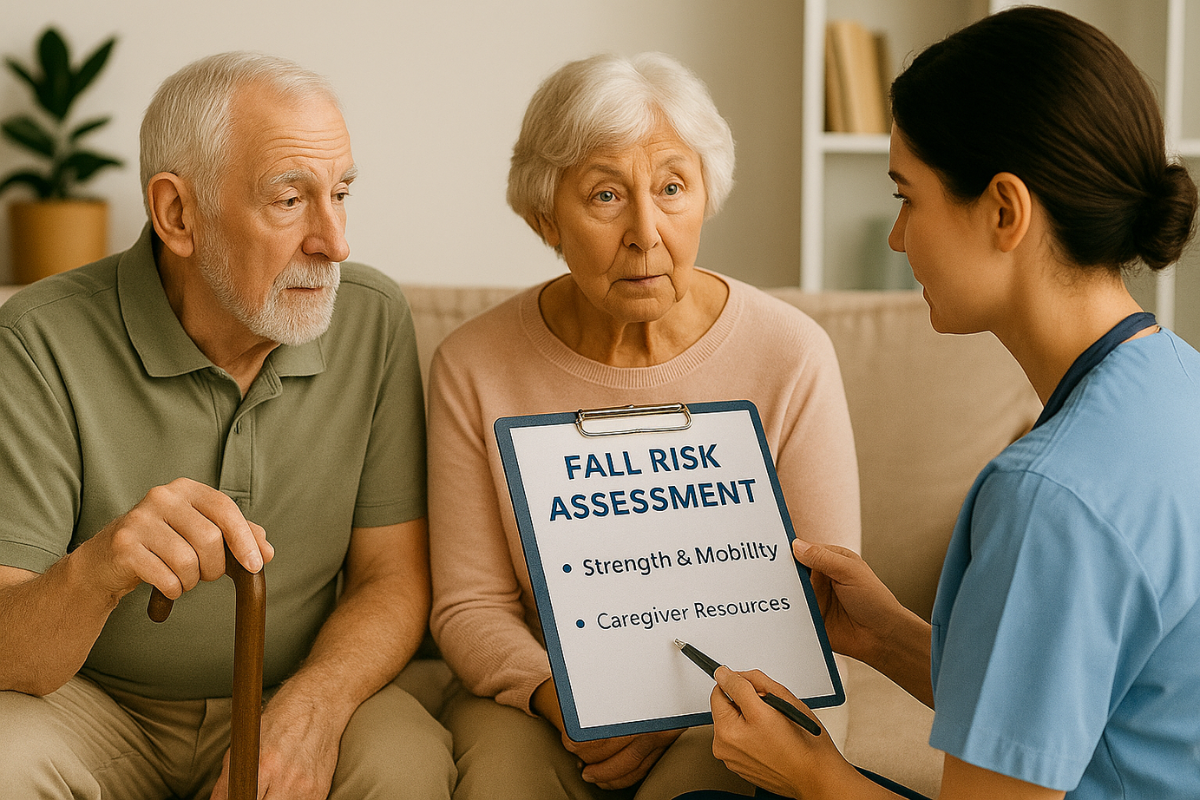
How In-Home Fall Risk Assessments Help Seniors Stay Safer
In-home personal assessments offer a unique advantage: they show how a senior moves in the spaces where they actually live. Instead of trying to imagine how clinic test results apply at home, the clinician can observe real-world challenges:
Getting up from the favourite chair
Navigating doorways and narrow hallways
Managing steps, entrances, and bathrooms
Using (or misusing) mobility aids
This reduces guesswork and produces practical recommendations that fit both the person and their home.
What a Kinesiologist-Led Initial Assessment Includes
A kinesiologist-led in-home fall risk assessment often includes:
Health and fall history – recent falls, dizziness, conditions, medications
Objective movement tests – TUG, 30-Second Chair Stand, gait observation
Home safety walkthrough – lighting, flooring, stairs, bathroom setup, clutter
Structured summary and baseline report – current function, priority risks, and clear next steps
At HomeStretch Active Living, this process is captured in a Movement Score Report that quantifies baseline mobility and highlights priority actions.
Turning Results into a Personalized Movement Plan
A personalized movement plan translates assessment findings into:
Meaningful goals – “stand up from the couch without help,” “walk to the mailbox,” “use stairs more confidently”
Progressive exercises – balance and strength work tailored to available space and equipment
Home adaptations – grab bars, lighting improvements, cleared pathways
Reassessment schedule – to track progress and adjust the plan
Caregivers are coached on how to support exercises safely at home, and the plan is updated as strength and confidence improve.
Proven Fall Prevention Strategies That Work
The most effective fall prevention programs combine:
Strength and balance training
Home safety modifications
Medication review and vision checks
Ongoing monitoring and reassessment
Balance and Strength Exercises for Stability and Confidence
Simple, progressive exercises can significantly improve stability:
Weight-shift practice – Stand with feet shoulder-width apart, gently shift weight side-to-side for 1–2 minutes while holding a stable surface.
Tandem stance – Stand heel-to-toe for up to 30 seconds, starting with hand support and gradually reducing it as safe.
Sit-to-stand repetitions – Rise from a chair (ideally without using hands) for 8–12 repetitions, progressing from assisted to unassisted.
Aim for:
Strength work 2–3 times per week
Short balance drills 3–5 days per week
Many older adults notice improved confidence and function within 6–12 weeks, especially with professional guidance.
Home Safety Modifications That Reduce Fall Hazards
High-impact changes often include:
Removing loose rugs and clutter
Improving lighting in hallways, entrances, and stairways
Installing grab bars in bathrooms and secure handrails on stairs
Using non-slip mats and considering non-slip floor treatments
These changes reduce environmental risk immediately and are often prioritized right after assessment.
Medication and Vision Checks
Two often-overlooked drivers of falls are:
Medications that cause dizziness, drowsiness, or blood pressure drops
Vision changes that affect depth perception and hazard detection
Regular medication reviews and eye exams are key components of a complete fall prevention plan.
When to Seek a Professional Fall Risk Assessment
Families should arrange a professional assessment whenever warning signs or health changes suggest increased risk.
Warning Signs Families Should Not Ignore
You should treat the following as red flags:
Any fall in the last 12 months – even if there was no injury
New unsteadiness or shuffling gait
Difficulty getting up from a chair or needing to “rock” several times
Repeated near-falls or stumbling in the same spot
Sudden drop in activity or loss of confidence
Unexplained dizziness or fainting spells
Recent medication changes or new confusion that affects mobility
If any of these are present, a fall risk assessment can uncover reversible causes and guide immediate safety steps.
How Often Should Fall Risk Be Reassessed?
For many older adults, an annual screening is enough to catch gradual decline.
For those at higher risk, reassessment is recommended:
After any fall
After hospitalization or major health event
After medication changes affecting balance
When caregivers notice obvious functional decline
Following the start of an exercise or fall prevention program, reassessment every 6–12 weeks is common to track progress and adjust the plan.
How Regular Assessment Supports Independence
Regular fall risk assessment:
Spots changes early before a serious injury occurs
Directs targeted interventions that rebuild or maintain mobility
Tracks progress, which boosts confidence and motivation
Reduces fall-related emergency visits and hospitalizations
Over time, consistent balance and strength training, combined with home adaptations and caregiver education, helps older adults stay active, social, and independent in the routines they value most.
How to Book a Free In-Home Fall Risk Assessment with HomeStretch
If you’ve noticed warning signs, or simply want to be proactive, an in-home fall risk assessment is a powerful first step.
Before your free consultation, it helps to gather:
A short summary of recent falls or mobility changes
A list of current medications
A few daily tasks that have become harder or more tiring
During the consultation, a kinesiologist will:
Review your needs and concerns
Explain the assessment process and Movement Score Report
Outline next steps, such as an in-home assessment and a personalized movement plan
There’s no obligation to commit just an opportunity to understand your options and explore how compassionate, in-home support can help. HomeStretch Active Living offers free consultations for families across Southern Ontario who want safer, more confident movement at home.
Ready to protect independence and reduce fall risk? Take Our Free 5 - Minute Fall Risk Home Assessment
Frequently Asked Questions
-
Exercises like weight shifts, tandem stance, and sit-to-stand repetitions are highly effective. They can be adapted to different ability levels—starting with hand support and progressing as balance improves. With regular practice (2–3 times per week for strength and 3–5 days for balance), many seniors notice better stability and confidence within 6–12 weeks.
-
Family members can:
Clear cluttered walkways
Secure or remove loose rugs
Improve lighting (especially near stairs and entrances)
Install grab bars and sturdy handrails
Check that mobility aids are properly fitted
Engaging the senior in these decisions helps ensure changes feel supportive not restrictive.
-
For many older adults, once a year is appropriate. Those with higher risk (recent falls, major health changes, or big medication shifts) should be reassessed more frequently after each event and at intervals of 6–12 weeks when actively working through a fall prevention program.
-
Medication review is critical because some drugs can cause dizziness, drowsiness, or blood pressure drops. Identifying and adjusting these medications, under a healthcare provider’s guidance, can significantly improve stability and reduce falls.
Related Posts
Author Bio - Melissa Gunstone, BSc, Kinesiologist
Founder of HomeStretch Ontario Helping Ontario seniors stay strong, safe, and independent — one step at a time.
The 3 Biggest Barriers to Aging in Place - Niagara - St. Catharines, Hamilton, Dundas, Burlington, Toronto - Fall Prevention | Strength & Mobility | Caregiver Resources