How to Create a Post-Operative Fitness Plan for Seniors: Safe Exercises and Recovery Strategies
December 05, 2025
For many older adults, surgery is only the beginning of the journey.
The real challenge starts at home, when the hospital team has discharged them, the pain is real, and confidence feels low. Without a clear plan, it’s easy for seniors to move less, lose strength quickly, and become fearful of walking or using stairs. That deconditioning can lead to more falls, more hospital visits, and less independence.
A structured post-operative fitness plan changes that story. With the right exercises, progression, and support, seniors can rebuild strength, improve circulation, and regain balance in a way that respects surgical precautions.
Families get a roadmap, not just a sheet of random exercises, and caregivers know what to watch for and when to ask for help.
This guide walks you step by step through the essentials of post-operative fitness for seniors;
Why it matters, safety principles, best exercises, surgery-specific timelines, and how kinesiologists and caregivers can work together to protect independence at home.
Why Is Post-Operative Fitness Critical for Seniors?
Post-operative fitness for seniors is targeted, progressive activity that helps prevent muscle loss, improve circulation, and restore functional mobility after surgery. Movement stimulates blood flow, maintains joint range, and keeps the nervous system “awake” so the body doesn’t slip into long-term weakness and stiffness.
Different components of a good plan deliver different benefits:
| Domain | How It Works | Expected Outcome |
|---|---|---|
| Mobility | Early range-of-motion and walking restore natural movement patterns | Less stiffness, better gait, lower DVT risk in the first 0–2 weeks |
| Strength | Progressive resistance rebuilds key muscle groups for transfers | Easier sit-to-stand and stair use by 3–12 weeks |
| Balance | Proprioceptive training improves postural control and confidence | Fewer falls, more confidence with daily tasks by 4–12 weeks |
Together, mobility, strength, and balance shorten recovery timelines, reduce complications, and preserve the ability to live independently.
Benefits of Post-Surgery Exercise for Senior Recovery
Well-designed post-surgery exercise helps to:
Preserve muscle and joint mobility
Improve blood flow, reducing the risk of clots and lung complications
Support pain control and reduce stiffness
Shorten time needed for assistance with walking, transfers, and stairs
Boost mood, confidence, and motivation to stay active
Seniors who follow structured early mobility programs often move from assisted walking to independent ambulation sooner, which means less time feeling “stuck” and more time doing the things they care about.
How Post-Operative Fitness Prevents Falls
Falls after surgery are rarely “just accidents.” Strength loss, balance changes, pain, and fear all contribute. A targeted program that includes balance drills, gait training, and home safety adjustments can:
Retrain weight shifting and stepping
Improve reaction time on uneven surfaces
Reduce near-falls during turns, transfers, and stair use
Build confidence so seniors are less afraid to move
When caregivers remove trip hazards and support safe practice in the home, the benefits of exercise are multiplied.
Principles of a Safe Post-Operative Fitness Plan for Seniors
A safe plan always starts with medical clearance and progresses based on how the person is functioning not just how many weeks have passed since surgery.
Safety Checklist Before Starting
Use this quick checklist when building or reviewing a plan:
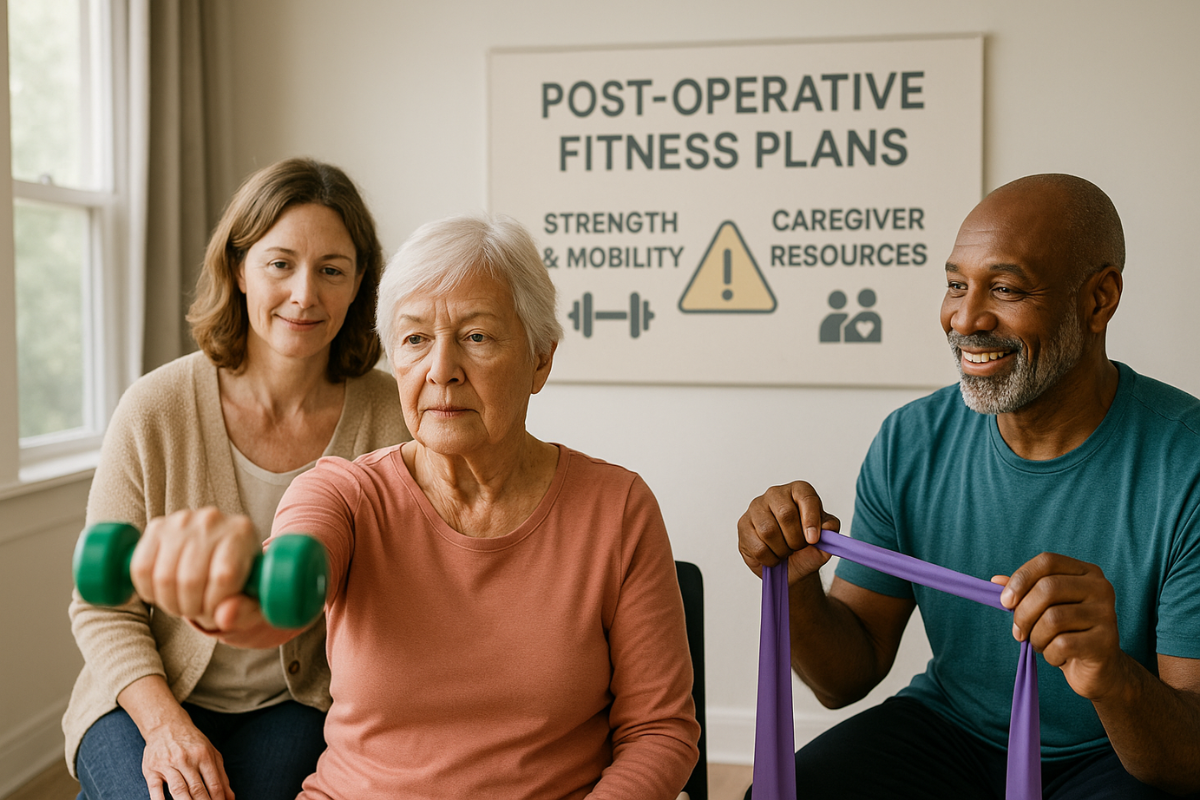
Confirm surgeon or physician clearance and any specific restrictions (weight-bearing limits, heart rate limits, hip precautions, etc.).
Establish simple baseline measures (e.g., sit-to-stand count, walking distance, pain at rest and with movement).
Start with low-intensity mobility and strength work, then progress gradually as function improves.
Monitor for red flags: increased pain or swelling, dizziness, shortness of breath, changes in wound appearance, or any new weakness.
How to Start Safely: Clearance and Progression
A typical early progression might look like this (always tailored to the individual and surgery type):
Week 0–1: Circulation exercises (ankle pumps, breathing), gentle ROM, very short walks as allowed.
Weeks 1–3: Build basic strength (sit-to-stands, light band work), increase walking distance, introduce light balance drills.
Weeks 3+ : Add more resistance, longer walks, and more challenging balance tasks as tolerated.
Progress when functional goals are met (e.g., stand up from a chair independently 10 times) rather than just because another week has passed.
Four Core Exercise Categories for Senior Post-Operative Recovery
A comprehensive program usually includes four types of exercise:
Early Mobility – circulation and gentle movement
Strength Training – rebuilding key muscle groups
Balance and Gait Training – fall prevention and confidence
Flexibility / Range of Motion (ROM) – keeping joints moving without stressing healing tissues
Early Mobility Exercises
Early mobility focuses on short, frequent bouts of movement to support circulation and lung health:
Ankle pumps – moving feet up and down while lying or sitting
Seated marches – lifting one knee at a time while seated
Diaphragmatic breathing – slow, deep breaths into the belly
These can often be done hourly or several times a day, depending on tolerance and medical advice.
Strength Training Exercises
Strength work gradually rebuilds muscle power for everyday tasks:
Sit-to-stands from a chair
Seated leg extensions to activate the quadriceps
Resistance band rows to support posture and upper-body function
Aim for 2–3 sets of 8–15 repetitions, adjusting as pain and fatigue allow. Progress from assisted to unassisted to resistance-based versions over time.
Balance and Gait Drills
Balance training helps seniors trust their body again:
Weight shifts (side-to-side, forward-back) while holding a counter or chair
Tandem stance (one foot in front of the other) with support close by
Heel-to-toe walking along a counter or hallway
Practise about 10–15 minutes per day, with rests as needed. Simple tests like the Timed Up and Go (TUG) can show improvements.
Flexibility and Range-of-Motion Work
Gentle ROM and stretching keep joints moving:
Ankle circles
Seated hip slides
Shoulder rolls and gentle arm raises
Hold stretches for 10–20 seconds, repeat 2–4 times, and always stay within a pain-free range that respects surgical precautions.
The Best Post-Operative Exercises: A Simple Reference Table
Here’s a quick-reference table caregivers and seniors can use to build a basic daily routine:
| Exercise | Target | Intensity / Dose |
|---|---|---|
| Ankle pumps | Circulation | 10–20 reps every hour while awake |
| Seated leg extensions | Quadriceps strength | 2 sets of 10–15 reps, 2–3× per day |
| Heel-to-toe walk | Gait & balance | 2–3 × 10 steps, once or twice daily |
| Seated marches | Mobility & breathing | 1–2 minutes every 2–3 hours |
| Resistance band rows | Upper body strength | 2 sets of 8–12 reps, once daily |
These numbers are guidelines; a kinesiologist or rehab professional can adjust doses based on pain, fatigue, and medical status.
Tailoring Post-Operative Plans by Surgery Type
Not all surgeries are the same. A senior recovering from hip replacement will have different precautions and milestones than someone recovering from cardiac surgery.
Common Surgery Types and Goals
| Surgery Type | Precautions / Focus | Typical Goals by Phase |
|---|---|---|
| Hip replacement | Avoid extreme hip flexion/rotation; glute activation; early walking | 0–2 wks: safe transfers; 3–6 wks: steady gait; 6+ wks: stairs & community walking |
| Knee replacement | Protect incision; early quad activation; focus on flexion/extension | 0–2 wks: functional ROM; 3–6 wks: quad strength; 6+ wks: progressive loading |
| Cardiac surgery | Monitor exertion; use RPE/HR zones; breathing & gradual walking | 0–2 wks: breathing + short walks; 3–6 wks: longer low-intensity walks; 6+ wks: endurance building |
After Hip Replacement
Key priorities:
Safe transfers (bed, chair, toilet)
Gentle glute and hip abductor activation
Protected walking using an appropriate device
Progress from basic circulation exercises and glute squeezes to supported standing exercises and mini-squats as weight-bearing status allows. Persistent or increasing pain, swelling, or colour changes in the leg require prompt medical review.
After Knee Replacement
Focus on:
Regaining knee flexion and full extension with heel slides and knee extensions
Quad activation with isometric holds and later sit-to-stands
Swelling management with elevation, pacing, and (where prescribed) cold therapy
Tracking knee ROM and sit-to-stand counts can show progress and guide when to add steps, stairs, or longer walks.
After Cardiac Surgery
Key elements:
Very gradual walking progression guided by perceived exertion
Breathing exercises to support lung recovery
Strict adherence to heart rate and lifting restrictions provided by the cardiac team
Stop and seek immediate help if there is chest pain, severe shortness of breath, or unusual dizziness.
The Role of a Kinesiologist in Post-Operative Senior Rehabilitation
A kinesiologist bridges the gap between hospital discharge and real-life independence at home. They:
Assess strength, balance, gait, and range of motion
Translate surgical restrictions into a clear, stepwise exercise plan
Coach safe technique for transfers, walking, and stairs in the actual home environment
Reassess regularly and adjust exercises based on progress and pain
At HomeStretch Active Living, kinesiologists provide in-home, evidence-informed programs that blend fall prevention, strength training, and functional practice (like navigating hallways, kitchens, or driveways) so gains translate directly into everyday life.
How Kinesiologists Personalize In-Home Fitness Plans
Personalization goes beyond picking exercises from a list. A kinesiologist will:
Review the home for hazards (rugs, cluttered hallways, poor lighting, tricky stairs)
Involve caregivers in spotting, cueing, and tracking exercises
Set specific, measurable goals (e.g., “Walk to the mailbox and back without rest by week 4”)
Use simple metrics (sit-to-stands in 30 seconds, balance time, walking distance) to show progress
This kind of tailored plan gives seniors a clear path forward and helps families see that their efforts are working.
How Family and Caregivers Can Support Post-Operative Fitness
Caregivers are often the glue that holds the plan together. Their role isn’t to “be the therapist,” but to support safety, routine, and encouragement.
Practical actions include:
Set a daily routine with short, scheduled exercise blocks
Track progress in a simple notebook or checklist (reps, distance, pain levels)
Supervise balance and walking practice, standing close or using a gait belt if recommended
Optimize the environment by removing trip hazards, improving lighting, and placing sturdy chairs where rests may be needed
Motivational Tips for Caregivers
Offer small choices (“Before lunch or after lunch?”) to maintain autonomy
Celebrate small wins (“Yesterday you did 6 chair stands; today you did 8!”)
Keep sessions brief (5–15 minutes) but consistent
Use visual progress trackers (e.g., a weekly chart on the fridge)
When to Seek Professional Help
Always contact a medical professional immediately if there is:
New or worsening chest pain
Sudden shortness of breath or trouble breathing
Large increase in swelling, redness, or warmth near the incision
Sudden weakness, loss of balance, or changes in speech or vision
A fall that causes pain, confusion, or visible injury
If progress plateaus or confidence remains very low despite effort, that’s also a good time to book a professional review or in-home assessment to adjust the plan.
Support Before and After Surgery
If you or a loved one is preparing for or recovering from surgery, you don’t have to navigate post-operative fitness alone. HomeStretch Active Living offers kinesiologist-led, in-home programs designed specifically for older adults to rebuild strength, improve balance, and reduce fall risk all within the safety and comfort of home.
Book a free consultation today and find out whether an in-home kinesiologist supported program is the right fit for your recovery plan.
Frequently Asked Questions
-
Most seniors begin very gentle movement such as ankle pumps, breathing exercises, and short assisted walks, within the first 24–48 hours after surgery, depending on medical clearance. A kinesiologist can help determine the safest timeline and create a customized plan that respects surgical precautions.
-
Early safe options include circulation exercises, seated marches, heel slides, gentle range-of-motion work, and short-distance walking. These exercises protect healing tissues while preventing stiffness, muscle loss, and blood clots.
-
Watch for warning signs such as increasing pain, swelling, dizziness, shortness of breath, or changes in the incision site. If any of these appear, pause the exercises and contact the medical team. A guided program from a kinesiologist ensures progression stays within safe limits.
-
Yes. Discharge sheets are often brief and not tailored to the home environment. A kinesiologist translates those instructions into a step-by-step in-home plan, teaches proper technique, tracks progress, and modifies exercises as recovery improves — reducing fall risk and boosting confidence.
Related Posts
Author Bio - Melissa Gunstone, BSc, Kinesiologist
Founder of HomeStretch Ontario Helping Ontario seniors stay strong, safe, and independent — one step at a time.
The 3 Biggest Barriers to Aging in Place - Niagara - St. Catharines, Hamilton, Dundas, Burlington, Toronto - Fall Prevention | Strength & Mobility | Caregiver Resources