From Floor to Standing: Why Learning to Get Up Safely Is a Lifesaving Skill
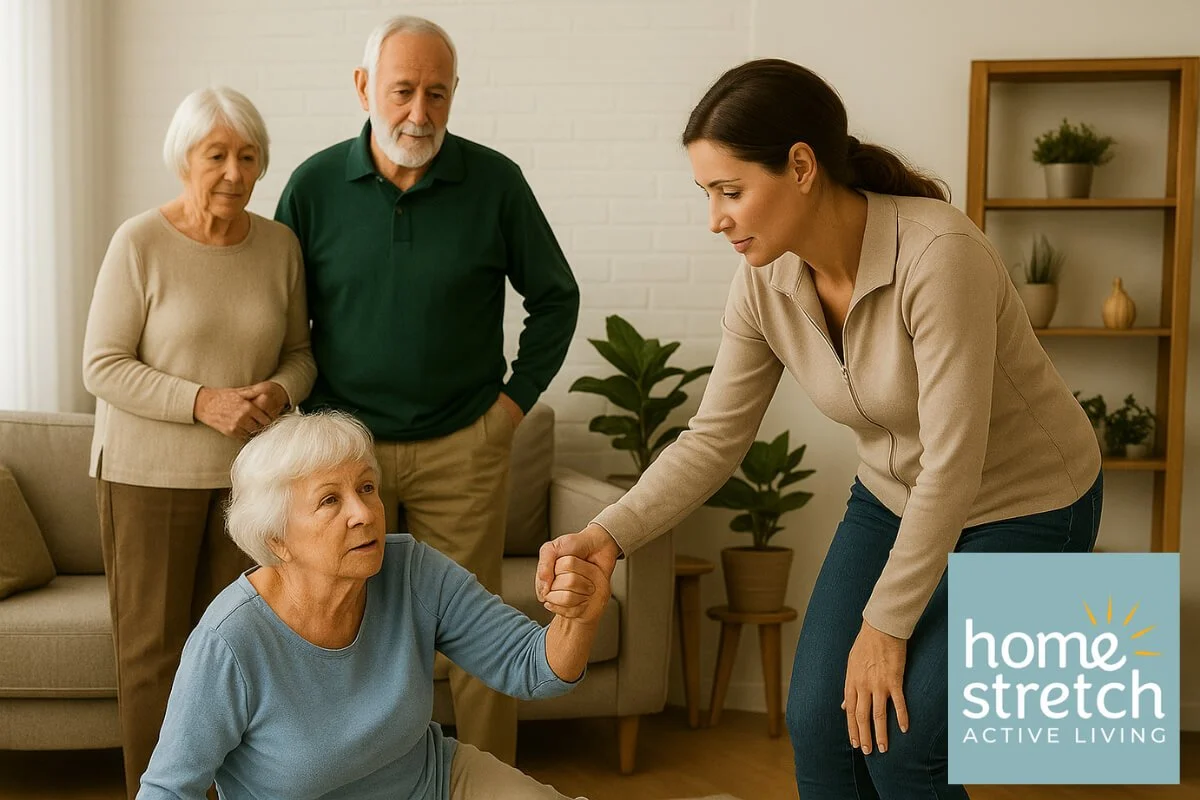
Falling is one of the biggest fears for older adults, and for good reason.
What many people don’t realize is that the danger doesn’t end after the fall.
Knowing how to get up safely can mean the difference between a quick recovery and a serious injury.
Take our Free 5-Minute Fall Risk Home Assessment to see how your current
✅ balance,
✅ mobility, and
✅strength
compare to safe aging benchmarks. Click here and Try for Free
At Home Stretch Active Living, we teach our clients that getting up isn’t just a physical skill, it’s a lifesaving one. It’s about building strength, confidence, and calm under pressure so that if a fall ever happens, you know exactly what to do.
Why Getting Up Matters
Many people avoid getting down to the floor entirely, worried they might not be able to get back up.
Unfortunately, this fear leads to stiffness, loss of confidence, and greater fall risk over time.
“Avoiding the floor doesn’t keep you safe — it actually limits your ability to move freely and confidently.”
— Melissa Gunstone, Founder, Home Stretch Active Living
Learning and practicing safe floor-to-standing techniques restores both mobility and self-trust.
It teaches your brain and body that you can move safely, even in challenging positions.
The Science Behind the Skill
Movement specialist John Sinclair describes this process as “rewiring the body’s motor patterns.”
When we practice getting up in slow, controlled steps, we retrain the nervous system to respond quickly and efficiently in real life.
This is a key part of what we call neuro-motor training — improving your ability to move confidently through space by reinforcing balance, core control, and reaction time.
Think of it like rehearsing an emergency drill: the more often you practice, the faster and safer your body responds when it counts.
How to Get Up Safely: Step-by-Step
Always make sure the area around you is clear and you have something stable nearby to hold on to, like a sturdy chair or low table.
Step 1 — Stay Calm
Take a deep breath. Check if you’re hurt before trying to move.
If you feel pain, dizziness, or something doesn’t feel right — stay where you are and call for help.
Step 2 — Roll to Your Side
Bend your knees and gently roll onto your side.
This reduces pressure on your joints and helps your body prepare to move.
Step 3 — Move to All Fours
Use your arms to push your upper body up so you’re on your hands and knees.
Take your time — this position provides balance and control.
Step 4 — Crawl to Support
Slowly crawl toward a sturdy piece of furniture.
Make sure it’s heavy enough to support your weight (a sofa, chair, or countertop).
Step 5 — Bring One Knee Up
Place one foot flat on the floor, keeping your hands on the support surface.
You should now be in a half-kneeling position.
Step 6 — Push to Stand
Shift your weight forward and use your arms and legs together to push yourself upright.
Move slowly — avoid jerking or twisting motions.
Step 7 — Pause and Breathe
Once standing, take a moment to steady yourself before walking away.
If you feel lightheaded, sit down safely and rest.
Practice Makes Confidence
The best way to prevent panic during a real fall is to practice getting up when it’s safe.
During Home Stretch programs, we teach floor-to-standing transitions using mats and guided support.
This practice improves: - Lower body and core strength
- Balance and coordination
- Confidence and calm under pressure
Over time, these drills help your body remember the safest way to move — even when you’re surprised by a stumble.
“We don’t just train for strength — we train for resilience.”
— Melissa Gunstone
If you’re unsure where your starting point is, try our Free 5-Minute Fall Risk Home Assessment. It’s a simple self-check you can do at home to understand your risk and start building confidence safely.
Overcoming the Fear of Falling
Fear is one of the biggest barriers to staying active.
But every time you safely get down and back up, that fear fades a little more.
When your brain learns, “I can do this,” your body follows.
That’s where confidence, independence, and peace of mind truly begin.
Final Thoughts
Getting up from the floor isn’t just an exercise — it’s a fundamental skill for independence.
It helps you stay calm, move with confidence, and recover quickly if a fall ever occurs.
Start small, move safely, and celebrate every bit of progress.
Because every time you practice, you’re building strength where it matters most — from the ground up.
Want to learn safe, guided ways to practice getting up and down from the floor?
✅ Take our Free 5-Minute Fall Risk Home Assessment to understand your mobility and balance today.
or
Book a session with a Home Stretch Kinesiologist for guided, one-on-one support.
FAQs About Getting Up Safely
Q1: What’s the safest way to get up after a fall?
Move slowly and stay calm. Roll to your side, get onto your hands and knees, crawl to a sturdy surface, and push up using both arms and legs.
Q2: How can I practice getting up safely if I’m afraid of falling?
Start on a soft surface like a mat, with support nearby. Practice with a caregiver or kinesiologist for safety and guidance.
Q3: Why is it important to practice getting up?
It builds strength, flexibility, and confidence — all key to preventing future falls and improving independence.
Q4: What if I can’t get up on my own?
Call for help using a nearby phone or medical alert device. If possible, move toward a brighter or more visible area so help can find you easily.
Q5: Can I still practice if I have knee or hip pain?
Yes. With proper modifications and guidance from a professional, you can strengthen supporting muscles and find safe movement patterns for your joints.
Related Posts
Author Bio - Melissa Gunstone, BSc, Kinesiologist
Founder of HomeStretch Active Living. Known as The Fall Prevention Coach, Melissa has spent over a decade helping seniors across Ontario improve strength, balance, and brain health to protect independence.
How to Get Up Safely After a Fall- Guide for Seniors - Niagara - St. Catharines, Hamilton, Dundas, Burlington, Toronto - Fall Prevention | Strength & Mobility | Caregiver Resources